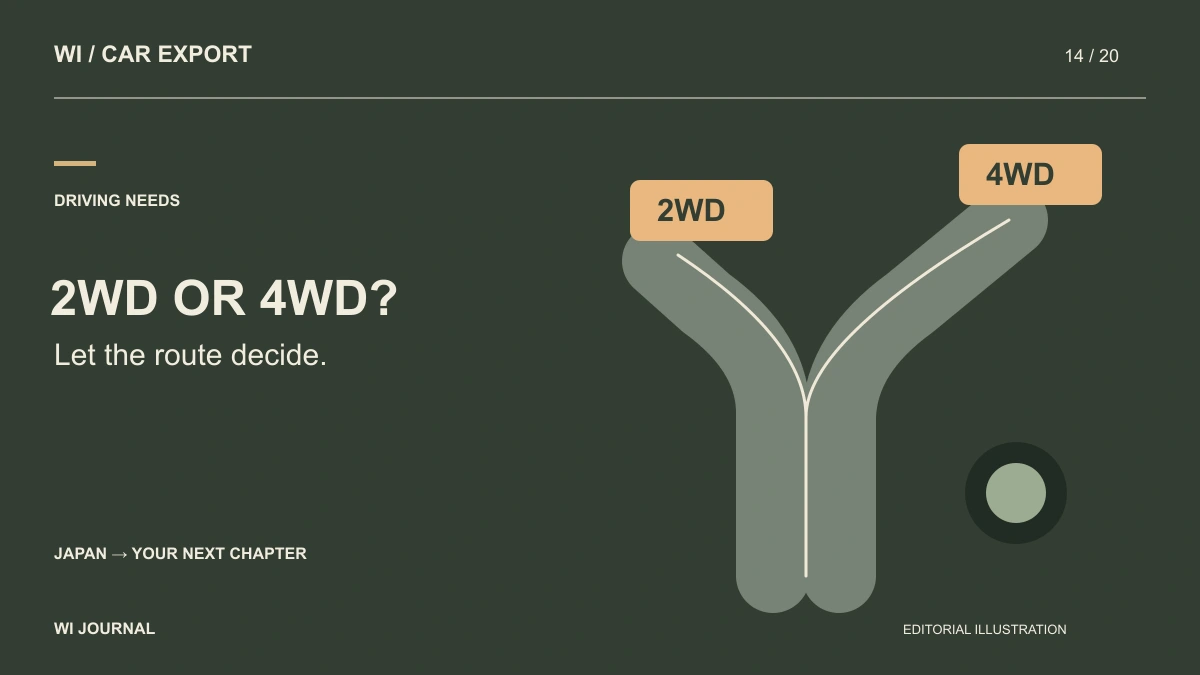
Choose 2WD or 4WD from your actual route, surface, tyres, clearance, local support and vehicle condition—not a universal ranking.
Choose 4WD because your regular route presents a traction problem that the exact system can help manage—not because 4WD is automatically the safer or “better” badge. Choose 2WD when it meets the route, tyre and load requirements without paying for capability you are unlikely to use.
This is a route-led comparison, not a handling test or a universal safety ranking. Manufacturers use terms such as 4WD, AWD and model-specific system names differently, so verify how the system fitted to the actual car operates.
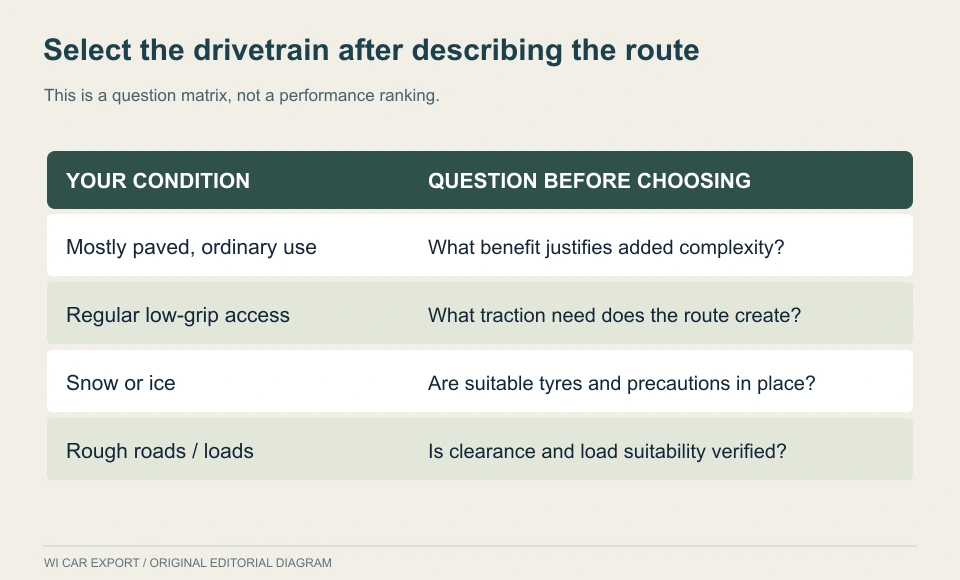
Describe the difficult part of the route
Start with the worst recurring section, not the average kilometre. Record:
- surface: sealed road, gravel, mud, sand, snow or mixed;
- gradient and whether starts occur on the incline;
- rainfall, ice or snow frequency and duration;
- road maintenance and drainage;
- ground-clearance hazards and water crossings;
- passenger, luggage or work load;
- mobile coverage, alternative routes and recovery access.
“Sometimes it rains” is not specific enough. A paved urban commute with rare bad weather creates a different decision from a steep unsealed access road used every morning.
Identify what 4WD would solve
Additional driven wheels can be relevant when the recurring problem is getting moving or maintaining drive on a low-traction surface. But driveline choice does not fix insufficient ground clearance, unsuitable tyres, excessive speed, poor visibility or an unsafe water crossing. A low vehicle with 4WD may still be wrong for a deeply rutted route; a 2WD vehicle with suitable tyres may meet a well-maintained road’s needs.
Ask how the exact system works. Is it permanent, automatically engaged, driver selectable or intended only for particular conditions? Are there speed or surface restrictions in the owner’s manual? Does the model use a dedicated maintenance schedule, matching tyre requirement or fluid? Obtain the correct manual for the model code and production period rather than relying on a generic 4WD explanation.
Tyres and braking remain separate decisions
Treat AWD as a traction capability, not proof of better winter stopping performance. Michelin’s winter-driving guidance emphasises that AWD does not replace appropriate tyres; grip still matters when braking and turning. This is US tyre-maker guidance, not a comparative test of every Japanese 2WD and 4WD vehicle. Read Michelin’s AWD and winter-tyre explanation.
For your destination, ask a qualified tyre supplier which tyre specification suits the exact vehicle, load, climate and legal requirements. Check that the required size, load rating and seasonal type are readily available. Inspect the used car’s current tyres, but budget according to what you will need locally rather than assuming the tyres in Japan are suitable for your route.
Compare complete vehicles with a route scorecard
Use pass/fail criteria before comparing price:
| Criterion | 2WD candidate | 4WD candidate |
|---|---|---|
| Clears the route’s ruts, ramps and obstacles | Pass / fail | Pass / fail |
| Correct tyre solution available locally | Pass / fail | Pass / fail |
| Driveline operation suits recurring surface | Pass / fail | Pass / fail |
| Passenger and load requirement met | Pass / fail | Pass / fail |
| Local parts and diagnostic support available | Pass / fail | Pass / fail |
| Import, registration and insurance confirmed | Pass / fail | Pass / fail |
| Condition and service evidence acceptable | Pass / fail | Pass / fail |
Reject a vehicle that fails a non-negotiable; do not hide the failure inside a total score. Among vehicles that pass, compare landed cost, condition, service evidence and your expected ownership period.
Inspect the driveline you are buying
For a 4WD candidate, request evidence covering the complete driveline and any relevant warning indicators, leaks, unusual noises, tyre-size consistency and documented maintenance. If the system has selectable modes, confirm the controls and indicators operate through an agreed inspection. For a 2WD candidate, apply the same standard to its transmission, driven axle, tyres and traction-related systems.
No dashboard photograph proves the system’s mechanical condition. A thorough used-car assessment should include inspection rather than relying on a checklist alone; the AA’s general guidance makes that same distinction for used-car buying. See the AA used-car inspection checklist.
Two decisions that can both be correct
A buyer whose daily home access is a steep, loose surface may make verified additional traction a non-negotiable. Another buyer using maintained city and motorway roads may prioritise a well-documented 2WD vehicle and invest in the correct local tyres. Neither choice establishes a global winner.
Write your route brief first, then compare model code, clearance, system operation, tyre plan and condition evidence. If the route risk is serious, have a local driving, tyre or off-road specialist review the plan before purchase.
To apply the route scorecard to current fixed-price Japanese vehicles, browse Japan Stock and verify the exact driveline on each listing.
Original WI Car Export editorial illustration, AI-assisted vector design. Not vehicle photography.