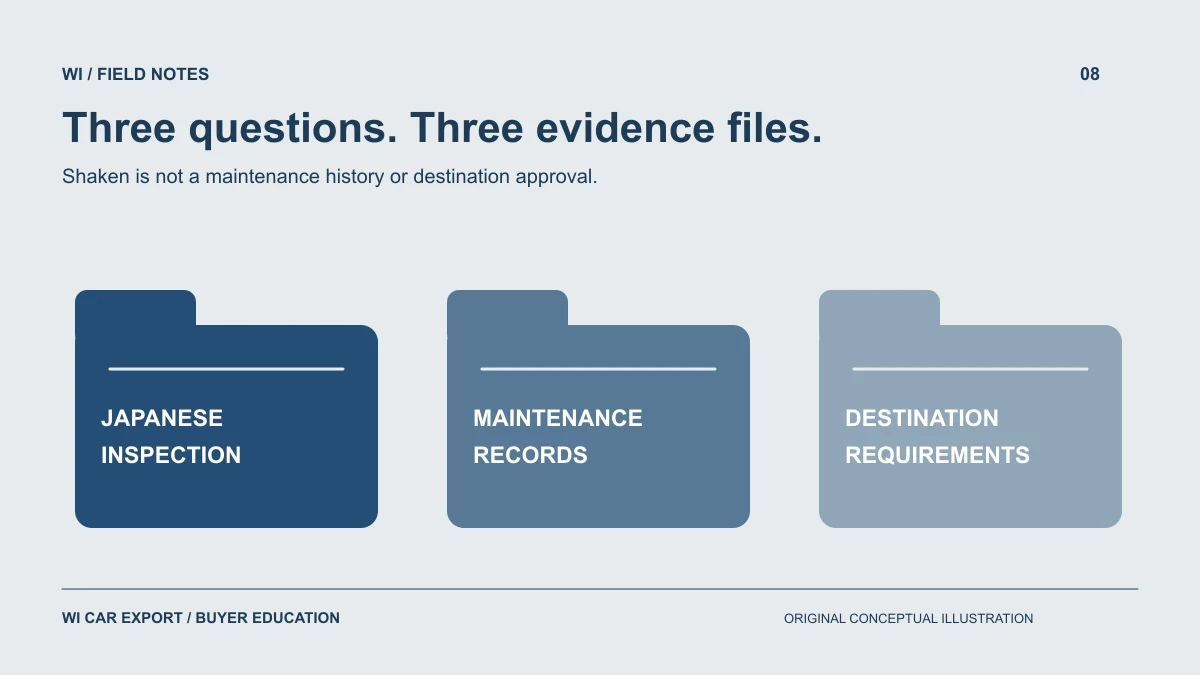
Shaken is Japan's periodic vehicle inspection. It documents conformity on a date — not future reliability, service history, or destination eligibility.
Shaken is Japan's periodic vehicle inspection, and evidence of one is not a warranty, a maintenance history, or automatic permission to register the car overseas. An export buyer should treat it as one dated piece of evidence and keep the other questions separate.
Japan's Shikoku Transport Bureau explains that shaken checks conformity with national safety and environmental standards at intervals and does not guarantee safety until the next inspection. The same guidance distinguishes inspection from ongoing maintenance. Source: MLIT Shikoku Transport Bureau, vehicle inspection and maintenance.
Last updated: 13 September 2026.
Which three questions can a "shaken" label not answer?
A single label cannot tell you what was established at inspection, what maintenance the car has received, or whether your destination will register it. Each is a separate enquiry with its own evidence, and a translated listing field is not a substitute for the underlying record.
What was established at inspection?
You need the relevant document, the vehicle identity, the inspection information and the date. A translated listing field is not a substitute for the underlying record. Ask which document supports the entry, and ask for a legible image of it rather than a summarised status line.
What maintenance has the car received?
Ask for dated work records, because an inspection does not itemise the repairs around it. An inspection and a repair may occur at about the same time, but the existence of one does not describe the other. If a seller says "fully serviced for shaken," request the actual work description.
Can this car be imported and registered at your destination?
That is a separate enquiry under the destination's own requirements, not something a Japanese expiry date settles. Do not infer acceptance from an inspection validity date. Confirm the exact vehicle with the relevant authority or a qualified local importer before you purchase or transfer any funds.
Our pre-shipment inspection guide explains why destination requirements need their own check.
Why translate the question, not just the word?
A short listing entry about inspection validity means little until you know which document it came from. Ask what the entry means and request a legible image of the relevant document. Have unclear Japanese fields interpreted by a competent translator or document professional rather than guessing.
Record where each date came from. The date a document was issued, the date of first registration and the vehicle's manufacturing date answer different questions; the manufacture and registration date guide provides a useful way to keep them separate. If two records disagree, resolve the discrepancy rather than selecting the date that makes the purchase easiest. Ask whether they concern the same vehicle, whether one is an older record, and what each field actually describes.
How do you build a document map for the candidate?
List each piece of evidence, the question it can answer, and what it deliberately leaves open. Inspection information, service invoices, an independent condition report and the export documents each cover a different part of the picture, and none of them covers all of it.
| Evidence | Useful question it can help answer | What remains separate |
|---|---|---|
| Japanese inspection information | What inspection status is documented, for which vehicle and date? | Current condition and future reliability |
| Service invoices and maintenance records | What work is recorded as completed? | Work not documented and the present condition of unassessed components |
| Independent condition report | What did the assessor establish within an agreed scope? | Areas excluded from the assessment or future changes |
| Export and destination documents | What paperwork is needed for this shipment and registration? | Requirements not covered by a particular document |
This is an evidence-organizing framework, not an exhaustive list of legally required documents. The applicable paperwork depends on the destination and transaction. Confirm requirements before relying on a seller's generic checklist.
Should an expired inspection automatically rule out a car?
No. An expiry status alone does not explain why a car is offered for export or establish its mechanical condition. It also does not make a car eligible to be driven. Ask what the status means for the planned transaction and transport, then obtain the appropriate current assessment.
The reverse is equally true: a future expiry date does not eliminate the need for due diligence. Imagine a hypothetical car advertised with remaining inspection validity but no service invoices. The expiry date does not fill the maintenance-history gap. You would still ask what work has been done and what an inspector can establish now. Avoid paying a premium based solely on the assumption that Japanese inspection validity replaces work or approval at home, and ask the party making that claim to identify the specific destination rule and supporting evidence.
What enquiry gets beyond "has shaken"?
Send the stock reference and ask for the inspection status, the document behind it, the maintenance records, and what remains unverified. That enquiry does not ask the seller to guarantee the future; it asks for evidence you can review before committing any money to the purchase.
"Please identify the Japanese inspection status and the document supporting it, provide the available maintenance records, and explain which parts of the current condition remain unverified. I will confirm destination eligibility separately."
Use the service-history checklist to organize what comes back. WI Car Export connects buyers with fixed-price Japanese stock sourced and exported by Washin Auto. Contact the export desk with the candidate's reference and the specific records you need. Confirm what is available for that car; this article does not promise that every listing includes an inspection or complete service file.
Illustration: original WI Car Export editorial artwork, created with AI assistance. Conceptual, not a vehicle photograph or technical inspection diagram.