A car fits only if it reaches the space, passes the opening, parks with clearance and still lets people out. Measure more than length and width.
A car fits your garage only when it can reach the space, pass through the opening, park with suitable clearance and still let people and luggage in and out. Catalogue length and width are useful starting points, not a complete fit check.
Include mirrors, doors, tailgate movement, overhead obstacles and the actual approach. For an overseas purchase, measure the space first and request the missing vehicle measurements before committing. The objective is not to squeeze the largest possible car inside; it is to choose one you can use without depending on an unverified clearance.
Last updated: 13 September 2026.
Which three spaces must a garage-fit check cover?
The approach, the parked footprint and the access space are three different measurements, and passing one does not prove the others. A car that fits a rectangular bay may still have an unsuitable route into it, or leave no room to open a door.
| Space | What it includes |
|---|---|
| The approach | Driveway, turn into the opening, gates, slopes, fixed obstacles |
| The parked footprint | Occupied width, length and height in the intended configuration |
| The access space | Driver's door, sliding door, tailgate, charging point, route indoors |
Ask whether the dimensions you have include mirrors and any accessories, and do not assume that one brochure width answers every configuration. Toyota's MIRAI FAQ illustrates the distinction by giving separate reference widths with mirrors folded, mirrors open and doors open, and warning that measurement conditions affect the result. Use that distinction—not the MIRAI's dimensions—for your chosen car. Source: Toyota's mirror and door width FAQ.
How do you measure the narrowest usable opening?
Record the clear doorway width and height with the garage door fully open, including hardware, posts and low-hanging fittings. Then identify the narrowest point along the whole route: a gate, an offset turn or an object just inside the doorway can be more restrictive than the bay.
Measure the clear opening rather than the nominal structural opening. Inside, account for shelving, pipes, equipment and anything that will remain in place when the car is parked. Keep the measurement locations on a simple sketch so that the vehicle information can be compared with the correct part of the space. Do not use a universal minimum clearance from this article: none is provided. The safe and practical allowance depends on the geometry, vehicle, users and environment. If a fit is marginal, arrange an appropriate professional assessment or select a smaller candidate instead of attempting an uncertain manoeuvre.
What does a clearance calculation prove, and what does it not?
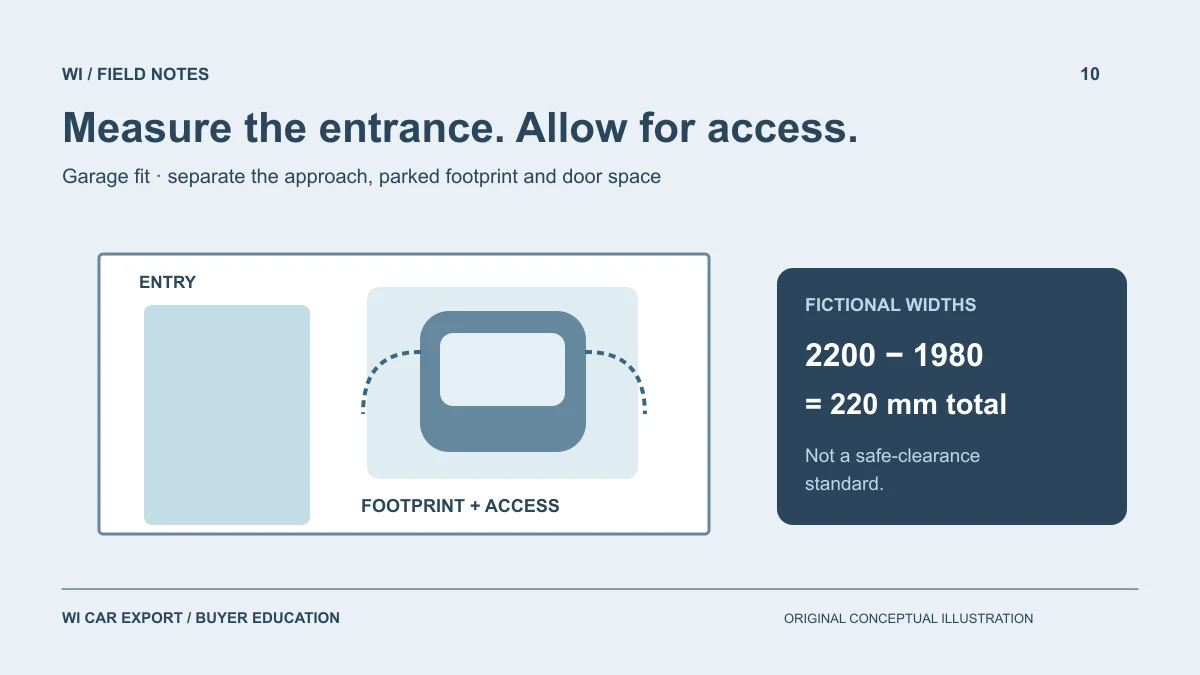
The arithmetic gives you a spare-width figure, and nothing more. A fictional clear opening of 2,200 mm and a vehicle measuring 1,980 mm across open mirrors leaves 220 mm total, or 110 mm on each side if perfectly centred and approached straight.
That figure does not prove the passage is safe or practical. It excludes steering movement, an angled approach, measurement error and other obstacles. Nor does it establish door-opening space inside: the doorway and the interior bay are different measurements, so do not divide a single spare-width figure and assume every task is solved.
What should a garage-fit worksheet cover?
Cover the five things you actually do: enter, park, leave the driver's seat, load the rear, and use the garage normally. For each one, record the space measurement on one side and the vehicle information or check you still need on the other.
| Task | Space measurement | Vehicle information or check |
|---|---|---|
| Pass through the entry | Narrowest clear width and height | Width in the intended mirror configuration and actual overall height |
| Park fully inside | Usable depth after fixed obstructions | Actual length and required front/rear allowance |
| Leave the driver's seat | Space on the driver's side | Door-opening movement and access needed by the actual user |
| Load the rear | Rear and overhead clearances | Tailgate movement and room for the intended luggage |
| Use the garage normally | Remaining paths and storage access | Whether parked doors or body obstruct those tasks |
For a shared garage, include the other vehicle in its normal position. For a family car, consider the real child-restraint access rather than only the driver stepping out. The family vehicle access checklist addresses the passenger side of that decision.
Can folding mirrors or a power tailgate solve a tight fit?
Not by assumption. Folding mirrors might change a reference width, but confirm the actual function and how the vehicle can be used safely. Do not assume your candidate has an adjustable tailgate opening limit, or that a setting removes every obstruction in the space.
If a car has roof equipment, a body kit, different wheels or suspension alterations, request the actual dimensions and relevant documentation. The modified-import checklist explains why the original specification may not describe the vehicle now offered.
What should you send the export desk?
Send the stock reference, your measured constraints and the specific vehicle dimensions you still need confirmed. Ask what can be confirmed for that car, because a listing photograph is not a clearance certificate. If the evidence stays marginal, compare a smaller vehicle or a different body style.
WI Car Export receives enquiries about fixed-price Japanese stock sourced and exported by Washin Auto. Contact the export desk with those details. A car that leaves room for your routine is a better fit than one that works only in a perfectly centred sketch.
Illustration: original WI Car Export editorial artwork, created with AI assistance. Conceptual, not a vehicle photograph or technical inspection diagram.