Compare Japanese WLTC and JC08 figures without mixing methods. Convert km/L to L/100 km and calculate a distance-weighted fuel example correctly.
Compare Japanese fuel-economy figures only after identifying the exact vehicle variant, test method and units. JC08 and WLTC are different test modes; converting kilometres per litre to litres per 100 kilometres does not make figures from different tests directly comparable. A laboratory result is a comparison input, not a guarantee for your route or a used car’s present condition.
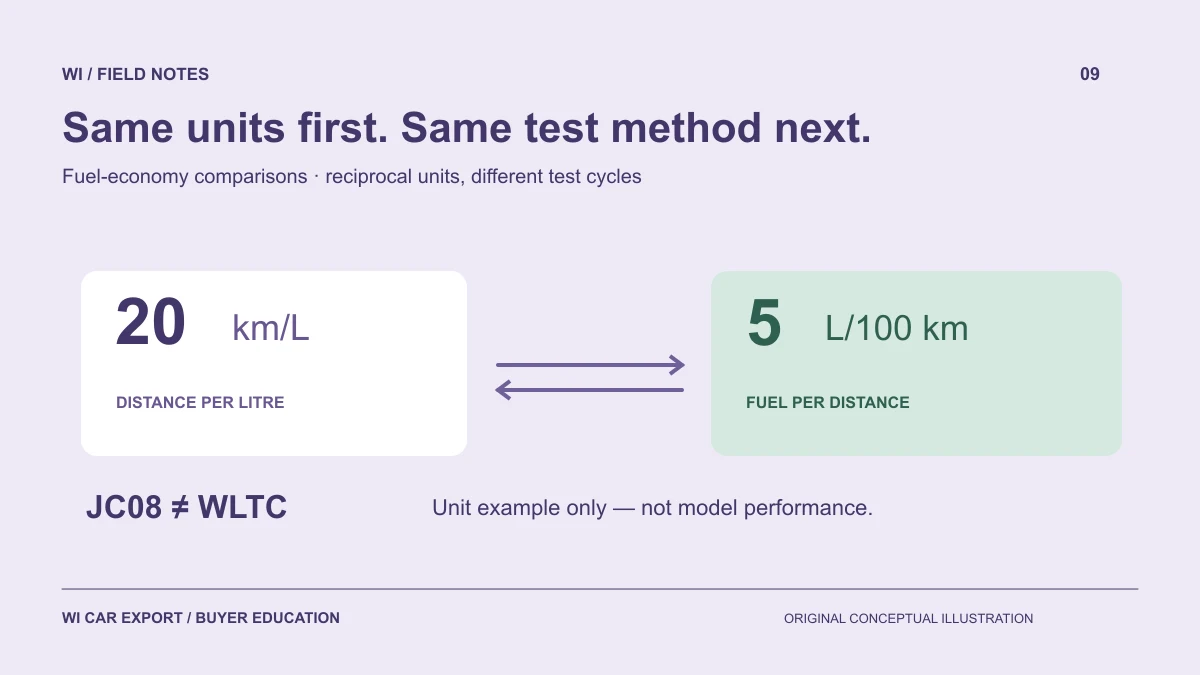
Toyota’s fuel-economy glossary distinguishes Japan’s JC08 mode from WLTC and explains the city, suburban and highway modes used in its WLTC presentation. Those labels matter as much as the headline number. Source: Toyota’s fuel-economy information glossary.
Keep four labels attached to every number
When recording a figure, include:
- Vehicle: exact generation, engine/hybrid system, drive configuration and relevant grade.
- Method: JC08, WLTC or another explicitly identified method; for owner observations, describe the actual measurement basis.
- Segment: combined, city, suburban or highway where specified.
- Units: km/L, L/100 km or another stated unit.
If any label is missing, do not silently supply it. A large km/L figure in a listing could refer to a particular variant or a source that the current car does not match. Ask for the underlying specification rather than ranking cars by an unidentified number.
Our trim and options verification guide helps establish the first label before the arithmetic begins.
Convert km/L to L/100 km correctly
The relationship is reciprocal:
L/100 km = 100 ÷ km/L
km/L = 100 ÷ L/100 km
For example, 20 km/L equals 5 L/100 km, while 25 km/L equals 4 L/100 km. These are unit conversions, not test results for any named car. In km/L, a higher number means more distance per litre. In L/100 km, a lower number means less fuel per distance.
Do not confuse the direction of improvement. A hypothetical change from 20 to 25 km/L is a 25% increase in distance per litre, but a change from 5 to 4 L/100 km is a 20% reduction in fuel per distance. Both describe the same conversion; the percentage depends on what you are measuring.
Can JC08 be converted to WLTC with a fixed discount?
There is no conversion supplied in this guide. They are different testing procedures, not different units for one measurement. Multiplying every JC08 figure by an arbitrary percentage would create an estimate whose assumptions need evidence; it would not produce a manufacturer’s WLTC result.
If one candidate has a JC08 figure and another a WLTC figure, first look for figures from a common method for the exact variants. If that is not possible, keep the mismatch visible and avoid declaring an efficiency winner from the two headlines.
Owner reports can add context, but they do not automatically solve the comparison. Check route, measurement period, fuel accounting, weather and vehicle specification. One driver’s dashboard average is not a controlled comparison with another car’s laboratory result.
Average fuel used, not just the displayed km/L values
Here is a fictional two-leg journey demonstrating the arithmetic:
| Leg | Distance | Assumed consumption | Fuel used |
|---|---|---|---|
| A | 100 km | 10 km/L | 100 ÷ 10 = 10 L |
| B | 100 km | 20 km/L | 100 ÷ 20 = 5 L |
| Total | 200 km | Calculated from total fuel | 15 L |
The overall result is 200 ÷ 15 = 13.33 km/L, rounded to two decimals, or 15 ÷ 200 × 100 = 7.5 L/100 km. It is not the simple average of 10 and 20, which would give 15 km/L.
This is a budgeting example, not a method for reconstructing an official WLTC combined rating. Use its principle when calculating a personal trip model: total the fuel for each distance segment, then divide the total distance by total fuel.
Turn a comparison into a budget without hiding uncertainty
Once you have a suitable L/100 km assumption, annual fuel cost is:
Annual kilometres ÷ 100 × litres per 100 km × local price per litre.
Use more than one plausible consumption assumption if the real route is unknown, and clearly label them as scenarios. Keep purchase price, maintenance, insurance and other ownership costs outside the fuel-only result unless you explicitly add them. The petrol-versus-hybrid break-even guide develops that next step.
Choose the correct fuel price, too. The Japanese petrol-grade guide explains why a grade name and an octane number need the right context.
WI Car Export offers Japanese fixed-price stock, not a guarantee that a used car will achieve a brochure figure. Browse the catalogue, identify the exact candidates and keep those four labels beside every fuel number. A modest figure with a clear basis is more useful than an impressive one you cannot trace.
Illustration: original WI Car Export editorial artwork, created with AI assistance. Conceptual, not a vehicle photograph or technical inspection diagram.