Use a frame-number recall search, distinguish campaign eligibility from completed repairs, and confirm overseas support separately.
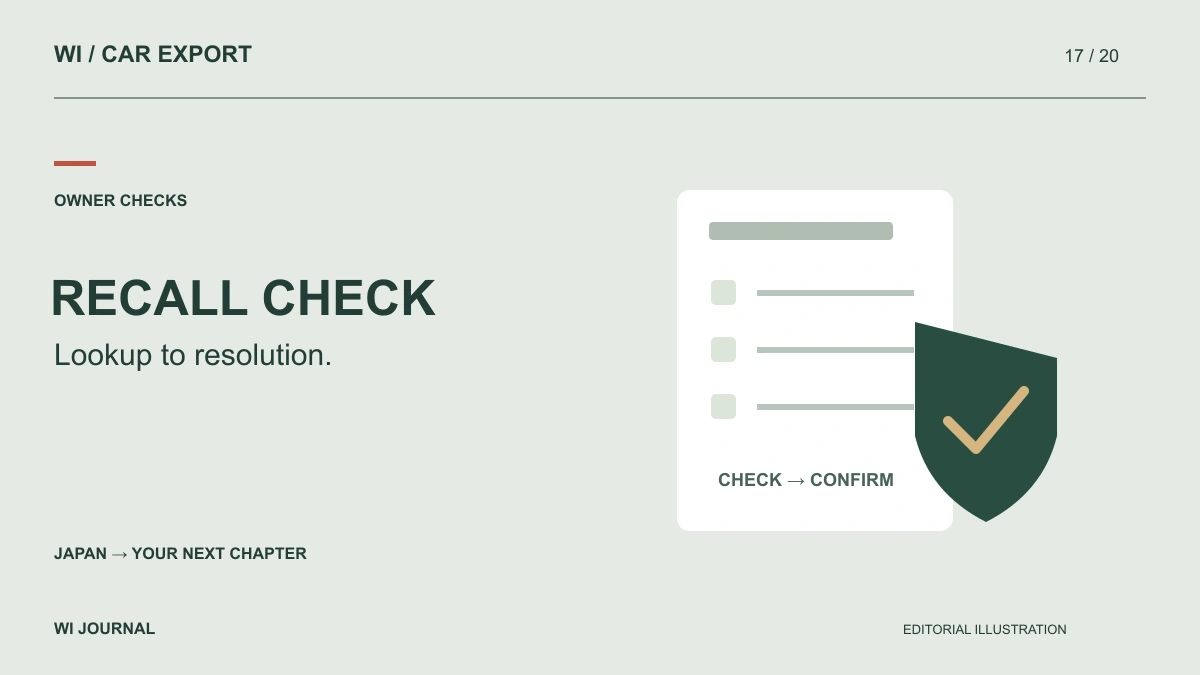
Recall research must answer two different questions: whether a campaign applies to a vehicle, and whether the required work has been completed. Do not merge them or assume every lookup provides both answers. Search with the exact frame number, save the dated result, then seek repair-status evidence and confirm separately whether support is available in the destination country.
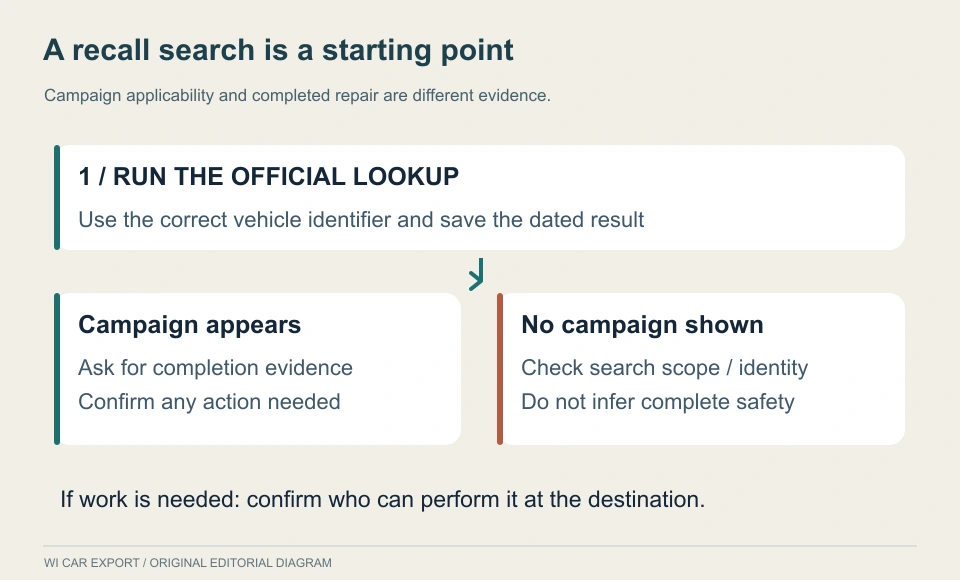
Use the exact vehicle identifier
Start with a clear image of the vehicle’s identification plate and the frame number shown in the available Japanese documentation. Transcribe it twice and compare the result; one wrong character can turn a meaningful lookup into a false “no result”.
For a Toyota, use Toyota Japan’s official recall information route rather than a generic list assembled by model year. Toyota states that its search accepts the vehicle’s frame number and covers recalls, improvement measures and service campaigns; it can also show repair implementation status (Toyota Japan recall FAQ). The same FAQ says its searchable history begins in January 1999 for recalls and improvement measures and January 2002 for service campaigns, so an empty result should be read within that stated scope.
For another manufacturer, locate that manufacturer’s official Japan-market lookup or contact route and record what the service says it covers. Do not substitute a recall list for a different country: campaign identifiers, included vehicle ranges and remedy administration can be market-specific.
Read “applies” and “completed” as separate fields
Use a small evidence log for every result:
| Field | What to record |
|---|---|
| Vehicle | Make, model/type code and frame number |
| Search | Official service used, date checked and coverage notes |
| Applicability | Campaign identifier and title exactly as displayed |
| Status | Outstanding, completed, unclear or no applicable record shown |
| Next evidence | Repair record, manufacturer/dealer confirmation or destination support check |
If a campaign is listed as applicable, that alone does not prove the remedy was performed. If the search shows completed work, save the result with its date and vehicle identifier. Because databases and vehicle records can be corrected, a screenshot should support the file rather than replace later confirmation.
Likewise, “no applicable record shown” is not a universal safety certificate. It means only that the searched service returned no applicable entry within its coverage and with the identifier supplied. It does not establish the car’s overall condition or replace a suitable pre-purchase inspection.
Build a proof ladder for completed work
When a campaign has applied, seek the strongest available evidence in this order:
- Current official frame-number result showing the implementation status for the exact vehicle.
- Matched repair documentation showing the frame number, campaign identifier, repair date and performing outlet.
- Written manufacturer or authorised-dealer confirmation tied to the same frame number and campaign.
- Unverified indicators, such as an undated sticker, handwritten note or seller recollection.
The fourth level can prompt a better enquiry but should not be upgraded into proof. A general service invoice is also insufficient unless it identifies the campaign or remedy. Keep original-language evidence and a working translation together; do not alter the source document.
If an official result is ambiguous, ask a qualified Japanese contact or authorised outlet to interpret the status. The objective is a traceable answer, not a confident translation guess.
Confirm overseas support as a new question
Completion status in Japan and remedy support abroad are independent. Before importing a vehicle with an outstanding or uncertain campaign, contact the manufacturer’s representative or authorised dealer in the destination country. Provide the full Japan-market frame number and campaign identifier, then ask:
- whether it recognises that Japanese-market campaign;
- whether it can inspect or complete the remedy locally;
- what documents it requires;
- whether parts must be ordered and how scheduling is confirmed;
- whether there are charges or eligibility limits for an imported vehicle.
Obtain the response in writing where possible. Do not assume a local dealer must perform work on a vehicle it did not sell, and do not assume the remedy will be free overseas. If the destination contact cannot confirm support, decide whether completion in Japan can be documented before purchase or whether the uncertainty makes the car unsuitable.
Make recall evidence part of the buying file
Repeat the official check shortly before the purchase decision, because a later campaign may supersede an earlier screenshot. Name files consistently—for example, frame number, campaign identifier and check date—and preserve the source URL.
Recall research should sit beside, not replace, condition evidence. A completed campaign says that a defined remedy was recorded; it does not certify unrelated mechanical, structural or electronic systems. Conversely, a clean-looking car can still have an open campaign.
Ask for the information needed to verify the car
When enquiring, specify that you need the exact frame number and any available campaign-completion evidence. Do not ask an exporter to promise how a foreign dealer will respond; obtain that confirmation from the destination network itself.
Contact WI Car Export with the stock reference and the specific recall evidence you need before making your decision.
Original WI Car Export editorial illustration, AI-assisted vector design. Not vehicle photography.