Learn how to verify workshop, diagnostic and spare-parts support for the exact Japanese vehicle variant before you commit to importing it.
A familiar badge does not guarantee familiar support. Before buying a Japanese-market vehicle, check whether workshops and parts suppliers at the destination can support the exact variant—not merely another car with the same model name. Your decision should rest on named businesses answering specific questions against the vehicle’s model and frame details.
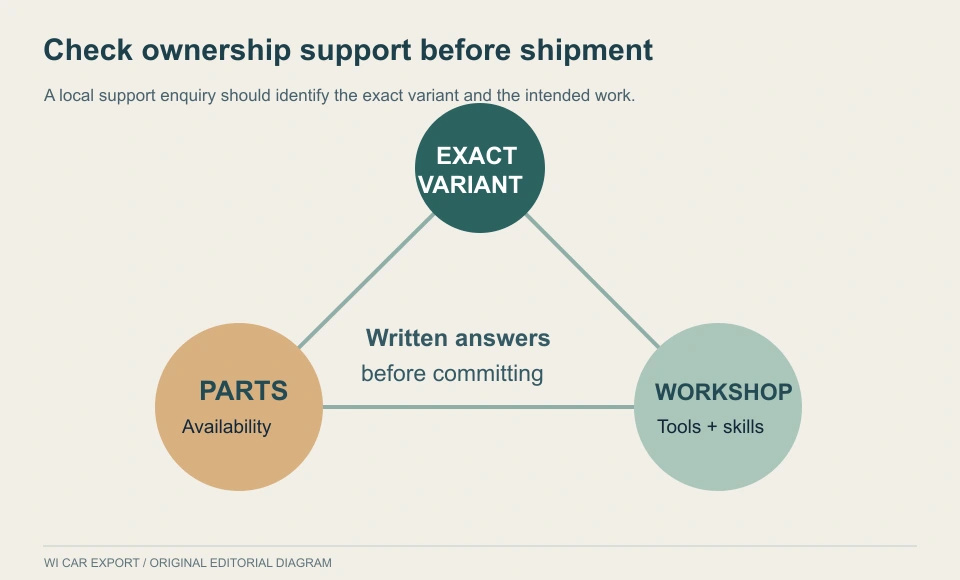
Define “support” before asking whether it exists
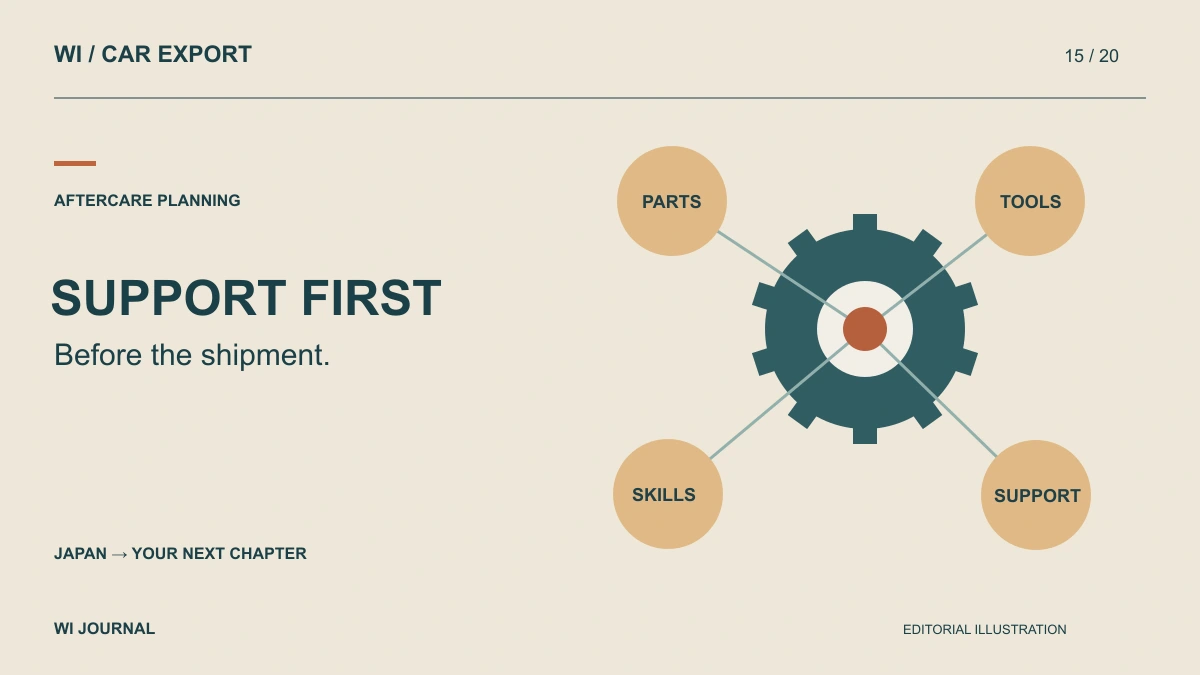
Parts availability is only one layer. A useful destination check covers four separate needs:
| Support layer | What to establish | Evidence worth keeping |
|---|---|---|
| Routine service | A workshop will service this variant and can obtain filters, fluids, brake and suspension parts | Written reply naming the model code or frame number |
| Diagnosis | A workshop can read relevant systems and interpret Japan-market fault information | Tool/platform named by the workshop, with any exclusions |
| Non-routine repair | There is a route for body, lighting, glass, hybrid/EV or model-specific components | Supplier response with an example lead-time process, not a universal promise |
| Technical information | The repairer can access suitable manuals, wiring information or parts identification | Confirmation from the repairer about the sources it actually uses |
This separation prevents a weak “yes, we work on Toyotas” from being mistaken for complete support. A garage may handle routine mechanical work but not calibrate a driver-assistance camera. A parts shop may stock service items for a locally sold engine while being unable to identify a Japan-only lamp assembly.
Build a small identification pack
Do not turn the exercise into a badge-and-year search. Ask the exporter for the clearest available evidence of:
- manufacturer, model and grade;
- model/type code and frame number;
- engine or propulsion description;
- transmission and drive type;
- photographs of the identification plate and any unusual equipment;
- the listing link and clear exterior, dashboard and under-bonnet images.
These identifiers are not interchangeable. Toyota’s explanation of a Japanese registration certificate treats the manufacturer name, frame number and model/type as distinct fields; the model/type designates the vehicle model, while the frame number identifies the vehicle itself (Toyota Japan’s certificate guide). A response tied only to a marketing name is incomplete.
Ask destination businesses questions they can answer
Contact at least one workshop and one established parts supplier in the country where the car will be used. The useful question is not “Can you get parts?” It is closer to:
Please check the model code and frame number supplied in this private enquiry. Can you service this exact Japan-market variant? Which routine parts can you identify locally, which would be special-order, and which systems or jobs would you decline?
Then test the answers with a short basket relevant to the car: oil and air filters, front brake friction parts, a suspension wear item and one variant-specific item such as a lamp, sensor or display component. You are assessing the route to an answer, not seeking an eternal stock guarantee. Ask who confirms fitment, what evidence they need, whether returns are possible, and how changing supply affects estimates.
For the workshop, ask separately about mechanical service, scan-tool coverage, hybrid/EV competence if applicable, camera or radar calibration, and parts fitting. Toyota Japan directs detailed questions about diagnosis, repairs and genuine-part numbers to dealers; the cited inquiry service is intended for Japanese-specification vehicles driven in Japan (Toyota Japan FAQ). That does not establish support in another country; confirm the destination route independently.
Turn replies into a practical go/no-go decision
Use a three-level support map rather than a vague impression:
- Green: a named local workshop accepts the exact variant, routine parts are identifiable through more than one route, and specialist systems have a credible support path.
- Amber: routine servicing is covered, but one or two important systems rely on special orders or a distant specialist. Record the inconvenience and decide whether it suits your usage.
- Red: businesses cannot identify the variant, essential diagnostic or safety-system work has no route, or the only assurance is “parts should fit” from a different model.
The result is vehicle-specific. An amber car may be reasonable for an enthusiast with alternative transport but unsuitable for a daily driver in a remote area. Do not solve a red result by assuming that an overseas seller, a generic scan tool or a visually similar local model will fill the gap.
Before committing, arrange an appropriate used-vehicle inspection and keep its limits clear: a checklist or condition review is not proof of future parts supply or a mechanical certification. The AA likewise includes a thorough inspection within its wider used-car assessment method (AA used-car checklist).
Send the support findings with your vehicle enquiry
When you have a shortlist, attach the workshop and parts replies to the vehicle file. Note unresolved items explicitly and ask for the exact vehicle evidence needed to close them. This makes “Can I maintain it?” a documented buying decision rather than a hope formed after the car arrives.
Contact WI Car Export with the stock link, destination and your variant-support questions so the team can confirm what vehicle information is available before you decide.
Original WI Car Export editorial illustration, AI-assisted vector design. Not vehicle photography.