Choose a Toyota Prius generation using exact model identity, drivetrain, condition evidence, destination fit and your real use case.
There is no universally “best” Prius generation. The useful answer depends on the actual car, your destination’s rules and support network, and whether you value purchase budget, newer equipment, cabin access or a particular drivetrain more highly.
This is a research-based selection method, not a road test. It deliberately avoids pretending that every car within a generation has identical condition or specification.
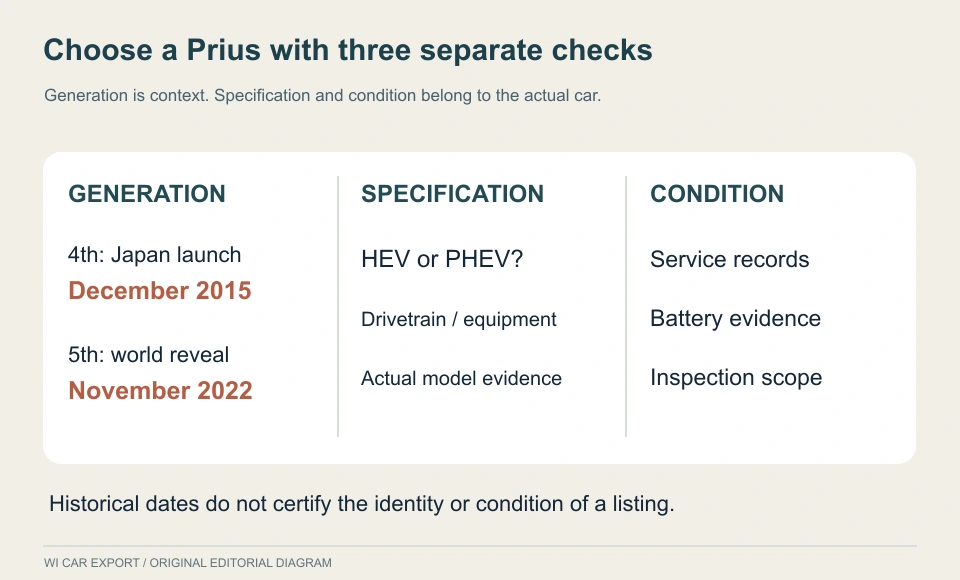
Use generation as a search filter, not a verdict
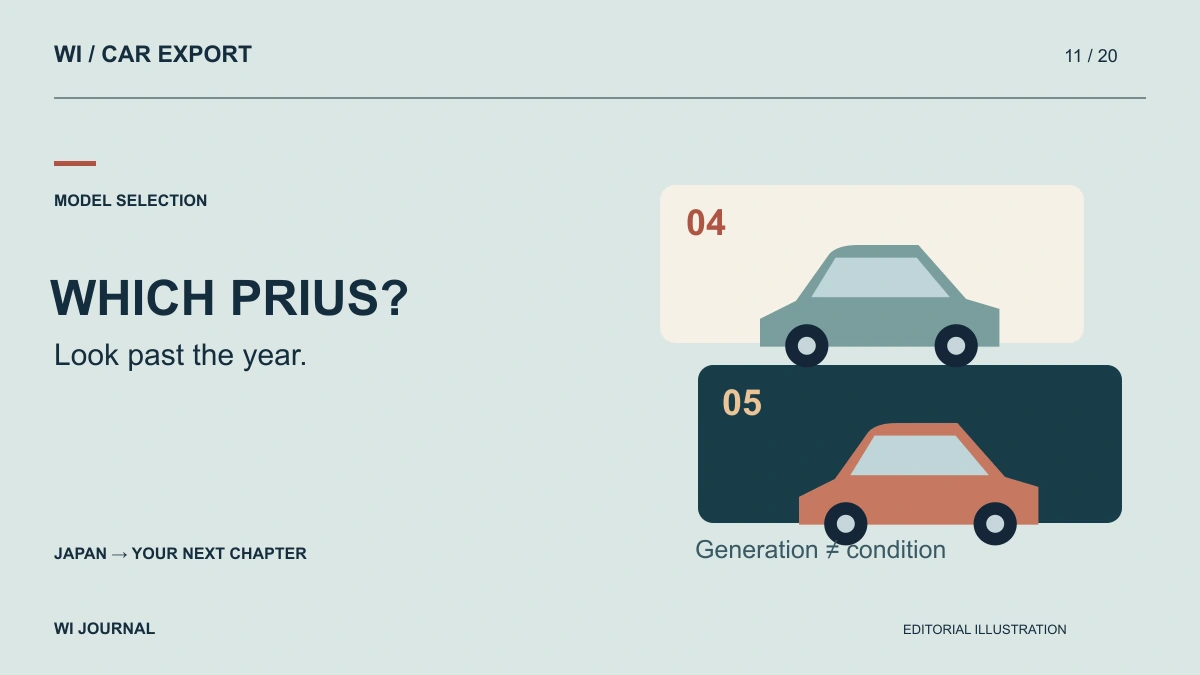
Generation labels help organise a large stock list, but the production boundary, model code, grade and powertrain must be verified on the individual vehicle. Registration year alone can be an imperfect shortcut when production dates, regional launches and document dates differ.
Two official milestones anchor newer used-stock research. Toyota launched the fourth-generation Prius at Japanese dealers on 9 December 2015; its announcement identified the first Prius use of the Toyota New Global Architecture and listed both 2WD and E-Four versions in the Japanese range. Read Toyota’s fourth-generation Japan launch. Toyota unveiled the fifth generation on 16 November 2022, announcing separate HEV and PHEV launch schedules. Read Toyota’s fifth-generation world premiere.
Those dates explain broad chronology. They do not identify the specification, condition or eligibility of a stock unit in front of you.
Decide the job before choosing the generation
Write a one-page use brief with non-negotiables:
- annual distance and typical trip length;
- passenger count, child-seat or mobility access needs, and luggage shape;
- urban, motorway, steep-road or winter-route exposure;
- 2WD or additional-traction requirement based on those routes;
- ordinary hybrid or plug-in hybrid preference;
- local access to Toyota-capable diagnostics and parts;
- maximum landed budget plus a repair contingency.
If you are considering a PHEV, add a realistic charging plan. If you cannot charge routinely, do not assume the plug-in label alone produces the ownership outcome you want. If you need E-Four, verify it from the exact model information rather than body styling or a seller’s generic generation description.
Compare actual candidates on the same evidence
Create a shortlist of three to five vehicles and use the same columns for each:
| Decision field | What to record |
|---|---|
| Identity | Frame number, model code, first-registration date, grade |
| Powertrain | HEV or PHEV; 2WD or documented E-Four |
| Use fit | Seats, access, luggage arrangement, route needs |
| Condition | Available exterior, interior, underside and diagnostic evidence |
| History | Service entries, dates, mileage progression and repair information |
| Hybrid evidence | Dated vehicle-specific report, tool used and stated limitations |
| Destination fit | Eligibility, parts, diagnostics, insurance and equipment compatibility |
| Cost | Quoted vehicle/export cost and separately verified local costs |
This table stops a newer but poorly documented car from winning merely because of its generation. It also prevents an older, cheaper listing from looking inexpensive after essential local work and missing evidence are considered.
Treat specifications as vehicle-level facts
Online Prius summaries often merge markets, grades and production periods. Before relying on a feature, verify the original Japanese specification for the model code and inspect evidence that the feature is present and operates. Pay particular attention to driver-assistance equipment, lighting, navigation and radio functions, wheel and tyre sizes, spare-wheel or repair-kit provision, charging equipment on PHEVs, and the number of keys.
Compatibility matters after export. A Japan-market navigation unit, connected feature or frequency-dependent system should not be assumed to work in another country. Ask a local specialist about conversion, replacement and support costs before treating the equipment as value.
Let condition break a close tie
When two generations both satisfy the use brief, give more weight to the stronger individual vehicle. Review service chronology, diagnostic evidence, body and underside condition, repair history, tyres, brakes, keys and local parts availability. A checklist supports this comparison; it does not replace a competent mechanical inspection.
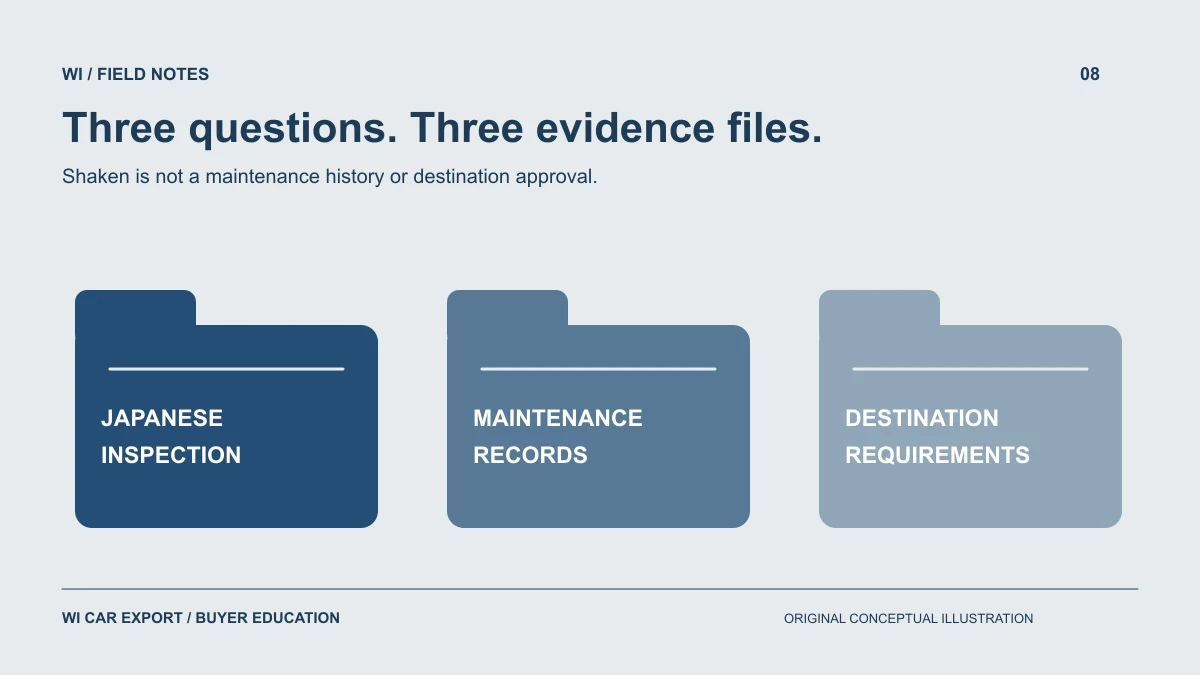
For hybrid-system evidence, request the complete dated record and its scope. Toyota’s domestic certified-used programme describes a dedicated diagnosis for eligible programme vehicles, but that process is not automatically included with all Japanese stock and does not create an export warranty. See the scope of Toyota Japan’s certified-used process.
A defensible final choice
An older generation can be a sound choice when the actual vehicle’s condition, documentation, destination fit and total cost meet your requirements. Choose newer when a verified capability materially solves your use case—not simply because a generation number is higher. If no candidate clears every non-negotiable, pause rather than relaxing an import or charging requirement after committing funds.
To apply this framework to live fixed-price listings, compare Toyota Prius vehicles in Japan Stock and verify each stock unit on its own evidence.
Original WI Car Export editorial illustration, AI-assisted vector design. Not vehicle photography.