Compare a family MPV and SUV by testing occupied seats, real luggage, child-restraint access, daily loading and route fit together.
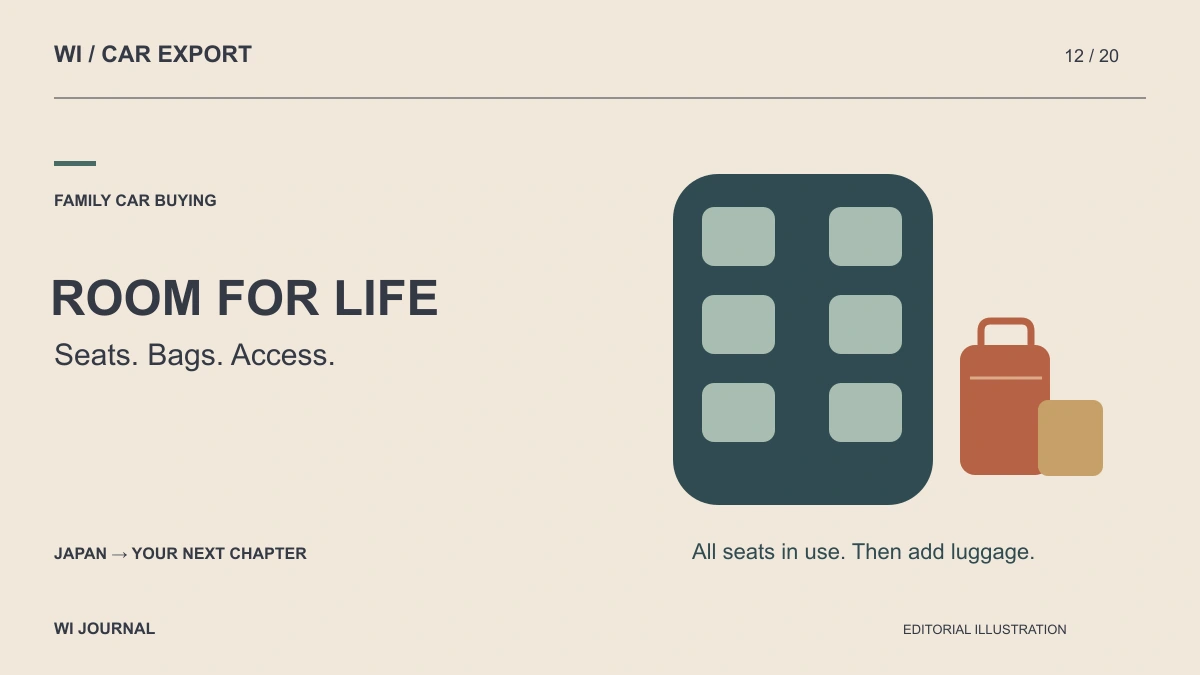
The better family vehicle is the one that carries your occupied seats and real luggage at the same time, while letting the people who use it get in, buckle up and load safely. Counting advertised seats or comparing exterior size is not enough.
Use this practical test before choosing a fixed-price Japanese MPV or SUV. It is a decision framework, not a claim that one body style is universally roomier, safer or easier to own.
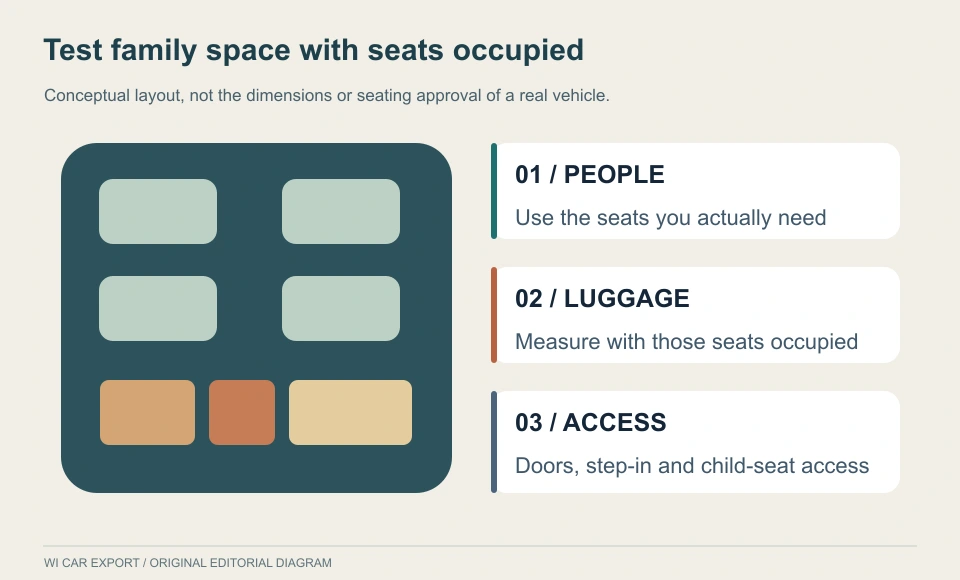
Begin with the hardest normal journey
Do not design the test around an empty school run if the vehicle must also handle airport trips or holidays. Describe the most demanding journey you expect to make regularly:
- every passenger, including children and occasional adult relatives;
- each child restraint or booster and where it must be fitted;
- pushchairs, wheelchairs, coolers, sports gear or work equipment;
- the number and approximate dimensions of suitcases or boxes;
- urban parking, rough roads, steep access, ferry ramps or low garages;
- how often the full load occurs.
Separate “must fit” from “nice to have”. A third-row seat that is used twice a year should not outweigh a daily access problem, but occasional use still needs a safe, workable plan.
Run the occupied-seat-plus-luggage test
For every candidate, draw the cabin with every required seat occupied. Then place each luggage item in the remaining load area on paper, using verified dimensions or seller-provided measurements where available. Do not count a seat that must be folded to carry luggage if a person needs that seat on the same journey.
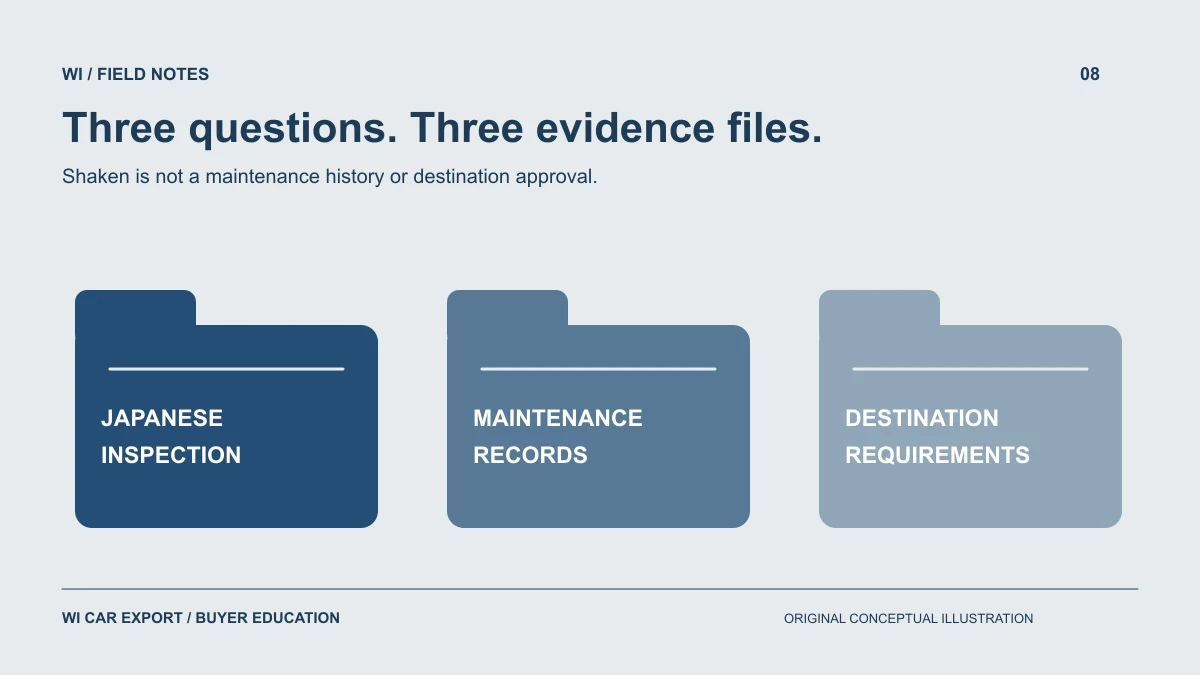
Ask for vehicle-specific evidence of:
- seat configuration and folding sequence;
- access to the rear row with the required child restraints installed;
- usable load-floor length, width at the narrowest point and height below the window line;
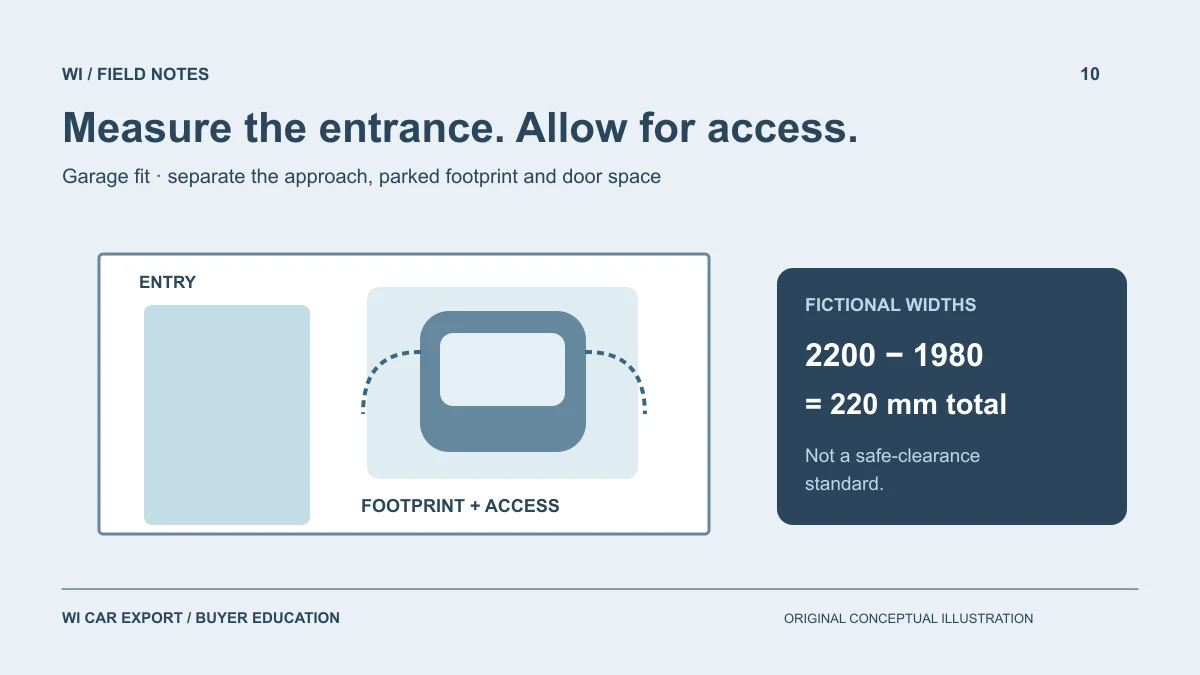
- tailgate or door opening width and loading height;
- anchorage locations required by your child-restraint rules;
- spare wheel, repair kit or underfloor storage occupying the planned space.
Measurements should state where they were taken. A maximum volume figure can conceal wheel-arch intrusions, a sloping tailgate or the need to stack luggage above a safe sight line.
Treat access as a daily task
An MPV’s sliding door may suit a narrow parking space, while an SUV’s seating height or door arrangement may suit a different household. Those are hypotheses to test on the exact model, not automatic body-style advantages.
Walk through a rainy-day loading sequence. Can an adult reach every buckle? Can a child enter without climbing across another passenger? Is there a stable handhold for an older relative? Can the main pushchair pass through the opening without removing wheels? Where does the driver stand while loading beside traffic?
If a family member has limited mobility, record their acceptable step height, door opening and seating position. Ask a local mobility specialist to review the actual vehicle and any intended modification before purchase.
Add the route and ownership filters
Once both body styles pass the people-and-luggage test, compare the factors that affect your location:
| Filter | Questions for the actual vehicle |
|---|---|
| Route | Ground clearance needed? Tight urban turns? Long high-speed journeys? |
| Parking | Overall dimensions and turning space suitable for home and work? |
| Climate | Rear ventilation, heating and demisting equipment present and working? |
| Tyres | Correct size readily available and affordable locally? |
| Service | Model knowledge, diagnostics and routine parts accessible locally? |
| Import | Exact model code eligible and insurable in the destination? |
Do not award points for equipment shown in another market’s brochure. Japanese grades and production periods can differ. Verify the model code, installed features and their current operation through records, photographs or an agreed inspection.
Inspect family-specific wear
Standard used-car checks still apply. The AA’s general buying checklist recommends a thorough inspection and attention to items such as tyres, lights, fluid leaks, electrics and evidence of crash repairs; that is useful general methodology, not a mechanical certificate for a car in Japan. Review the AA used-car checklist.
For a family vehicle, also look closely at every seat belt and buckle, seat-folding mechanisms, powered doors or tailgate, air-conditioning outlets, window controls and interior signs of water entry. Confirm the number of keys and any remote controls. A powered sliding door that appears on an equipment list still needs condition evidence.
Make the body-style decision last
An MPV wins when an actual MPV completes your occupied-seat, luggage and access tasks better within budget. An SUV wins when an actual SUV does so while better matching your route or ownership constraints. If neither can carry the full family scenario without unsafe stacking or sacrificing a required seat, change the shortlist rather than forcing the body-style preference.
Send the family layout, luggage dimensions and stock references when you enquire. To discuss what vehicle-specific photos, measurements and records are available, contact WI Car Export.
Original WI Car Export editorial illustration, AI-assisted vector design. Not vehicle photography.