Understand the difference between a Japanese car's chassis or frame number and model code, then cross-check documents for the exact vehicle.
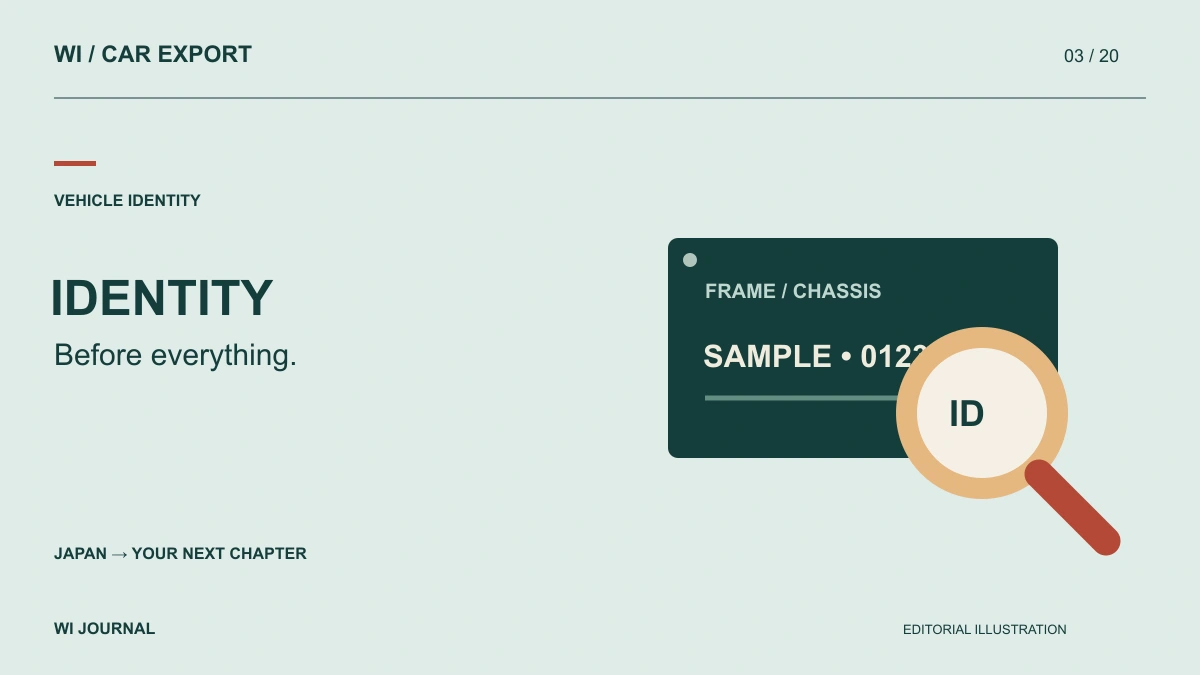
A chassis or frame number identifies the individual vehicle in the records supplied for it. A model code describes a model or configuration family. The two strings can look similarly technical, but they are not interchangeable: use the chassis or frame number to keep evidence attached to the correct car, and use the model code only as one clue when checking specification.
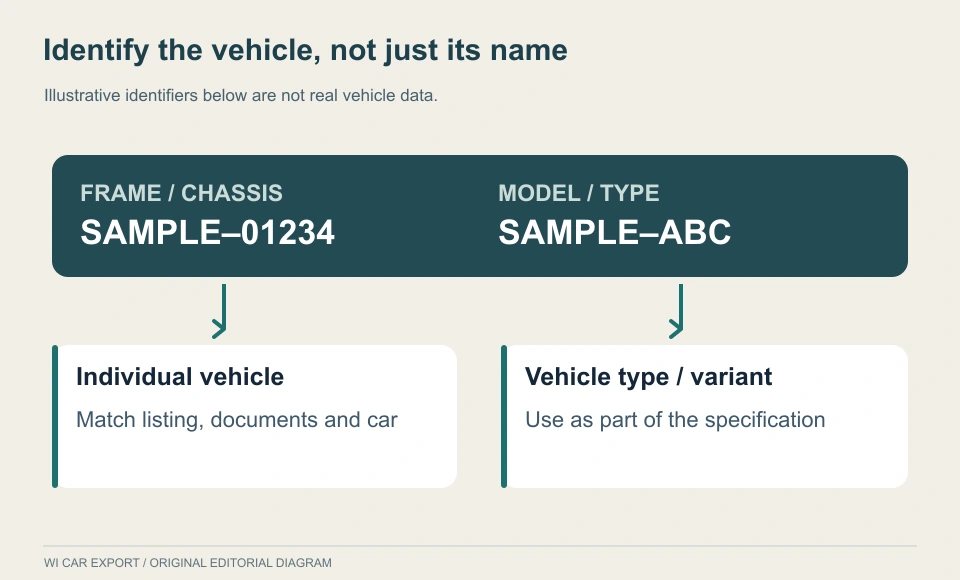
The practical difference
Toyota's explanation of Japan's automobile inspection certificate presents the frame number and model/type as separate certificate fields (Toyota certificate guide). That separation is useful well beyond Toyota: one field anchors the document to a specific vehicle, while the other helps describe what kind of vehicle it is.
Treat the chassis or frame number as the linking reference for your purchase file. It should connect the listing, quotation, certificate images, inspection evidence where available and shipping paperwork for one car.
Treat the model code as a classification clue. It may help narrow body, engine, drivetrain or production family, but the code alone does not prove every fitted option, trim feature or accessory. Market, production timing and optional equipment still need vehicle-specific evidence.
Do not assume that every identifier on a Japanese record is a 17-character VIN or try to force it into a decoder. Ask what the field is called on the source document and preserve the characters exactly as shown.
A simple identity cross-check
Consider this fictional evidence pack:
| Item | Chassis/frame field | Model-code field |
|---|---|---|
| Stock page | ABC12-3456789 | ABC12-XZY |
| Certificate image | ABC12-3456789 | ABC12-XZY |
| Photo of stamped/plate identifier | ABC12-3456789 | Not visible |
| Quotation | ABC12-3456789 | ABC12-XZY |
The strings are invented. What matters is the matching method. All four items point to the same individual identifier, while the model code stays in its own column. If the quotation instead showed ABC12-3456798, the transposed final digits would be a stop-and-resolve issue—not something to dismiss because the colour and model name look right.
Copying errors deserve the same attention as major discrepancies. Watch for 0 versus O, 1 versus I, hyphens, prefixes and omitted trailing digits. Compare the source images at useful resolution rather than relying on manually retyped text.
Build one evidence file per chassis
Name or index every downloaded item with the stock reference and chassis/frame number. A compact register might contain:
- stock-page capture and access date;
- seller's quotation;
- legible certificate image;
- identifier photo, if available;
- option and condition evidence;
- shipping documents when issued;
- a discrepancy log with the resolution and date.
This structure prevents a common remote-buying failure: receiving a useful photograph but losing certainty about which similar vehicle it depicts. The image itself should show a contextual identifier where practical, or the seller's message should unambiguously attach the file to the stock reference.
Redact identifiers before posting documents publicly. Within the transaction, retain unedited originals and send sensitive records only through the agreed channel.
What a matching model code does—and does not—prove
A matching model code is a consistency check. It can help reveal that a document belongs to a different model family. It does not independently verify the badge, grade, factory options, later accessories, odometer, condition or repair history.
Likewise, a matching chassis/frame number proves that the evidence refers to the same stated identity; it does not make every claim in that evidence accurate. Identity verification and condition assessment are separate jobs.
When equipment matters, request proof of the actual component: a control panel, seat layout, wheel, camera view, power-door switch or other relevant feature. When condition matters, request condition evidence or an appropriate inspection. Do not ask a model-code lookup to answer questions it was not designed to settle.
Resolve mismatches before progressing
Use a short, neutral message:
The final digits of the chassis/frame number on the quotation appear to differ from the certificate. Please confirm which record belongs to the stock reference in this enquiry and provide a corrected document or a clear explanation.
Then pause reliance on the affected material until the correction is documented. Do not edit your local copy to make the records agree, and do not accept a replacement page without rechecking every identifier.
This routine is especially valuable when comparing similar-colour vehicles with the same model code. The model code may match across several cars; the chassis/frame number is what keeps the evidence set individual.
To apply the check to a fixed-price vehicle, browse WI Car Export's Japan stock, note the stock reference, and request the available vehicle-identity documents for that exact listing.
Original WI Car Export editorial illustration, AI-assisted vector design. Not vehicle photography.