Turn Japanese used-car service records into a dated mileage chronology, distinguish schedules from completed work and assess evidence gaps honestly.
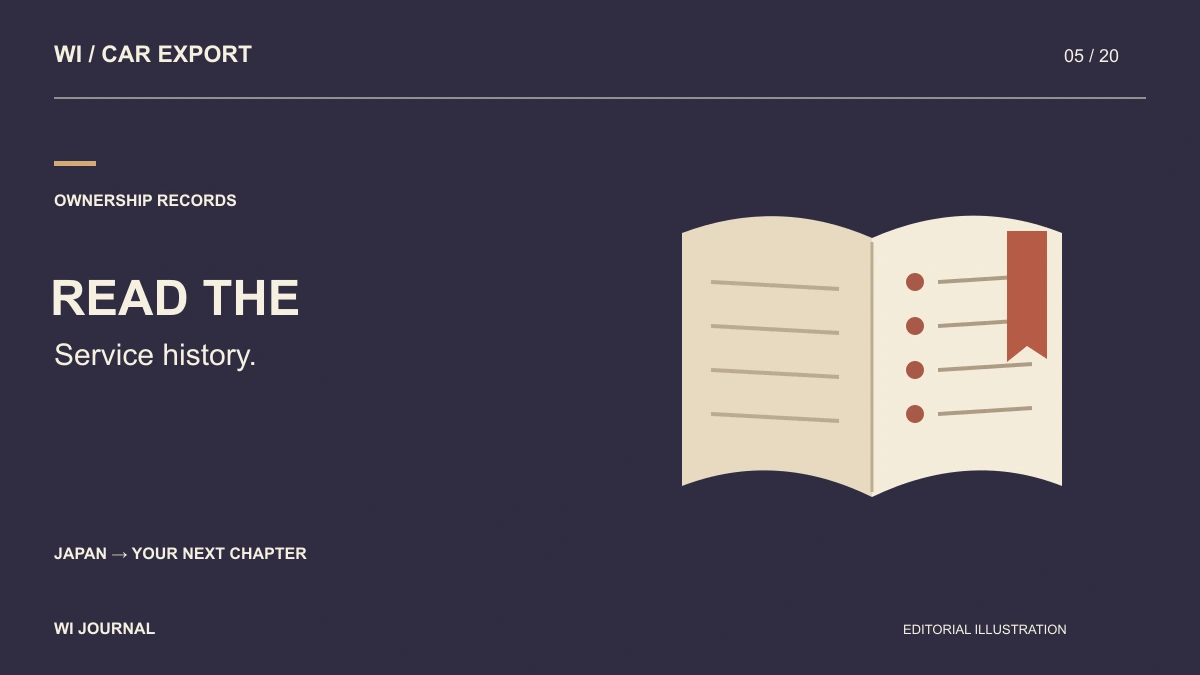
A useful service history is a vehicle-specific chronology of dated work and mileage readings. A maintenance book by itself is only a container: blank pages, generic schedules or dealer stamps without readable dates and entries do not prove that the listed car received regular servicing. Review the records line by line, then make any gaps explicit.
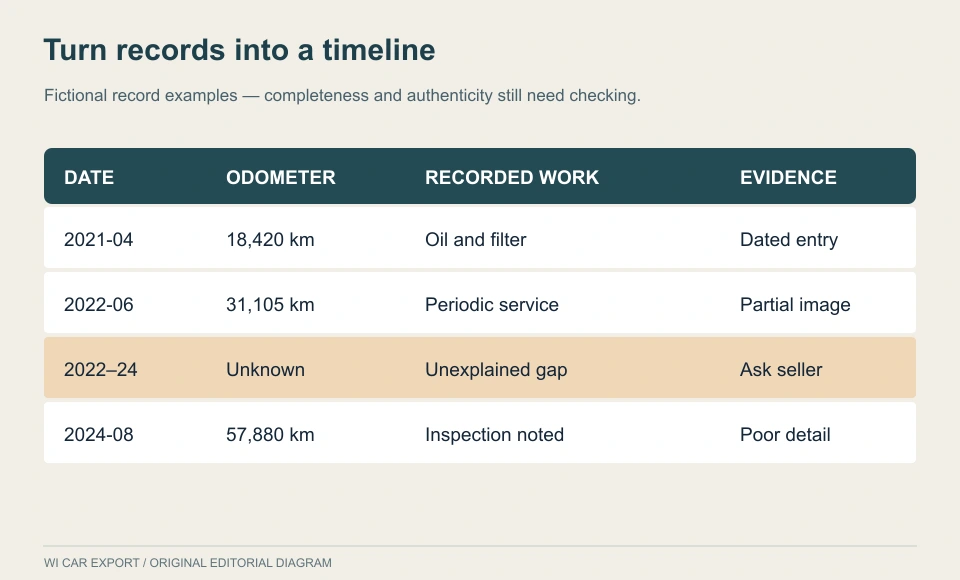
Separate the book from the completed record
Manufacturer materials explain what maintenance records are designed to contain. Toyota says its maintenance notes include service timing and items as well as records of maintenance performed (Toyota maintenance notes). That description does not establish that a particular Toyota—or any WI Car Export vehicle—has a completed history.
For the actual car, ask for legible images of the cover or identifying page and every completed entry. The chassis or frame number, registration details or other vehicle identifier should connect the book to the listing. If the identity page is absent, record that limitation instead of assuming the book belongs to the car.
Distinguish three kinds of content:
- Schedule: work the maker recommends at a time or distance.
- Record: work entered as performed on a stated date or mileage.
- Invoice or receipt: a separate transaction document that may add parts, labour and workshop detail.
A printed schedule is not evidence that the scheduled work happened.
Build a one-page chronology
Transcribe the evidence into a table rather than judging a stack of photos from memory:
| Date | Odometer | Work recorded | Provider shown | Evidence quality | Questions |
|---|---|---|---|---|---|
| 12 Apr 2021 | 18,420 km | Oil and filter | Stamp readable | Dated entry | None |
| 03 Jun 2022 | 31,105 km | Periodic service | Name unclear | Partial image | Request full page |
| 18 Aug 2024 | 57,880 km | Inspection; items not legible | Stamp visible | Poor detail | Ask for close-up |
These entries are fictional. Their purpose is to show the method: retain the original wording where possible, mark unreadable material and keep questions beside the affected row.
Now calculate the intervals. In the example, the first two records are 13 months and 12,685 km apart. The next visible entry is more than two years and 26,775 km later. That interval is a record gap, not proof that no maintenance occurred. Missing pages, work performed without a book entry or genuinely missed servicing are different explanations; the evidence does not choose among them. Compare recorded work against the applicable manufacturer schedule for the exact model and usage conditions; chronology alone does not establish adequate maintenance.
Test the chronology for internal consistency
Read dates and odometer values in sequence. A lower later mileage, duplicated page, unexplained vehicle identifier or entry dated before the car's first registration deserves clarification. It may be a transcription problem, image-order mistake, odometer replacement or another issue; do not diagnose the cause remotely.
Check whether invoices and book entries reinforce each other. An invoice should identify the vehicle and date clearly enough to join it to the chronology. A parts line can be useful, but do not expand an abbreviation or Japanese term beyond what a reliable translation supports.
Pay attention to evidence quality:
- Is the whole page visible, including headings and page number?
- Are dates, mileage and work items legible at original resolution?
- Does the stamp identify a provider, or is it only a blurred mark?
- Are consecutive pages supplied, or only selected entries?
- Is the source a photograph of an original record or a typed summary?
Use “unreadable” and “not supplied” as valid findings. They are more accurate than silently filling blank cells.
Interpret gaps without overclaiming
Set a decision rule before looking at the car. For example: investigate any unexplained interval over 24 months, any mileage sequence that goes backwards, and any major claimed work with no vehicle-specific evidence. Those thresholds are your purchasing policy, not a universal maintenance standard.
Then record the evidence status of each issue:
- Resolved: additional evidence answers the question.
- Explained but unverified: a plausible account is supplied without supporting record.
- Open: no answer or inadequate evidence.
Keep decision impact in a separate column: material if the issue changes your willingness to buy, inspect or price, and non-material otherwise. A finding can be both open and material; the labels answer different questions.
This prevents a neat-looking stamp book from receiving more weight than its contents justify. Conversely, it prevents an honest gap from being described as confirmed neglect.
Ask for the right follow-up
Avoid “Does it have full service history?” because “full” is undefined. Ask instead for all available completed maintenance-book pages and vehicle-linked invoices, at original readable resolution. Identify the exact interval or entry you want clarified.
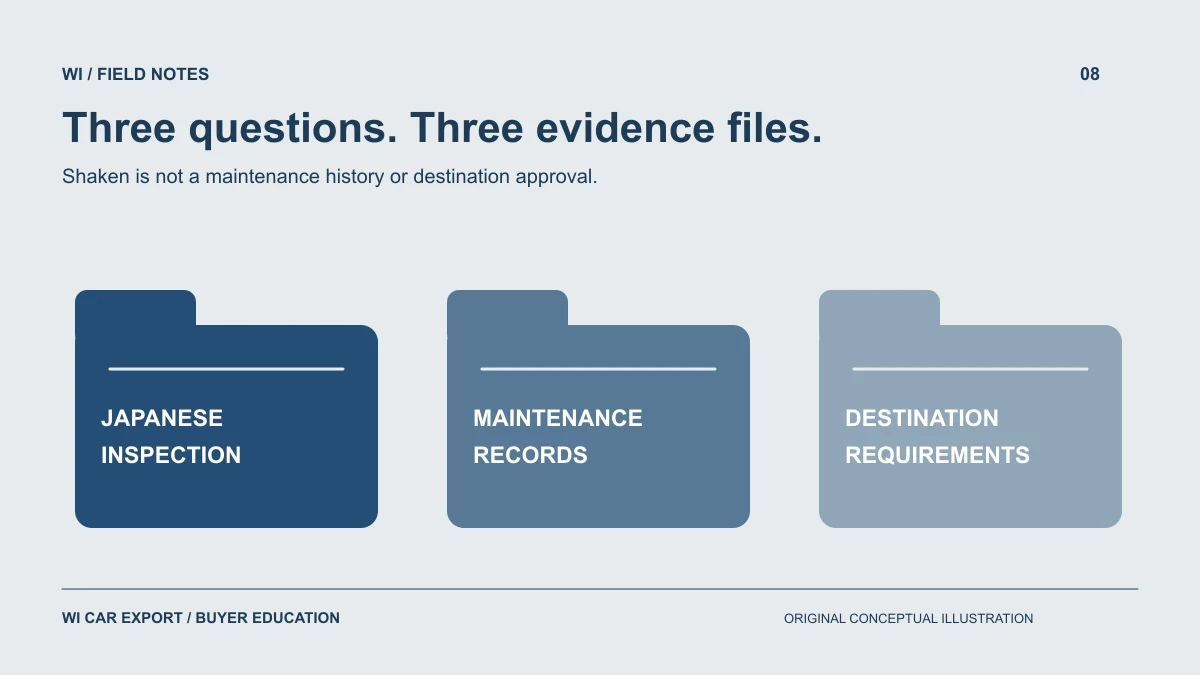
Service records also remain different from a present-condition inspection. A well-documented past does not prove current mechanical condition; an inspection today cannot recreate missing history. Use each evidence type for its own job.
If a vehicle's history could change your decision, contact WI Car Export with the stock reference and ask which vehicle-specific service records can be supplied for chronology review.
Original WI Car Export editorial illustration, AI-assisted vector design. Not vehicle photography.