Separate cargo dimensions from payload, calculate a ready-to-work weight example, and check axle limits and local approval before importing.
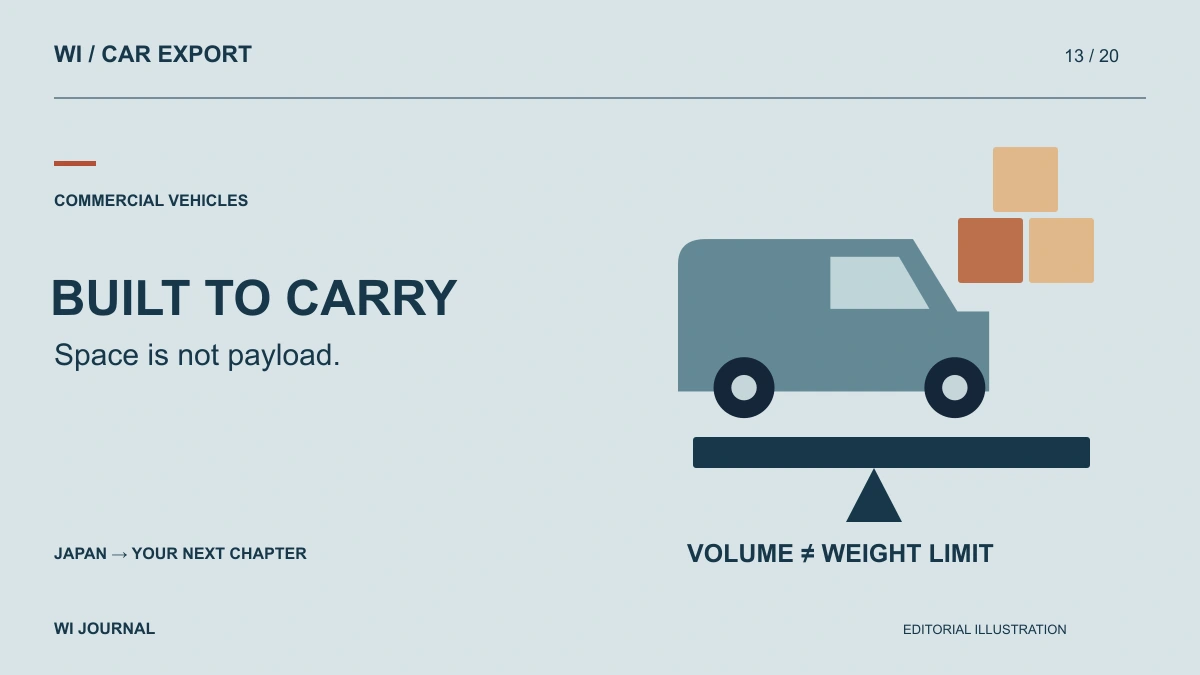
A large cargo floor does not prove that a van or truck can legally or safely carry a heavy load. Load space is about dimensions; payload is about mass. Buyers need both, plus axle limits and destination approval, before choosing a commercial vehicle from Japan.
The terminology below uses a UK government definition as a clear example. Your destination may use different terms, measurement rules and licence thresholds, so confirm them locally for the exact vehicle.
Keep volume and payload in separate columns
Load-space dimensions answer whether the cargo fits: floor length, width between wheel arches, internal height, door opening and loading height. Payload arithmetic answers whether the vehicle can carry the people, body, equipment and cargo without exceeding a limit.
A high-volume cargo can be light; a compact load of tools, liquids, machinery or construction material can be heavy. Shelving, refrigeration, a crane, a tail lift, spare wheels and towing equipment consume capacity even when sellers describe them as part of the vehicle rather than the customer’s cargo.
Use a verified ready-to-work weight
UK guidance defines maximum authorised mass (MAM), also called gross vehicle weight (GVW) or permissible maximum weight, as the vehicle’s weight including the maximum load it can safely carry on the road. It says this figure is normally shown on a vehicle plate or sticker. The same guidance defines “mass in running order” for cars, buses and lorries as including the driver, the body, normal parts, essential fluids and a full tank of fuel. See GOV.UK’s vehicle-weight definitions.
Do not assume a listing’s “empty weight” uses the same definition. For a purchase decision, seek the original plate and documents, then obtain or plan for a credible weighed ready-to-work figure that includes the actual people, fuel, permanent bodywork and installed kit.
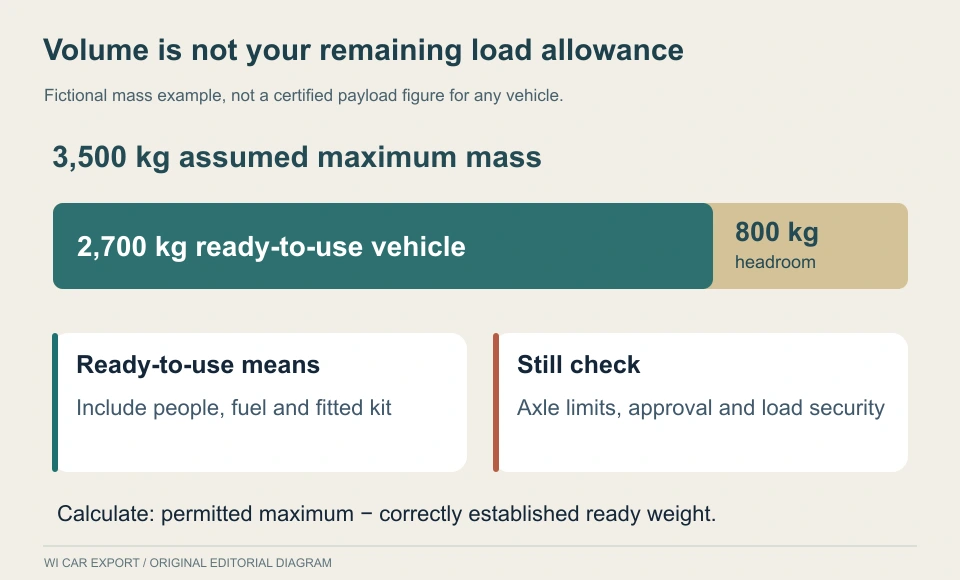
Worked example: 800 kg is headroom, not a cargo promise
Consider a fictional truck with:
- verified maximum permitted mass: 3,500 kg;
- measured ready-to-work mass, including people, fuel and installed kit: 2,700 kg.
The arithmetic is:
3,500 kg − 2,700 kg = 800 kg
That 800 kg is theoretical remaining headroom to the stated maximum. It is not automatically an 800 kg cargo allowance. The vehicle must also remain within front- and rear-axle limits, tyre ratings and any destination-specific limits. Load distribution can overload an axle before the total reaches 3,500 kg. The measurement itself also needs a known scale, date and configuration.
Allow a sensible operating margin rather than planning every trip exactly at a limit. The appropriate margin is an operational and regulatory decision for the owner and local specialist, not a universal percentage.
Map each item and its position
Build a loading sheet before selecting the body:
| Item | Mass | Position | Permanent or trip-specific? |
|---|---|---|---|
| Driver and passengers | ___ kg | Cab | Trip-specific |
| Shelving or lining | ___ kg | Cargo body | Permanent |
| Tools and spares | ___ kg | Mark on plan | Usually permanent |
| Cargo | ___ kg | Mark on plan | Trip-specific |
| Accessories | ___ kg | Front/rear/roof | Permanent |
Mark which items are already included in the ready-to-work weighing, so people, fuel or fitted equipment are not counted twice. Add only the remaining load, then have a qualified body builder or commercial-vehicle specialist review axle distribution and securing points. Roof loads, tow loads and body conversions can introduce separate limits; do not infer them from gross mass alone.
Check the actual Japanese vehicle
Request photographs of the manufacturer and body-builder plates, frame number, model code and any axle-weight markings. Compare them with the export and registration documents. Ask for cargo-bed or interior measurements taken at the narrowest usable points, plus door apertures and obstructions.
Inspect chassis and body condition, corrosion, suspension, tyres and evidence of prior commercial use or modification. Confirm whether fitted equipment operates and whether its documentation is available. A general used-vehicle checklist can organise the review, but payload suitability needs commercial-vehicle expertise.
Confirm approval before committing
Import eligibility is separate from carrying capacity. The UK, for example, has vehicle-approval routes for some imported, built or modified vehicles, with requirements and exemptions depending on the circumstances. That example should not be applied to another country or treated as a decision on one truck. Review the UK vehicle-approval overview.
Before purchase, give the exact frame/model details and proposed body or conversion to the destination licensing authority, an approved engineer or another qualified local specialist. Confirm registration category, driving-licence implications, inspection, emissions, dimensions, axle limits and modification approval in writing where possible.
If you have a Japanese van or truck reference and a defined load case, contact WI Car Export to ask what vehicle plates, measurements and condition evidence are available for that stock unit.
Original WI Car Export editorial illustration, AI-assisted vector design. Not vehicle photography.