Calculate a petrol-versus-hybrid fuel-only break-even point with a transparent worked example, distance scenarios, formulas and exclusions.
A hybrid does not automatically cost less overall, and a lower purchase price does not automatically make a petrol car the better buy. The useful question is narrower: how long would fuel savings take to recover the hybrid’s price premium under your own driving conditions?
This guide provides a reusable calculation. Its figures are fictional illustrations, not WI Car Export prices, model specifications or fuel-economy promises.
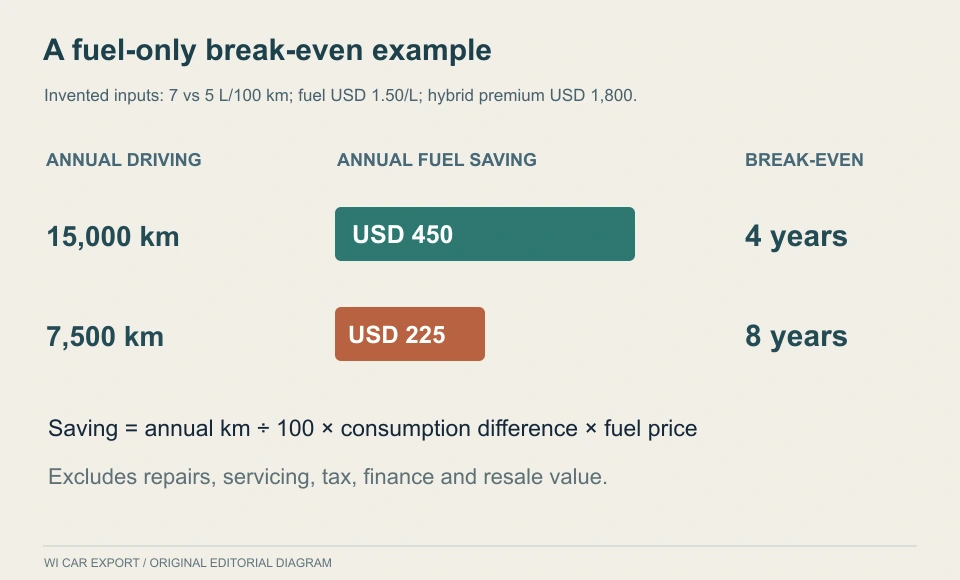
The answer from one worked example
Assume two otherwise suitable cars:
| Fictional input | Petrol car | Hybrid car |
|---|---|---|
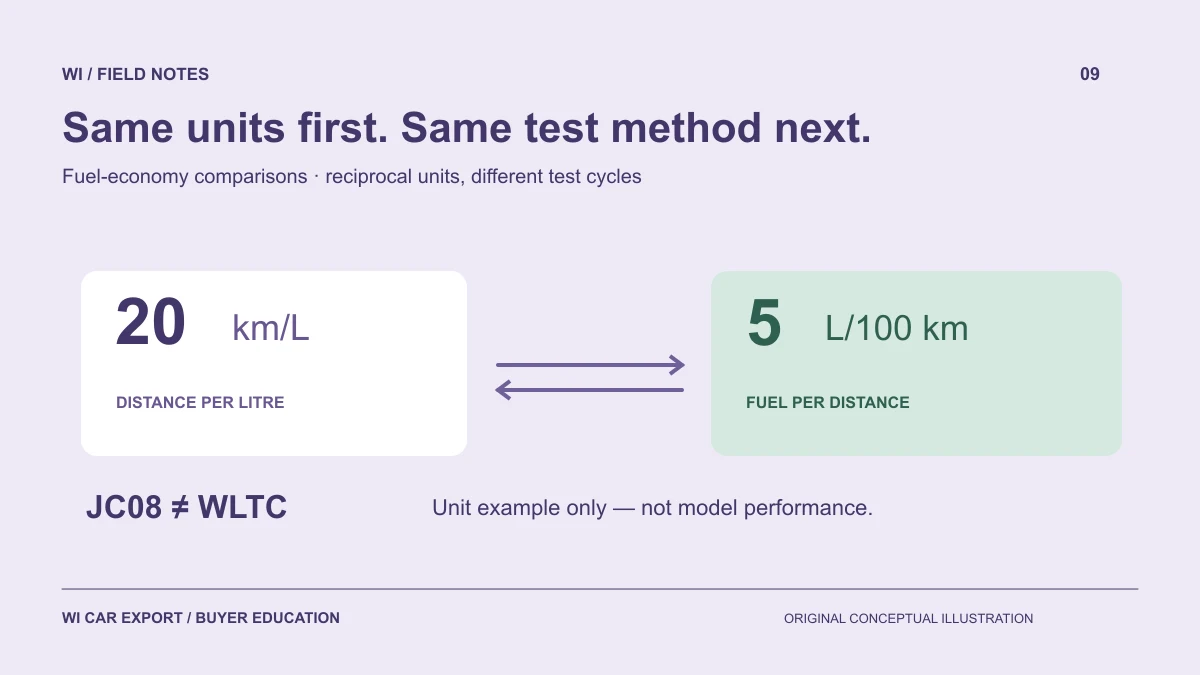
| Fuel use | 7 L/100 km | 5 L/100 km |
| Annual distance | 15,000 km | 15,000 km |
| Fuel price | USD 1.50/L | USD 1.50/L |
| Hybrid purchase premium | — | USD 1,800 |
The petrol car would use 15,000 ÷ 100 × 7 = 1,050 litres a year. The hybrid would use 15,000 ÷ 100 × 5 = 750 litres. The difference is 300 litres, worth 300 × USD 1.50 = USD 450 per year.
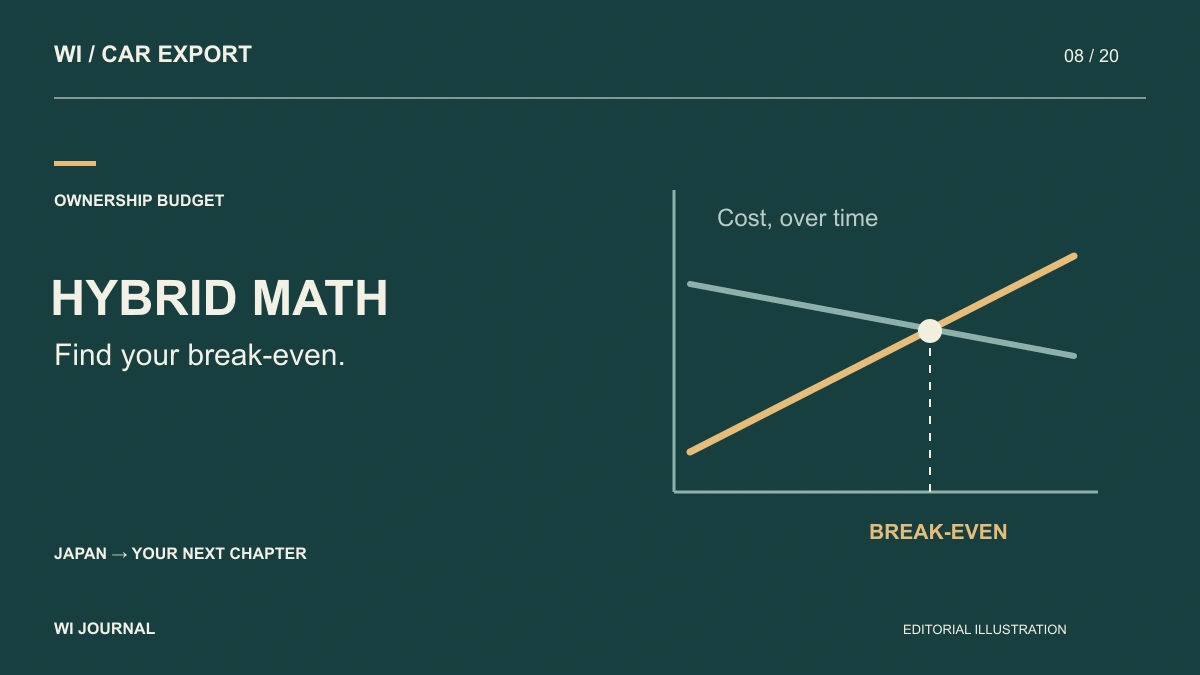
On fuel alone, the break-even period is therefore:
USD 1,800 ÷ USD 450 per year = 4 years
That four-year result is not a prediction. It is the output of four invented inputs. Change any input and the answer changes.
Distance can move the answer dramatically
Suppose the same buyer drives only 7,500 km per year. Annual fuel use becomes 525 litres for the petrol car and 375 litres for the hybrid. The 150-litre difference is worth USD 225 at the same fictional fuel price.
USD 1,800 ÷ USD 225 per year = 8 years
Halving the annual distance doubles the fuel-only break-even period in this example. This is why a taxi operator, a rural commuter and a household using a second car for occasional errands should not copy one another’s conclusions.
Use three scenarios, not one hopeful forecast
Build low-, expected- and high-distance cases before choosing a car. For each case, use the same formula:
- Annual fuel cost =
annual kilometres ÷ 100 × litres per 100 km × fuel price per litre. - Annual fuel saving =
petrol annual fuel cost − hybrid annual fuel cost. - Fuel-only break-even years =
hybrid price premium ÷ annual fuel saving.
Use consumption estimates that reflect the exact versions being compared and a route mix resembling yours. A city-heavy pattern and a steady high-speed pattern should not be assumed to produce the same result. Treat official test-cycle figures, owner reports and your own past fuel records as different evidence types rather than blending them without labels.
If the calculated annual saving is zero or negative, there is no fuel-only break-even at those inputs. That does not make the hybrid unsuitable; it means fuel savings are not the reason to pay more.
What this calculation deliberately excludes
This is not a total-cost-of-ownership model. It excludes:
- maintenance and repairs, including any hybrid-system work;
- insurance, registration charges, taxes and import duties;
- finance costs and the time value of money;
- resale value and the length of time you will actually keep the car;
- tyre size, specification differences and optional equipment;
- shipping, port, clearance and destination costs.
Those exclusions matter. A lower-priced car with weaker evidence may not be the lower-risk purchase, while a more expensive example with a strong history may be preferable even when its fuel-only payback is slower. Compare landed cost and condition separately from the fuel calculation.
Compare actual cars, not powertrain labels
Once the arithmetic produces a sensible range, return to the individual vehicles. Confirm the exact model code, year, mileage, fuel type and equipment. For a hybrid, ask what battery or hybrid-system evidence is attached to that particular car; do not infer battery condition from the word “hybrid”. For both cars, review the available condition and service evidence and budget for an independent inspection where appropriate.
A practical decision rule is simple: choose the hybrid for fuel savings only if the conservative break-even period fits comfortably inside your expected ownership period. If it does not, decide whether the hybrid’s other characteristics are worth the premium to you. If the numbers are close, vehicle condition and documentation deserve more weight than a fragile fuel-price forecast.
To compare fixed-price Japanese vehicles after running your own scenarios, browse current Japan Stock and assess the exact cars behind the numbers.
Original WI Car Export editorial illustration, AI-assisted vector design. Not vehicle photography.