Request more useful remote car photos and videos with an identity-first shot list, worked example and clear boundary between evidence and inspection.
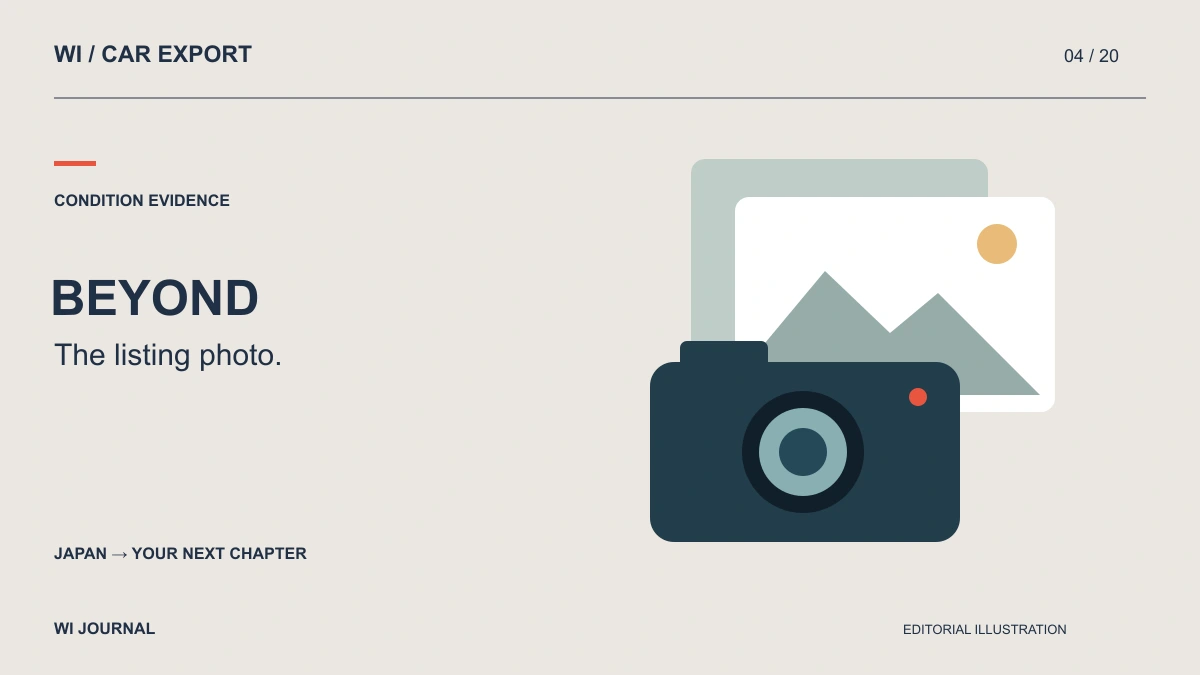
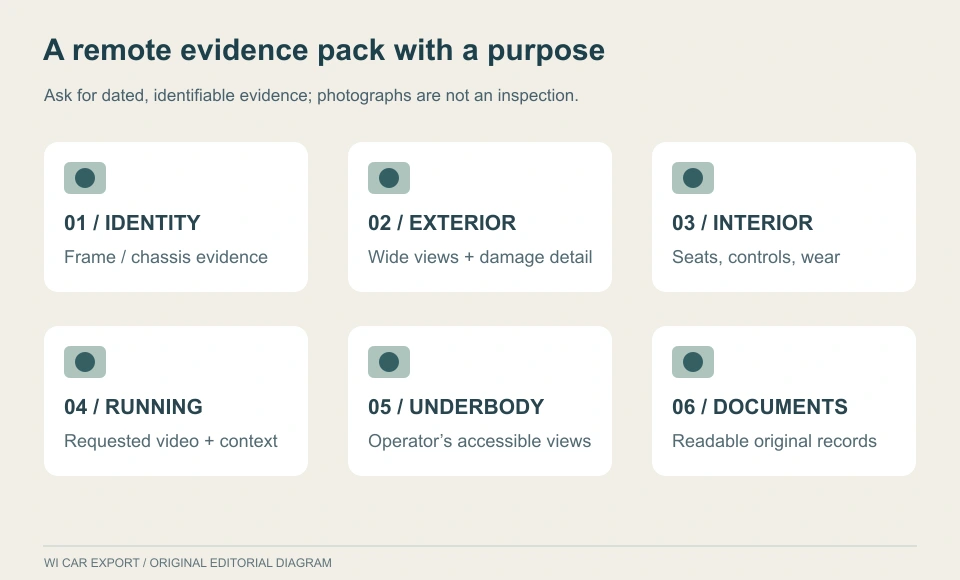
Remote photos and video are most useful when each file answers a defined question about one identified vehicle. Ask for a compact evidence pack with context, detail and operation clips—not “more photos.” The result can improve your buying decision, but it remains visual evidence rather than a mechanical inspection or condition guarantee.
Start with identity and recency
Give the seller the stock reference and chassis or frame number you are considering. Ask that the response clearly ties every file to that vehicle. Where practical, begin a video with the stock reference or identifier in context, then continue without cuts to the area being shown.
Also request the capture date. A recent image can show current visible condition; it cannot establish what happened before or after capture. Preserve the original files and message thread rather than relying only on compressed screenshots.
Use a three-layer shot list
The most efficient pack moves from orientation to detail to operation.
1. Context photographs
Request full views of the front, rear, both sides and roofline, plus oblique views that show adjacent panels together. Add the cabin from both front doors, rear seating area, luggage area and engine bay. These images establish where later close-ups belong and help reveal differences in panel alignment, colour or cabin completeness that isolated detail shots may hide.
2. Targeted detail photographs
Choose details based on your intended use and the existing listing, for example:
- each wheel and tyre sidewall;
- lower bumpers, sills and wheel arches;
- windscreen edges and lamp lenses;
- driver's seat bolster, steering wheel and pedal area;
- instrument display with the ignition on;
- dashboard warning lights after start-up;
- cargo floor and spare-wheel or repair-kit area;
- controls for any advertised feature;
- every disclosed scratch, dent, stain or damaged trim item.
Ask for one wider locator image followed by a close-up of each issue. A coin or ruler can show scale, but it should not cover the damage.
3. Short operation videos
Keep each request observable. Useful clips may include a cold start if the seller can genuinely confirm the engine is cold, idle with the instrument panel visible, exterior lighting, windows, mirrors, air-conditioning controls, power doors and the infotainment display. Do not ask for risky manoeuvres or assume a yard can provide a road test.
A clip shows what was visible or audible under those capture conditions. It does not diagnose the engine, transmission, battery, brakes or hidden structure.
A worked request pack
Suppose a listing shows a dark front-quarter photo and mentions a power sliding door, but offers no close view of the left sill. A focused request would be:
- one full left-side image in even daylight;
- one oblique image connecting the front bumper, wing and front door;
- wide and close images of the left sill and both left wheel arches;
- one continuous clip showing the stock reference, dashboard start-up and power sliding-door operation;
- one image of the sliding-door switch and one of the door track.
This fictional pack is more decision-useful than twenty random images. It tests the listing's specific evidence gaps and advertised feature without pretending to assess unrelated systems.
Know the boundary between evidence and inspection
The AA's general used-car checklist recommends a thorough inspection as part of assessing a used vehicle (AA used-car checklist). Photos and video cannot reproduce underbody access, paint-depth measurement, diagnostic scanning, fluid testing or a qualified technician's physical checks.
Use three labels in your worksheet:
- Observed: directly visible in the supplied file under stated conditions.
- Reported: stated by the seller but not demonstrated in the file.
- Not assessed: outside the evidence or needing a physical inspection.
For example, “air-conditioning indicator illuminated during a 20-second clip” is an observation. “Air-conditioning cools correctly in all conditions” would require more evidence. “Refrigerant system healthy” is a diagnostic conclusion the clip cannot support.
Make the request proportionate
Prioritise evidence that could change your decision. Identify five must-have answers, then a secondary list if the vehicle remains under consideration. Some files or inspections may not be available for a particular stock vehicle; ask what can be supplied before treating the request as agreed.
Close with a written summary of unresolved points. If an important area cannot be shown, price and decide with that uncertainty visible rather than converting absence of evidence into “no problem.”
For a specific fixed-price vehicle, send WI Car Export the stock reference and your prioritised evidence request. Ask which photos, videos and inspection information are available for that car before relying on them.
Original WI Car Export editorial illustration, AI-assisted vector design. Not vehicle photography.