Check a Japan-market Nissan LEAF by exact model, charging ports, local infrastructure, route needs and dated battery evidence before importing.
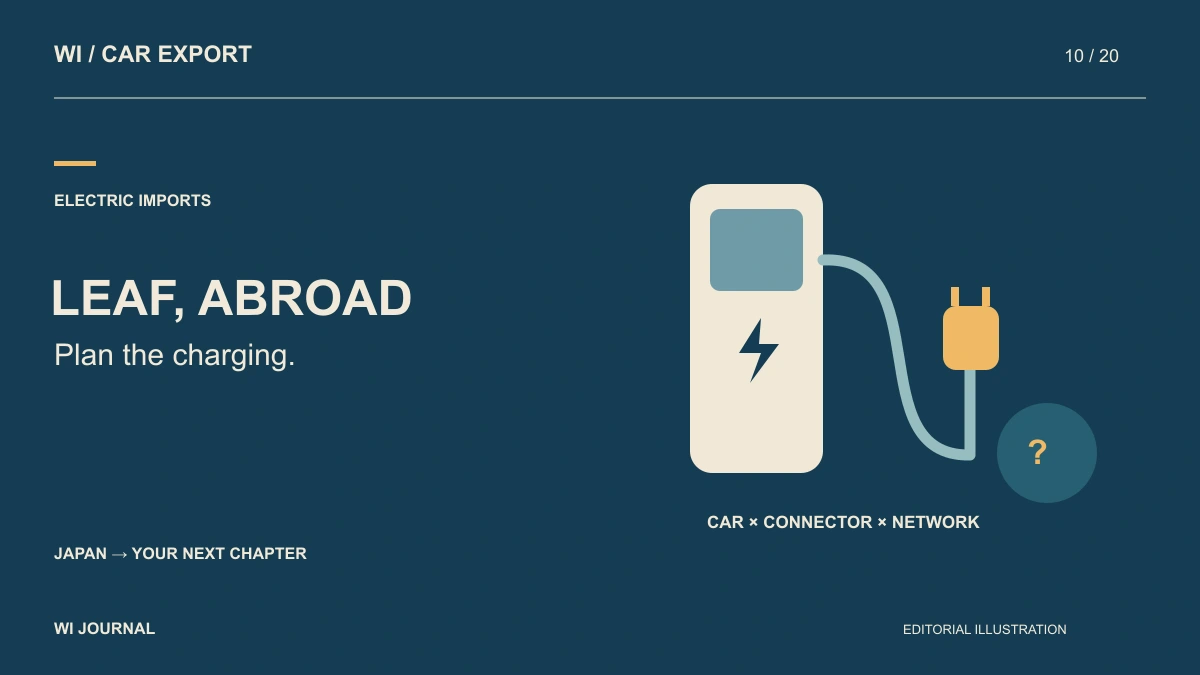
A used Nissan LEAF can be evaluated responsibly only after three questions have specific answers: Which exact vehicle is it, how will you charge it locally, and what dated battery evidence is available? A badge, model year or online connector chart cannot answer all three.
This is a research-based pre-purchase framework, not a road test or a promise of range, charging speed or battery life.
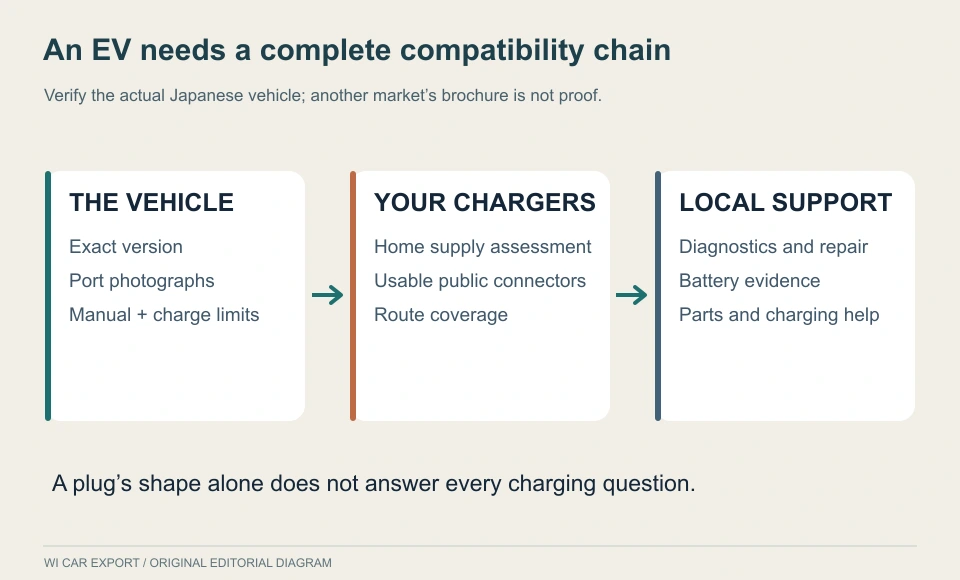
Identify the exact LEAF before checking compatibility
Record the frame number, model code, first-registration date, battery version if documented, trim and installed equipment. Ask for clear photographs of both charging inlets, the labels around them and any supplied charging cable. Then locate the Japanese owner’s manual that matches the model and production period.
This vehicle-first method matters because specifications vary by market and version. Nissan UK’s 2023 LEAF manual, for example, says the normal-charge connector shape varies by country between Type 1 and Type 2, while describing CHAdeMO for quick charging on that UK-market vehicle. That is useful evidence that regional variation exists; it cannot establish the inlet fitted to a particular Japanese-market car. See Nissan UK’s charging table and country caveat.
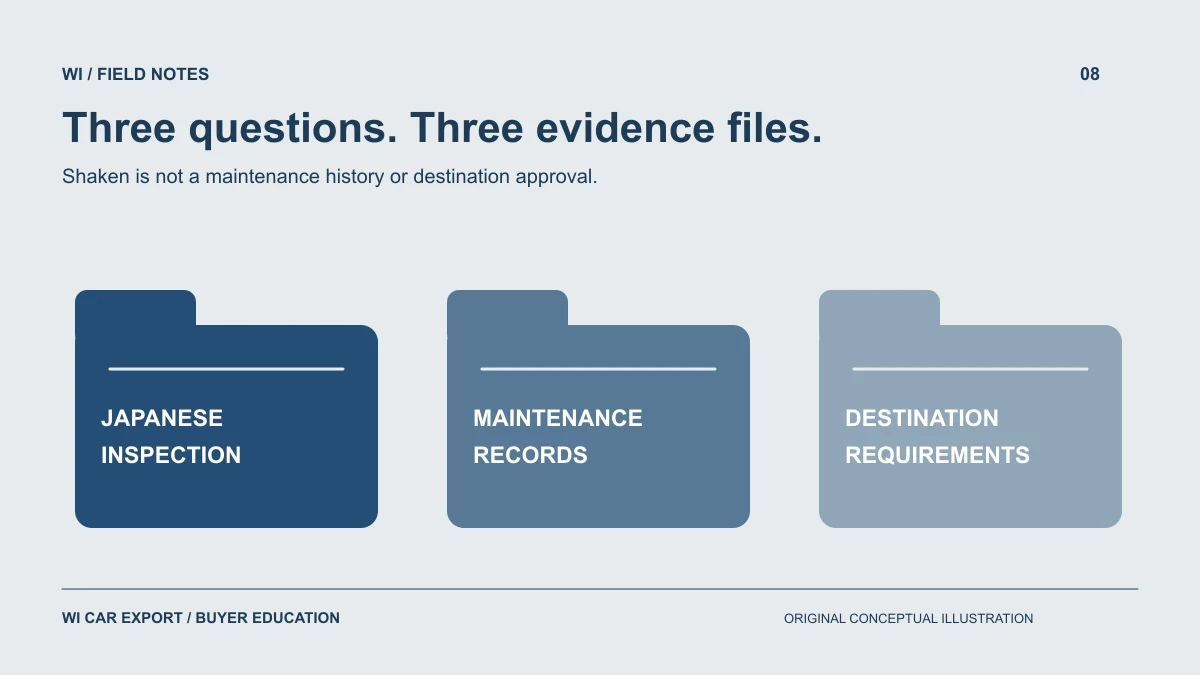
The correct evidence chain is therefore: exact car → port photographs and labels → matching Japanese manual → confirmation by a qualified local charger installer or EV specialist.
Map the car to the charging you can actually use
Do not stop at “there are chargers in my country”. Build a route-level map:
- Home or base charging: socket or wallbox type, supply voltage, installation capacity, parking arrangement and cable compatibility.
- Routine public charging: connector offered at the locations you would genuinely use, access hours, reliability information and payment method.
- Long or exceptional journeys: distance between compatible sites, alternative sites and the consequences of one being unavailable.
- Support: a local workshop or technician willing to service the exact LEAF generation and charging equipment.
Have an electrician or qualified installer assess the proposed home-charging arrangement. An adapter should never be treated as automatic proof of electrical compatibility, safe current handling or regulatory acceptance.
Request battery evidence with a date and identity
Ask what battery-condition information is available for the exact car and when it was recorded. Useful supporting material may include a manufacturer diagnostic report, dashboard battery information, service records and diagnostic trouble-code results. Request full, legible pages tied to the frame number and mileage rather than a cropped number without context.
Nissan Japan describes a battery condition certificate that reports state of health, estimated remaining capacity and an estimated range derived from test-cycle range. Nissan explicitly says the certificate records the vehicle’s condition at the measurement date and does not guarantee future capacity or performance. It also says the scheme was initially available only for some LEAF vehicles at selected sellers. Therefore, request a certificate when one genuinely exists, but do not assume every export LEAF can obtain one. Review Nissan Japan’s certificate scope and limitations.
If no certificate is available, that is not automatically a rejection. It changes the uncertainty. Decide whether alternative evidence, the purchase terms and your repair contingency are sufficient.
Build a personal energy and route case
Avoid choosing the car from an advertised range figure alone. Write down a demanding normal day: kilometres, speed mix, elevation, weather, passenger and luggage load, climate-control use, and the charging opportunity before the return journey. Add a reserve that reflects the consequences of arriving low on energy.
Then ask a local EV specialist to help interpret the exact vehicle’s evidence against that route. Laboratory-cycle figures, dashboard estimates and a previous driver’s experience are not interchangeable. Range also varies with use and conditions; Nissan’s own certificate explanation notes influences including weather, congestion, driving style, air-conditioning use and tyre pressure. Nissan explains those conditions alongside its range estimate.
Use a go/no-go checklist
Proceed only when you can answer “yes” to the essentials:
- The frame number, model code and registration details agree across the listing and documents.
- Port photographs and a matching manual establish the car’s actual charging arrangement.
- A local specialist has confirmed a compliant everyday charging path.
- Compatible public charging covers the routes that matter, with a backup plan.
- Battery evidence is dated, legible, vehicle-specific and understood within its limits.
- Your budget includes local registration, charging installation, maintenance and an EV repair contingency.
A LEAF that passes someone else’s checklist can still fail yours because charging access and daily routes are local. Make infrastructure a purchase criterion, not a problem to solve after shipping.
To examine available fixed-price vehicles and request the stock details needed for this check, browse Japan Stock.
Original WI Car Export editorial illustration, AI-assisted vector design. Not vehicle photography.