Verify trim and must-have options on an individual Japanese used car with an evidence ladder, feature matrix and contradiction checks.
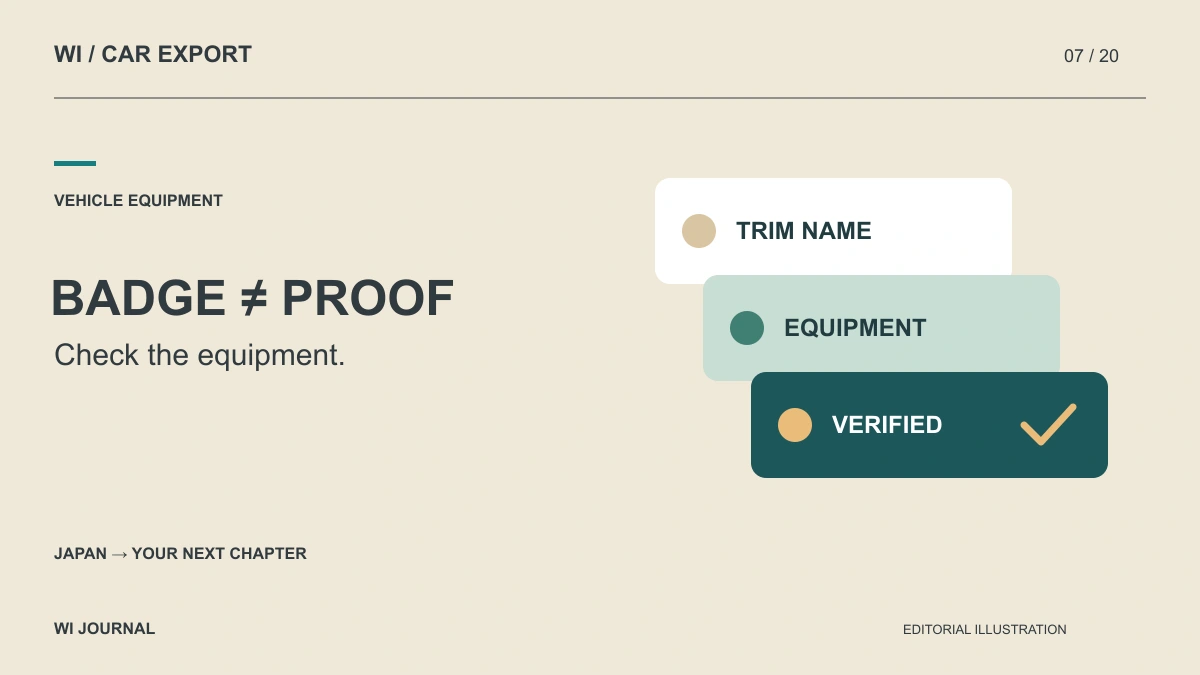
A badge or model code can suggest a Japanese used car's trim, but neither proves the equipment fitted to that individual vehicle. Verify important options through a chain of evidence: the vehicle's identifier, a reliable specification source for the relevant production context, and clear proof of the actual component or function.
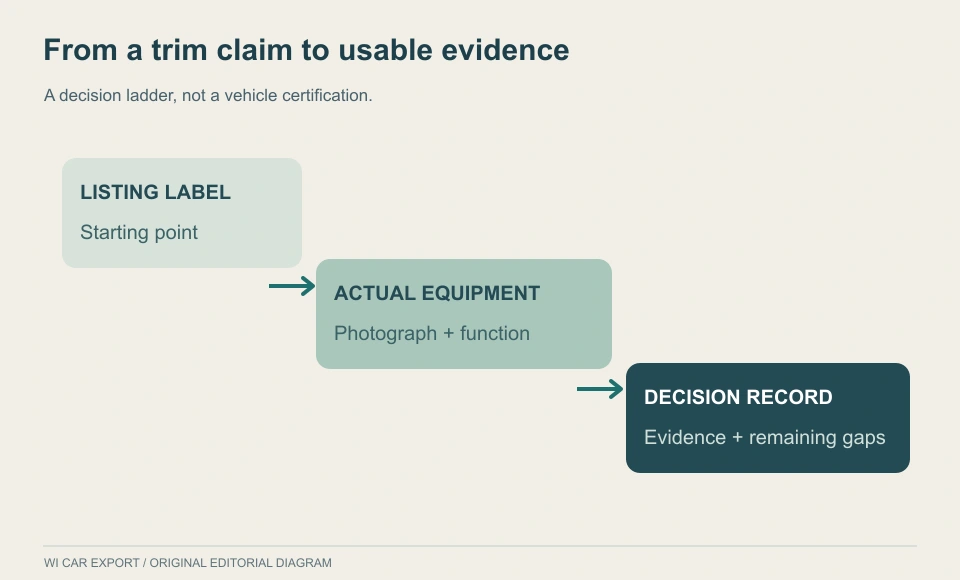
Start with the consequence, not the trim name
Ask what you actually need the trim label to answer. If your requirement is seven seats, a 360-degree camera or power sliding doors, verify that feature directly. A trim name is only a shortcut and may be mistranslated, abbreviated or applied differently across market and production period.
Create two lists:
- Must-have: absence would stop the purchase.
- Nice-to-have: affects preference or price but is not essential.
This keeps the request proportionate. It also prevents an attractive badge from distracting you from the feature that matters in daily use.
Use an evidence ladder
Evidence becomes more useful as it moves closer to the exact car.
- Sales text or badge photo: a claim or exterior clue; useful for forming questions.
- Model/type code and production context: narrows the possible configuration.
- Vehicle-specific document or build information: ties a specification record to the chassis or frame number where available.
- Clear component photographs: shows that the hardware or control is present.
- Operation evidence: shows the feature responding under the recorded conditions.
- Appropriate physical or diagnostic inspection: needed where presence alone cannot establish condition.
Toyota's certificate guide separates model/type from the individual frame number (Toyota certificate guide); use those fields to attach the option evidence to the correct car, not as proof of every fitted feature.
Build an option-proof matrix
Use a row for each must-have rather than one overall “trim verified” box:
| Required feature | Listing claim | Evidence requested | Evidence received | Decision |
|---|---|---|---|---|
| Seven seats | “7 seater” | Full second/third-row views; seat-belt positions | Pending | Open |
| 360-degree camera | Trim badge only | Camera lenses; display showing multi-view image | Pending | Open |
| Power sliding doors | “Power door” | Both switches; continuous operation clip | Left side only | Right side unverified |
| Adaptive cruise | Steering-wheel icon | Control close-up; instrument-menu view | Pending | Open |
These are fictional entries. The value lies in matching each claim to evidence capable of answering it. A dashboard button can show that a control exists, but a short clip may be required to show response. Even then, the clip is not a long-term reliability test.
Match proof to the feature
For seat count and layout, request wide cabin views with every seating row raised. Do not count headrests from a single angle.
For cameras and parking aids, request images of the camera locations or sensors plus the corresponding display while selected. A screen that shows a reversing image does not by itself establish a full surround-view system.
For power doors or tailgates, request the relevant controls and a continuous open-close clip for each claimed powered opening. One operating door does not verify the other.
For driver-assistance controls, document the buttons, instrument display and any available vehicle-specific specification evidence. Control presence does not establish calibration or safe operation.
For audio, navigation and connectivity, photograph the unit, menus and physical ports. Then check language, mapping, radio bands, subscriptions and device compatibility for your destination separately; the hardware's presence does not guarantee useful overseas service.
For wheels, body kits or branded accessories, capture markings and all four corners. Appearance alone cannot always distinguish factory equipment from a later replacement.
Handle contradictions without choosing the nicest answer
Suppose the listing calls a vehicle “Premium,” the rear badge appears to agree, but the cabin lacks the advertised powered-seat controls. Record three facts: the listing claim, the visible badge and the missing control evidence. Ask whether the badge, seat or listing description has changed, and request updated vehicle-specific proof.
Do not average conflicting evidence into “probably Premium.” A badge can be replaced, a photo can belong to another vehicle, equipment can be changed, or the trim description can be wrong. The cause remains unknown until supported.
The same caution applies to option packages. Two vehicles sharing a model code may have different optional equipment or later modifications. Verify the exact stock unit rather than transferring evidence from a brochure image or similar listing.
Record a decision that survives handoff
Save the stock reference, chassis/frame number, requested feature, evidence filename and conclusion in one worksheet. Use clear outcomes: verified present, verified absent, reported only, unclear, or not assessed. Date the evidence and retain the original files.
If a must-have remains unclear, either obtain better evidence, arrange a suitable inspection where available, or make the purchase decision on the basis that the feature is unverified. That is more reliable than using trim confidence as a substitute for option proof.
Ready to apply the matrix? Browse WI Car Export's fixed-price Japan stock, choose a vehicle reference and list the must-have equipment you want verified on that exact car.
Original WI Car Export editorial illustration, AI-assisted vector design. Not vehicle photography.