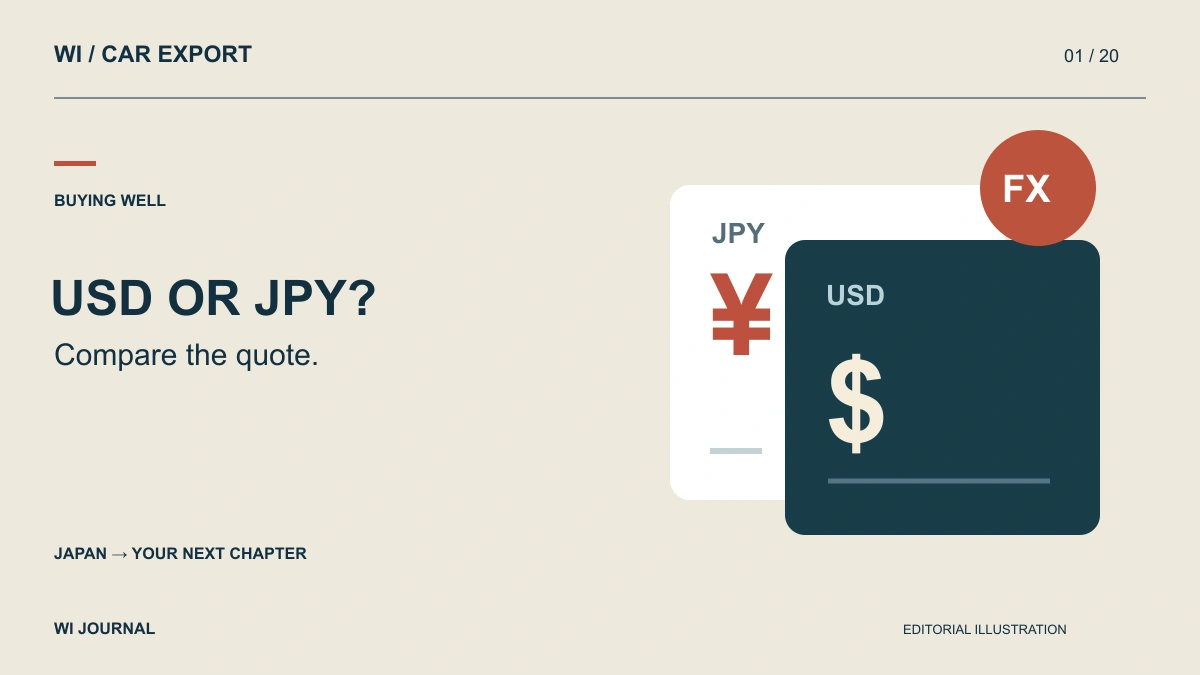
Compare USD and JPY Japanese car export quotes on equal terms, including scope, exchange rates, fees, timing and a transparent worked example.
A US-dollar quote is not automatically more expensive than a yen quote, and a yen quote is not automatically the better deal. The fair comparison is the amount you will actually need to send for the same vehicle, cost scope and payment date. Currency, included fees and exchange-rate timing must all be normalised before you compare the totals.
First make the quote scopes identical
Do not begin with the exchange rate. Begin by marking what each quote includes. One total may stop at the vehicle price, while another may include inland transport in Japan, export handling or ocean freight. Converting unequal scopes only produces a precise-looking but misleading answer.
Build a simple scope table. Ask each seller to confirm its vehicle and export charges in writing; ask your payment provider separately about executable exchange rates, sending fees and possible intermediary deductions:
| Cost line | JPY quote | USD quote |
|---|---|---|
| Vehicle | Included? | Included? |
| Japan-side transport and handling | Included? | Included? |
| Export documentation | Included? | Included? |
| Ocean freight | Included? | Included? |
| Bank or intermediary charges | Included? | Included? |
| Destination charges and taxes | Included? | Included? |
WI Car Export's buyer guide says its quotation identifies the vehicle and included export or local costs; the exact evidence and cost scope can vary by vehicle, so the issued quote remains the controlling document (WI Car Export buyer guide). Do not add a line to one quote merely because it often appears elsewhere. Ask whether it is included.
A worked USD-versus-JPY comparison
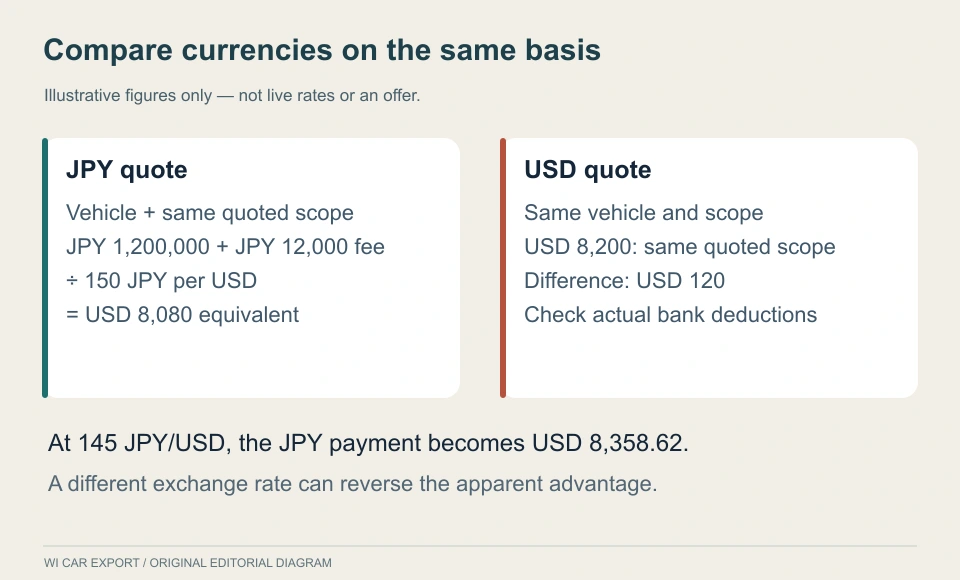
Consider two hypothetical, equal-scope offers for the same car:
- JPY offer: JPY 1,200,000 plus a JPY 12,000 transfer-related fee
- USD offer: USD 8,200
- Comparison rate: JPY 150 per USD
The yen amount to fund is JPY 1,212,000. With a rate quoted as JPY per USD, divide yen by the rate:
JPY 1,212,000 ÷ 150 = USD 8,080
On those illustrative inputs, the yen option costs USD 120 less than the USD 8,200 option. That is a calculation, not a live quote or an exchange-rate forecast. It also excludes any buyer-bank charge, intermediary-bank deduction or currency margin not already included in the assumed JPY 12,000 fee.
Now keep every assumption the same except the rate:
JPY 1,212,000 ÷ 145 = USD 8,358.62
At JPY 145 per USD, the same yen obligation costs about USD 158.62 more than the USD quote. A movement of five yen per dollar reverses the result. This is why a comparison should record both the rate and the time at which it was available.
Use the rate you can execute, not a headline rate
The most relevant rate is the one offered by the payment route you can actually use for the required amount. A rate shown in search results may be a reference rate rather than the amount a bank or transfer service will deliver after its margin and charges.
Ask your provider for an executable funding estimate, then record:
- the source currency and sending amount;
- the beneficiary currency and amount expected to arrive;
- the quoted exchange rate and expiry time;
- the sending, receiving and intermediary charges;
- who bears any shortfall.
Compare “source currency debited” for equal beneficiary amounts. If the exporter must receive exactly JPY 1,212,000, a transfer that may arrive short is not yet comparable with a fixed USD invoice.
Decide who carries the currency risk
A quote can be attractive today but leave its exchange rate open until payment. Record the currency in which the amount is fixed, the deadline for payment and what happens if the quote expires. Do not assume that a displayed USD equivalent fixes a yen invoice, or that an old pro forma invoice remains valid.
The lowest arithmetic total may not be the best operational choice. A buyer might reasonably accept a small difference for a fixed payable amount, a longer validity window or a payment route they can verify. That trade-off should be conscious rather than hidden inside a conversion.
Run a three-rate sensitivity check
Before choosing a yen obligation, calculate it at your executable rate and at two less favourable rates. For example, test JPY 150, 147 and 145 per USD. Add every known transfer cost to each scenario. The exercise does not predict the market; it shows how much room exists before the decision changes.
Keep the quotation, payment instructions and rate evidence together. Verify beneficiary details through the seller's established channel before sending funds. WI Car Export describes a bank-transfer process with manual receipt confirmation, but buyers should follow the current instructions issued for their own transaction (WI Car Export payment safety).
If you have a vehicle in mind, request an itemised quotation from WI Car Export and ask for the payable currency, validity period and included cost scope in the same message.
Original WI Car Export editorial illustration, AI-assisted vector design. Not vehicle photography.