Confirm spare keys, cables, tools and accessories with a vehicle-specific inventory covering evidence, sale inclusion, custody and carrier acceptance.
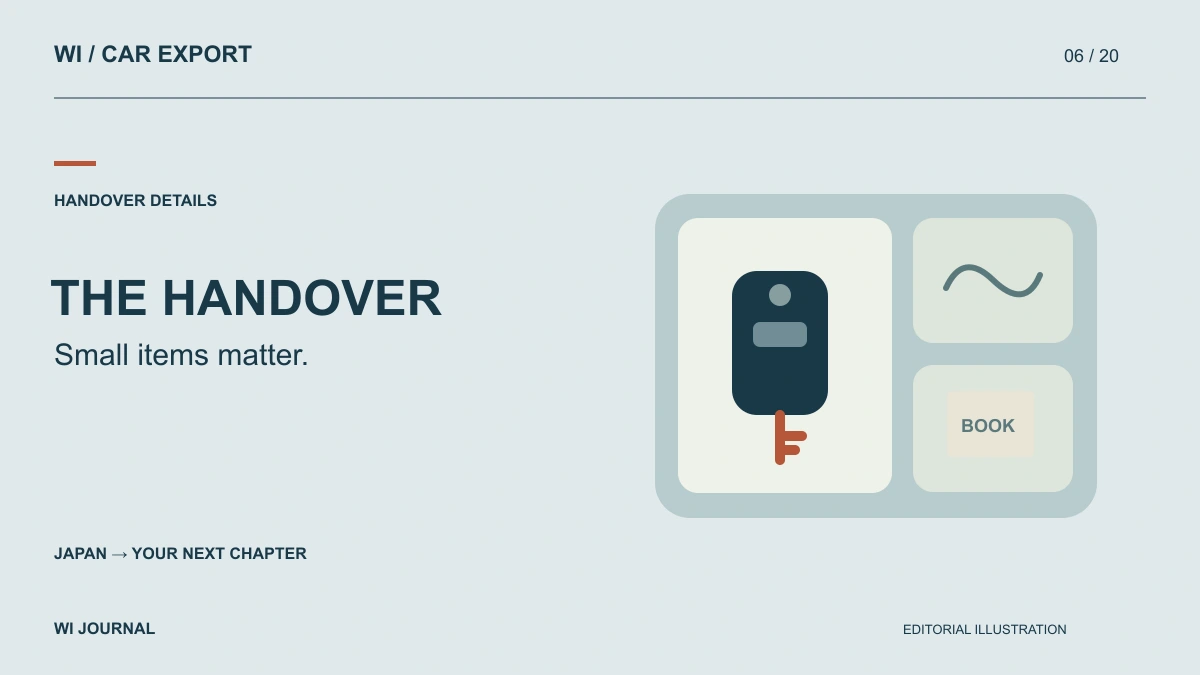
A photographed spare key or accessory is not automatically included in a Japanese used-car shipment. Before payment, create a vehicle-specific inventory that records what exists, what is included in the sale, where it will travel and whether the booked carrier accepts it. This small check can prevent assumptions about keys, charging cables, tools or removable equipment.
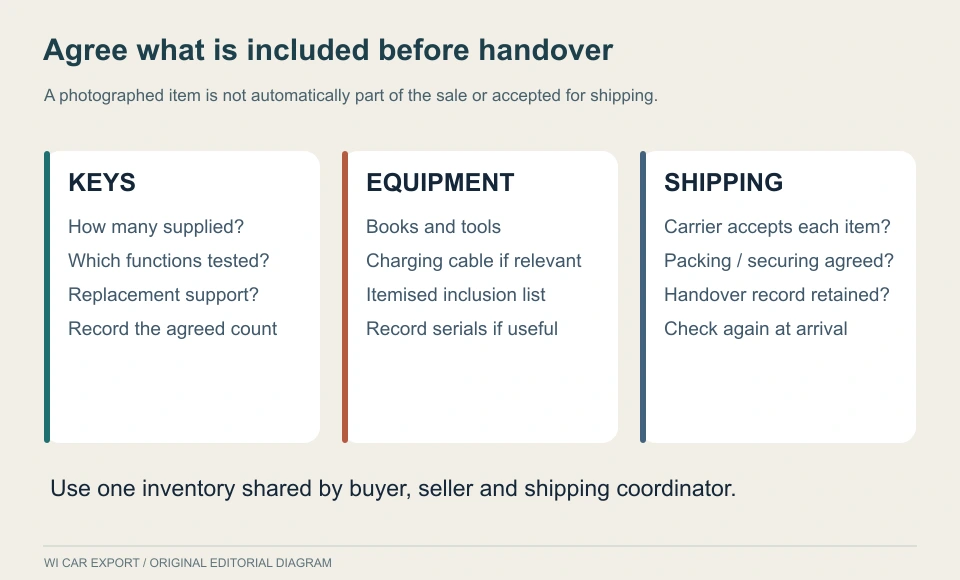
“Shown,” “included” and “accepted” are different
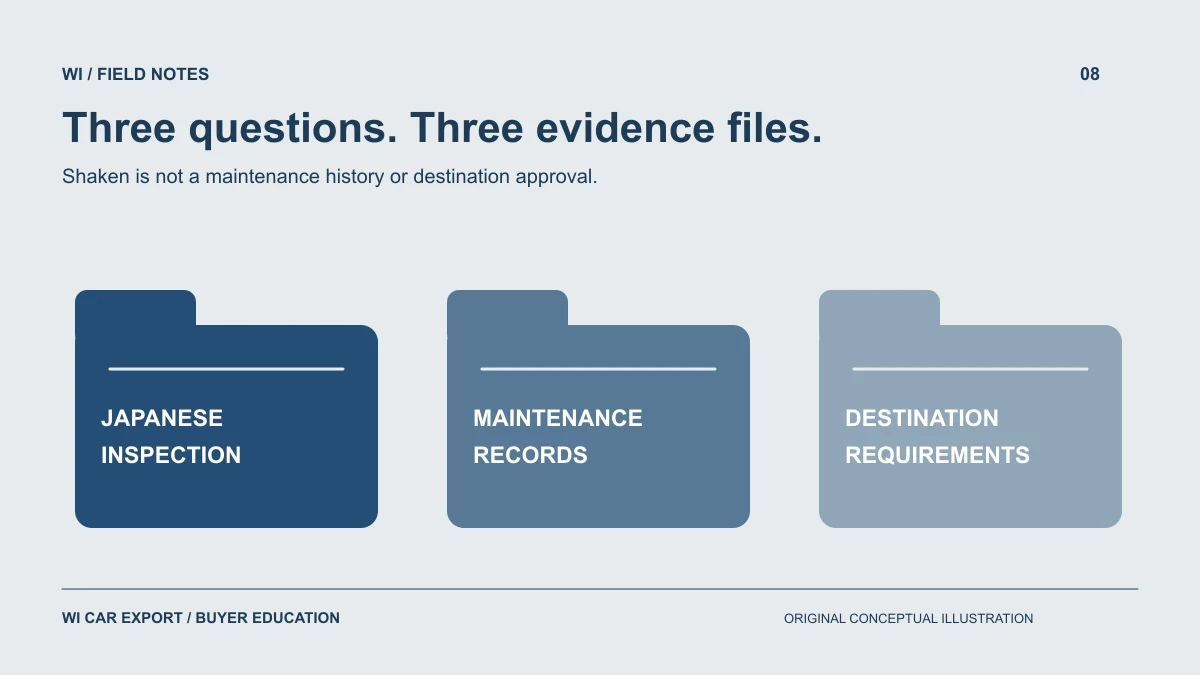
Treat every item as passing three separate tests:
- Existence: the item is shown or otherwise evidenced for the exact vehicle.
- Sale inclusion: the seller confirms it forms part of the agreed vehicle package.
- Transport acceptance: the carrier or packing method permits it to travel in the stated place.
Passing one test does not pass the others. A loose cable may appear in a cargo-area photo but be excluded from the sale. An included accessory may need separate packing. A seller's willingness to place an item in the car does not override the actual carrier's rules.
Carrier guidance can restrict personal effects and govern loose equipment in used vehicles, so the rule must be reconfirmed for the selected booking rather than inferred from another shipment (Wallenius Wilhelmsen used-unit shipping guidelines).
Build an accessory and key inventory
Use one row per item and avoid bundles such as “all accessories.”
| Item | Quantity evidenced | Included in sale? | Identifier/condition | Travel location | Carrier confirmed? |
|---|---|---|---|---|---|
| Main remote key | 1 | To confirm | Buttons shown | With vehicle/other | Pending |
| Spare key | 1 | To confirm | Mechanical or remote? | Pending | Pending |
| Owner's manuals | 1 set | To confirm | Language/volumes | Pending | Pending |
| Cargo cover | 1 | To confirm | Full photo requested | Installed | Pending |
| Charging cable | 1 claimed | To confirm | Plug ends and label | Pending | Pending |
The table is a framework, not a claim about any stock vehicle. Adapt it to the car: wheel-lock key, jack, tool kit, puncture-repair kit, removable head unit, floor mats, parcel shelf, tow-eye, third-row headrests or other equipment may matter to different buyers.
For every high-value or hard-to-replace item, request a clear image and note its visible condition. For a cable, photograph both connector ends and its label. For a wheel-lock key, show it beside the matching fastener. For remote keys, record quantity and visible button layout without assuming every function operates.
Give spare keys their own check
Ask how many keys will be handed over, then separate remote keys, smart keys and simple mechanical keys in the inventory. A photo of two key shells does not prove that both start the car or operate every remote function. If functionality matters, ask what can be demonstrated for that vehicle.
Missing key-number information can make replacement less straightforward. Toyota's Japanese support guidance tells owners whose key-number plate is missing to consult a dealer with the vehicle (Toyota key FAQ). That Toyota-specific advice is not a promise that an overseas dealer can supply or program a key for every Japanese-market vehicle. Before buying, ask a suitable local specialist what identification, vehicle presence and parts availability would be required.
A worked custody check
Suppose an electric vehicle listing shows two key fobs and a charging cable in the luggage area. Your decision sheet could read:
- Seller supplied one continuous video linking both keys and the cable to the stock reference.
- Seller confirmed in writing that two keys and the pictured cable are included.
- Cable labels and both ends were photographed; compatibility remains for the buyer to verify locally.
- Carrier acceptance and stowage instructions remain pending.
At this point, the items are evidenced and agreed, but the shipment plan is incomplete. Only after the carrier or forwarding arrangement confirms whether and how those items may travel should the location column be finalised. If separate packing is required, record the package reference and recipient rather than assuming it will remain with the car.
Reconcile at each handoff
Freeze the agreed inventory before shipment. Give it a version date and attach the supporting images. Ask for confirmation after any movement or repacking that changes custody. At destination, check the inventory before leaving the collection point where local procedure allows.
Carrier collection requirements, release documents, local charges and payment methods should be checked with the destination office before collection; Wallenius Wilhelmsen gives that advice for its private-vehicle shipments (carrier private-vehicle guide). Your actual carrier and destination instructions control.
Do not place passports, cash, personal documents or unlisted personal goods in the vehicle. Keep transaction originals and sensitive material in an appropriate separate channel.
For a car you are considering, send WI Car Export the stock reference and your key/accessory checklist. Ask for written inclusion and available evidence before arranging transport around any item.
Original WI Car Export editorial illustration, AI-assisted vector design. Not vehicle photography.