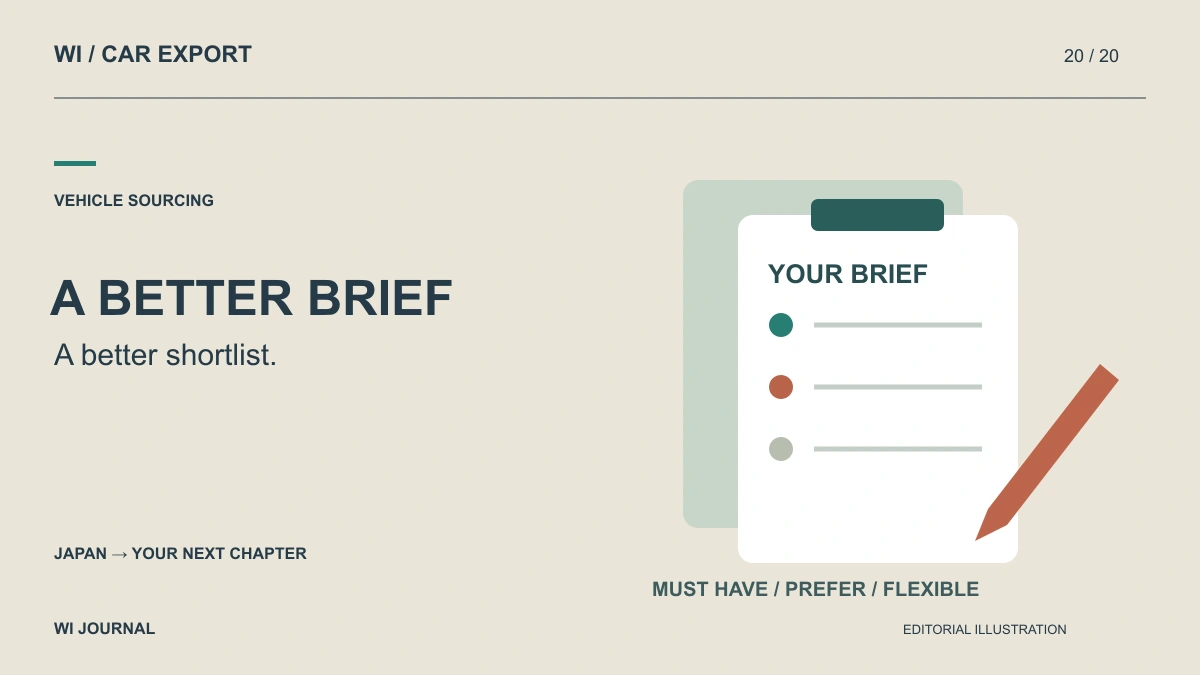
Separate must-haves, preferences and approved substitutes so your Japanese car search stays disciplined when a vehicle is unavailable.
A good sourcing brief does more than name a make, model and budget. It separates non-negotiable requirements from preferences, defines acceptable substitutes and tells the exporter what to do when the selected fixed-price car is unavailable. The result is a faster, safer decision without pretending that a saved listing is reserved.
Start with the job the car must do
Write two sentences about use before listing specifications. Include destination country, typical passengers or load, road and weather conditions, annual use, parking constraints and any feature that solves a genuine need. Then record the destination checks you—not the exporter—must obtain, such as import eligibility, registration, insurance and local service support.
This prevents a feature wish list from hiding the decision. “Seven seats” might be essential for one household, while another needs five seats and luggage room. “Four-wheel drive” may be a preference, but tyre availability and local driving requirements still need separate confirmation.
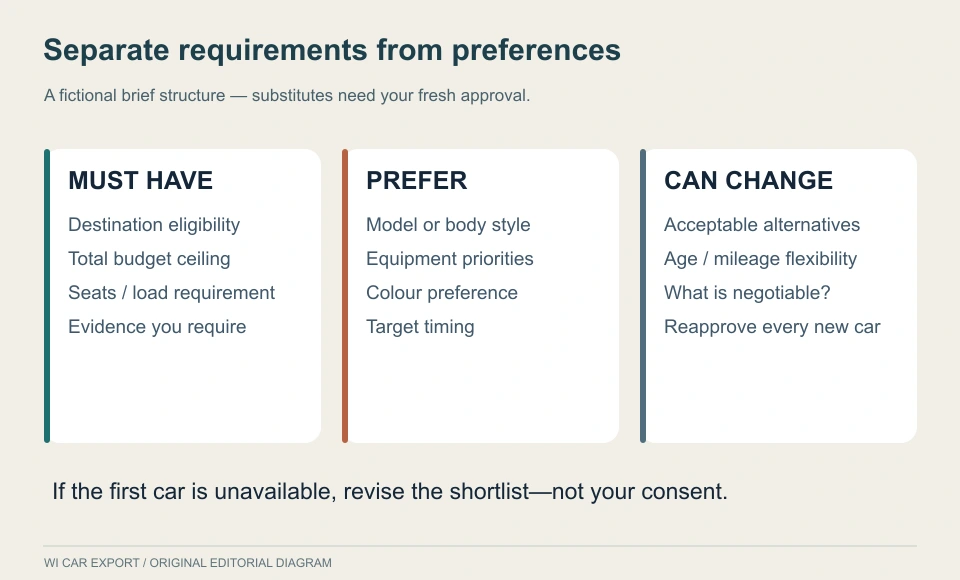
Divide the brief into four lists
Must-haves
These are pass/fail requirements. Keep the list short and testable: maximum overall dimensions, minimum seating, fuel or propulsion type, transmission, drive layout, specific safety equipment, destination age rule confirmed by the buyer, or a hard total budget ceiling defined by included and excluded costs.
Write how each requirement will be evidenced. “Low mileage” is vague; “odometer at or below the threshold stated in the brief, with the reading shown in current listing evidence” is testable. “No accident history” is also too broad unless you define the records and inspection evidence you require.
Ranked preferences
Preferences improve the choice but may be traded. Rank them: colour, wheel design, upholstery, sunroof, model year within an eligible range, mileage below a softer target, or a particular infotainment feature. A numbered ranking tells the exporter whether better condition should outrank colour or vice versa.
Approved substitutes
Pre-approve substitute search criteria, not the purchase of an unseen replacement. These could include a second colour, two adjacent grades, a slightly higher odometer limit, or another model that satisfies the same use case. State which combinations are allowed; do not let ten individually acceptable compromises accumulate into a car you would not have chosen. Every actual replacement vehicle still needs your fresh approval of its identity, evidence and quotation.
Stop conditions
Tell the exporter when not to proceed. Examples include missing identity evidence, a must-have not demonstrated, significant undeclared modifications, an unsupported infotainment or charging requirement, unresolved destination eligibility, or a total estimate above your ceiling.
Define budget and evidence precisely
State the budget’s currency and date, whether it covers only the vehicle or a broader landed estimate, and which destination costs remain outside it. Ask the quotation to identify inclusions and exclusions rather than applying a remembered percentage.
List the minimum evidence needed: stock reference, available model and frame details, current images, odometer evidence, equipment demonstrations, disclosed condition information and targeted checks. Historical records vary, so require missing items to be marked unavailable rather than assumed.
Decide what happens when the car is unavailable
A fixed-price car should not be treated as available simply because its listing opens. Your brief should authorise one of three responses:
- Hold the requirements: return only other available cars that meet every must-have.
- Use named substitutes: apply the exact substitute rules already approved, while flagging each difference.
- Pause and ask: if no compliant option exists, stop and request a revised brief.
Do not write “reserve the next similar car automatically”. Availability and any next transaction step must be confirmed for the specific vehicle. A buyer should review the identified car, current quotation and evidence rather than allowing the brief to become open-ended purchasing authority.
Fictional example: a family crossover brief
This example is fictional and the figures are not market prices or import rules.
Use: family of five, regular luggage, paved urban and rural roads, destination workshop support to be confirmed before purchase.
Must-haves: five usable seats with the appropriate seatbelts; automatic transmission; overall length below 4.60 metres; petrol or non-plug-in hybrid; vehicle and shipping components of the quotation no more than a fictional USD 18,000 ceiling; exact model code supplied for local parts checks.
Preferences, in order: strongest condition evidence; odometer at or below 70,000 kilometres; rear camera demonstrated; dark interior; silver, blue or white paint.
Approved substitutes: either of two grades named in the brief; odometer up to 85,000 kilometres only if condition evidence is stronger; no substitution on size or seating.
Stop: unresolved destination eligibility, material modification, an unexplained warning light remaining after the normal start-up self-check, or unavailable exact-variant workshop support.
If unavailable: show up to three currently available fixed-price alternatives and explain every deviation; otherwise pause.
The value of the example is its logic, not its vehicle category. Every preference has a rank, every must-have has a test, and the unavailable-car instruction cannot silently lower a critical requirement.
Send one version-controlled brief
Date and version the document. Replace the whole brief when a requirement changes; scattered chat messages create ambiguity. Ask the exporter to restate the must-haves and substitutions, then assess only the available vehicle presented.
Contact WI Car Export with your destination, fixed-price stock link if you have one, and completed sourcing brief. The team can respond against the specific vehicle and available evidence; no listing should be treated as reserved until availability and the next step are confirmed.
Original WI Car Export editorial illustration, AI-assisted vector design. Not vehicle photography.