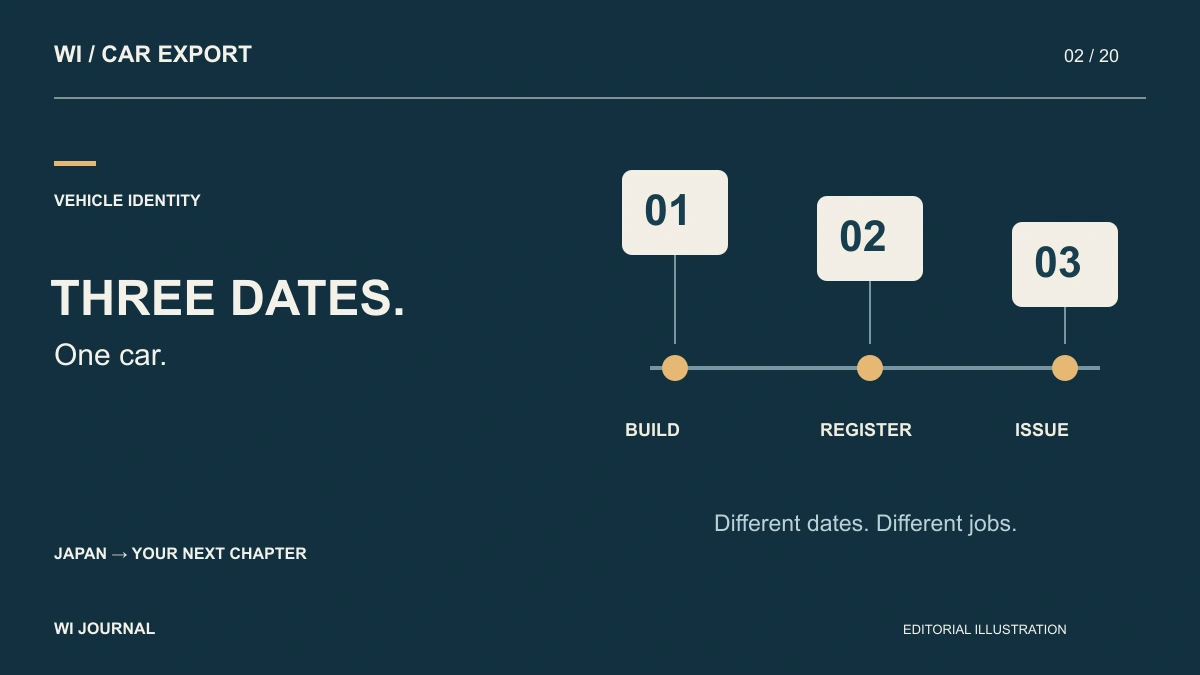
Manufacture year, first registration and certificate issue date answer different questions. Label each date by its source field before relying on it.
When a Japanese vehicle listing, export certificate and seller's message show different dates, they may not conflict. "Manufacture year," "first registration" and "document issue date" answer different questions. A careful buyer labels each date by its source and purpose instead of compressing them into one vague "year."
Last updated: 13 September 2026.
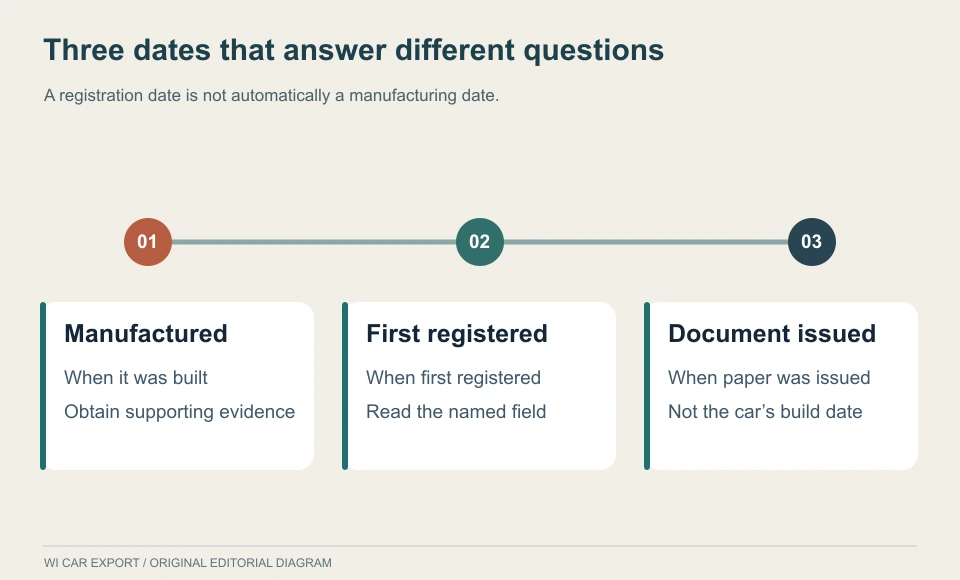
What does each of the three dates describe?
Manufacture year describes when the vehicle was produced, first registration when it was initially registered in Japan, and the issue date when that certificate was issued. Different documents may translate or abbreviate these labels differently, so work from the actual field label and image.
| Date field | What it answers | What it does not answer |
|---|---|---|
| Manufacture year | When the vehicle was produced | Not inferable from a year printed elsewhere |
| First-registration month/year | Year and month of initial registration | Does not supply a day-level date |
| Document issue date | When that certificate was issued | Not construction, not necessarily first use |
The evidence for a manufacture year may come from maker data or another vehicle-specific source, depending on the car. Toyota's guide treats the first-registration field and the certificate's issue date as separate fields, a distinction buyers need to preserve (Toyota certificate guide). A later issue date can therefore be perfectly consistent with an older first-registration date, and neither one dates the vehicle's construction. Work from the actual field label and the supporting image, not from the position of a date on a sales listing.
How do you build a date-field worksheet?
Record each question, the answer you found, the evidence behind it and its status in a single table. When a listing says "2020" and a certificate shows first registration in March 2021 and an issue date of July 2026, do not pick a winner.
| Question | Recorded answer | Evidence | Status |
|---|---|---|---|
| When was it manufactured? | 2020 claimed | Listing only | Ask for vehicle-specific support |
| When was it first registered? | March 2021 | Certificate field | Transcribe exact label and value |
| When was this document issued? | July 2026 | Certificate issue field | Not a manufacture date |
This example is fictional, but the method is reusable. It separates a sales claim from a document field and turns an apparent one-year discrepancy into a precise follow-up question. If a destination authority asks for a particular date, do not substitute another because it appears more favourable. Ask that authority, a licensed clearing agent or another qualified local specialist which source document and field it accepts. This article explains Japanese source records; it does not determine a destination country's age calculation or eligibility rule.
Why do the date differences matter before payment?
These dates influence different buying decisions, and ambiguity becomes expensive when each party gives "year" a different meaning. Manufacture timing may distinguish production changes; first registration may be the reference a buyer, insurer or destination process requests; the issue date only shows how current the copy is.
A quotation that simply says "year 2020" invites each party to fill the gap silently. Put the full label in messages: "manufacture year," "first registration month/year," or "certificate issue date." Include the value and a marked image where possible. The three dates should also be checked against the vehicle identifiers on the same evidence, because a clear date on a document for a different chassis resolves nothing. Match the frame or chassis number shown in the listing, certificate and any translated extract before relying on the date.
What are the five verification steps?
Capture the listing claim, request the source image, transcribe without interpretation, reconcile rather than overwrite, then confirm destination use locally. Keep all three date categories in your worksheet even when one is unknown: "not verified yet" is a useful status, better than a guess.
- Capture the listing claim. Save the exact wording and page reference rather than rewriting it as your preferred date type.
- Request the source image. Ask for a legible view that includes the field label, value and vehicle identifier.
- Transcribe without interpretation. Record the original label and any supplied translation separately.
- Reconcile, do not overwrite. Keep all three date categories in your worksheet, even when one is unknown.
- Confirm destination use locally. State which exact field you plan to rely on and ask the relevant destination professional whether it is acceptable.
A seller may not have manufacture evidence beyond the information available for a particular vehicle. Recording that gap honestly is better than filling it with a guess based on first registration.
Which questions produce clearer date answers?
Instead of asking "what year is the car?", send three separate questions about manufacture, first registration and document issue. Also ask whether the translated description is a full translation, a partial extract or sales copy, so a convenient summary is not mistaken for an official field.
- What is the stated manufacture year, and what vehicle-specific evidence supports it?
- What month and year are shown in the first-registration field?
- What is the issue date of the document being supplied?
- Is the description a full translation, a partial extract or sales copy?
When evaluating a vehicle, contact WI Car Export with the stock reference and request the available date fields and their supporting document images before making a destination-eligibility decision.
Original WI Car Export editorial illustration, AI-assisted vector design. Not vehicle photography.