Build a modification dossier, arrange the right inspection and confirm destination approval before importing a modified Japanese car.
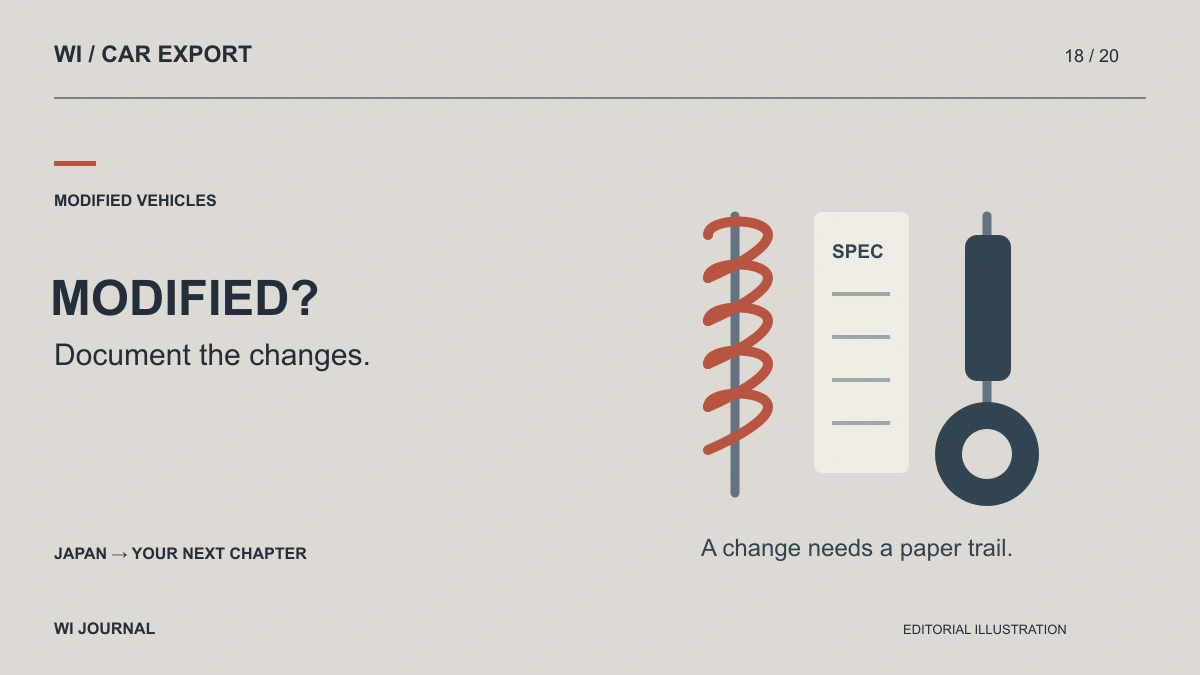
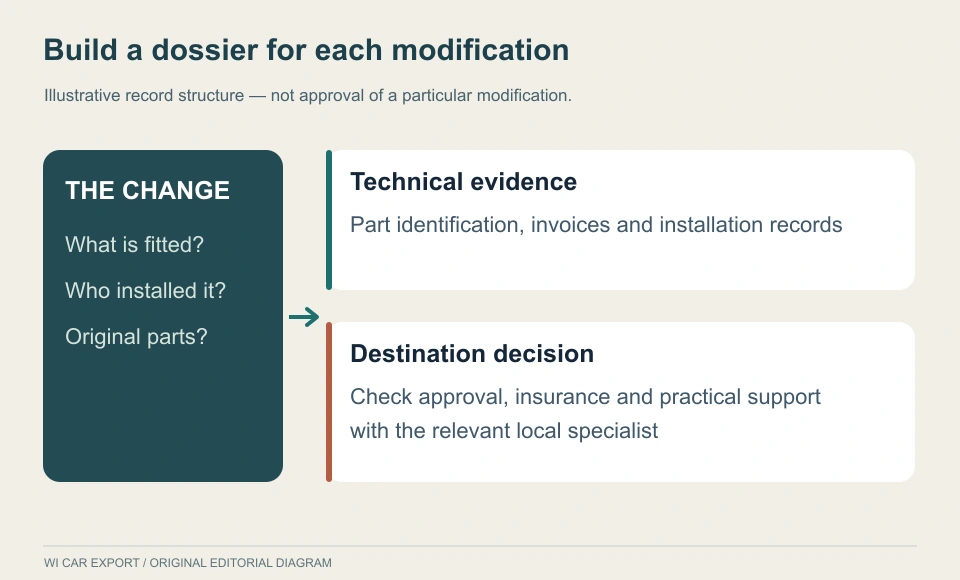
A modified car should be bought as a documented configuration, not as a standard model with an exciting parts list. Before importing, identify every change you can, connect it to invoices and specifications, arrange an appropriate inspection, and ask a destination approval specialist how that exact configuration will be treated. This is a documentation method, not legal advice or a verdict on any vehicle.
Establish the unmodified baseline
Record the car’s model/type code, frame number, engine or propulsion system, transmission, drive type and original grade. Then compare clear photographs against reliable manufacturer information for that production period. The purpose is not to prove that every unlisted bolt is original; it is to create a baseline from which visible and declared changes can be logged.
Request wide and close images of the exterior, engine bay, suspension/wheels, cabin, underbody and luggage area. Photograph warning lamps during start-up and the identification marks on major aftermarket components. A generic description such as “sports suspension” is less useful than the maker, part reference, visible condition and installation record.
Classify modifications by consequence
Organise the inventory into four groups:
- Fitment and wear: wheels, tyres, suspension, brakes and spacers. Record sizes, clearances, alignment evidence and condition.
- Powertrain and emissions: intake, exhaust, engine management, turbo/supercharger changes, cooling and fuel components. Record part numbers, maps or controller details and supporting measurements where available.
- Structure and safety: seats, belts, steering wheel, roll protection, lighting, glazing and any welded or cut bodywork. These deserve especially careful inspection and destination advice.
- Electrical and integrated systems: alarms, audio, cameras, gauges, battery changes and wiring additions. Ask how they interact with factory diagnostics and safety systems.
“Reversible” is not the same as “acceptable”. Reverting a change may need original parts, labour, calibration and evidence. If those items are missing, include that gap in the decision rather than assuming a simple return to stock.
Match each claim to evidence
Build a dossier with one row per modification:
| Record | Useful evidence | What remains unresolved |
|---|---|---|
| Component identity | Part label, model number, receipt or manufacturer sheet | Whether the part is genuine and correct for this car |
| Installation | Dated workshop invoice and photographs | Work hidden from view or later alterations |
| Setup | Alignment sheet, controller/map details or calibration record | Whether the current settings match the record |
| Condition | Independent inspection findings and current images | Future life or hidden internal wear |
| Destination treatment | Written advice from the relevant local authority or specialist | Final decision until the official process is completed |
Absence of paperwork is itself information. It does not automatically prove poor work, but it increases the amount a buyer must verify and may limit a specialist’s ability to assess the configuration remotely.
Arrange a thorough inspection by someone competent for the type of modification. The inspection request should identify the changes already found and ask the inspector to look for undeclared changes, interference, leaks, rubbing, damaged mounts, warning indicators and unsafe wiring. Keep the inspection’s scope explicit; no visual check can establish every internal condition.
Separate roadworthiness, registration and approval
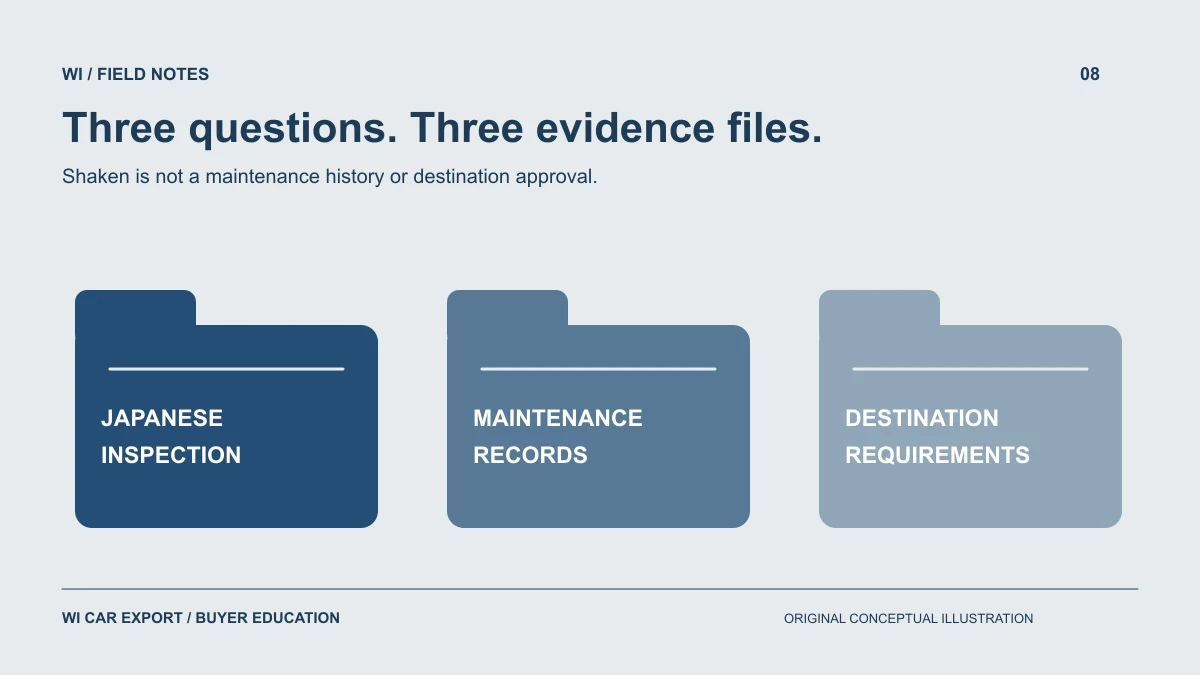
Ask a qualified destination professional three different questions:
- Can this vehicle be imported and registered in its present configuration?
- What approval, testing, declarations or evidence apply to these specific changes?
- What must be restored, altered or documented before the car can be used legally and safely?
Do this before purchase. Rules vary by country, vehicle category, age and modification, and a positive answer in one jurisdiction cannot be exported to another.
The United Kingdom provides a useful UK-only example of why documentation matters. GOV.UK says vehicle approval can apply to imported or radically altered vehicles, while exemptions and approval routes depend on the circumstances (GOV.UK vehicle approval overview). Its imported-vehicle registration guidance also lists form V627/3 when a vehicle has been structurally modified beyond the manufacturer’s specification (GOV.UK importing-vehicle guidance). Those pages do not determine the outcome for a particular car, and they say nothing about other countries; UK buyers should confirm the current route with the relevant UK authority or a qualified approval specialist.
GOV.UK also distinguishes Individual Vehicle Approval from the annual MOT: its IVA guidance says IVA examines how a vehicle is constructed or adapted, whereas an MOT addresses roadworthiness. Passing an MOT does not mean the car will pass IVA (DVSA IVA guidance). This distinction matters when sellers use “roadworthy” as if it settled approval.
Price the uncertainty, not just the parts
Before deciding, list the documents still missing, specialist inspections required, original parts needed, destination work, transport and time without the car. Obtain real quotations where possible rather than using a generic modification allowance. If approval or safe support depends on an answer nobody will give in writing, treat that as a stop condition.
The strongest modified-car purchase is not necessarily the most dramatic. It is the one whose present configuration can be identified, inspected, supported and accepted at the destination with evidence proportionate to the risk.
Contact WI Car Export with the stock link and your modification-evidence checklist to ask what records and detailed photographs are available for the car.
Original WI Car Export editorial illustration, AI-assisted vector design. Not vehicle photography.