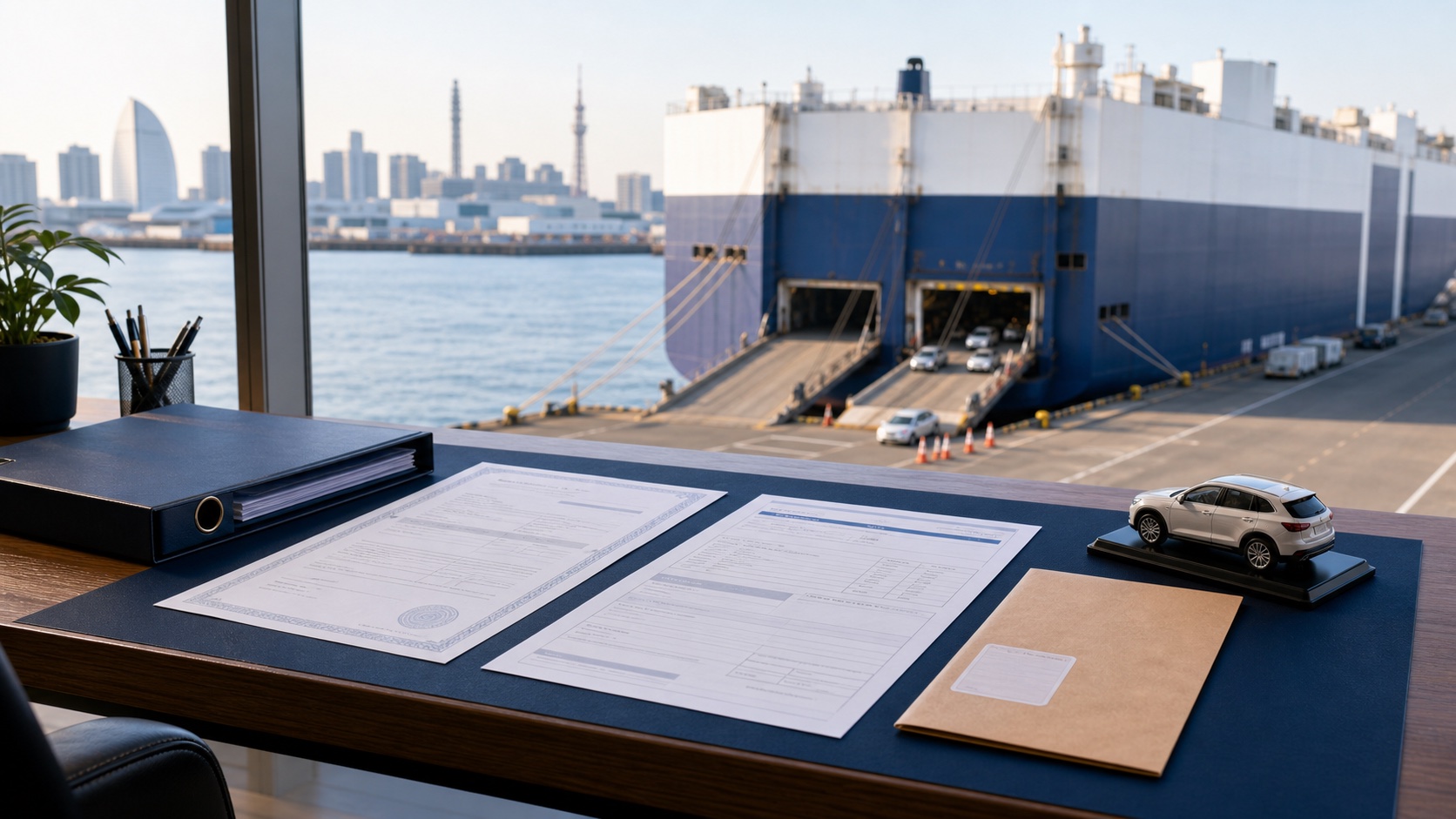
The documents needed to import a car from Japan normally include a commercial invoice, Japan export certificate, bill of lading and any destination-required inspection certificate. The exact clearance pack depends on your country, so confirm local rules before paying and make every name and chassis number match.
Last updated: 7 August 2026
Browse live Japanese stock with vehicle details and FOB prices
What are the four core documents for a Japanese car import?
The names vary slightly by country and shipping line, but four documents form the core export file for most used vehicles shipped from Japan.
| Document | What it proves | When you use it |
|---|---|---|
| Commercial invoice | The buyer, seller, vehicle and agreed value | Payment, customs valuation and clearance |
| Export certificate | The vehicle has been deregistered for export in Japan | Destination registration and customs checks |
| Bill of lading | The carrier received the vehicle for the stated voyage and consignee | Cargo release and port clearance |
| Inspection certificate | The vehicle passed the inspection required by the destination | Import compliance; only required for applicable markets |
Japan Customs states that a registered vehicle intended for export requires a Certificate of Registration Deletion, while a vehicle already deregistered requires a Certificate of Notice of Planned Export. These certificates are valid for six months. Your exporter manages the Japanese-side procedure, but the buyer should still check the chassis number and owner details on the copy.
What information must match across every document?
A small mismatch can delay clearance. Compare the following fields as soon as each document arrives:
- Buyer or consignee name, spelled exactly as required by local customs
- Vehicle make, model and chassis or frame number
- Engine size, manufacture year and first-registration date where shown
- Destination country and discharge port
- Invoice value, currency and agreed Incoterm such as FOB or C&F
- Vessel name and voyage number on the bill of lading
Which documents may your destination add?
Destination rules decide the rest of the file. Depending on the country and vehicle, you may need an import permit, certificate of roadworthiness, conformity certificate, odometer certificate, radiation check, biosecurity or cleaning certificate, proof of insurance, tax identification, customs declaration or local valuation report.
Do not assume that a document accepted in one country works in another. The inspection provider may also need to be specifically appointed by the destination authority. Our guide to pre-shipment inspections explains this distinction.
Which document proves the price for customs?
The commercial invoice is the starting document for customs valuation, but it may not be the only evidence requested. A customs authority can ask for the purchase agreement, proof of payment, freight invoice, insurance cost or an independent valuation. Do not ask an exporter to understate the price: a false invoice can create penalties, seizure risk and registration problems.
The Incoterm matters because it shows which costs sit inside the invoice. FOB normally ends at loading in Japan, while C&F includes freight to the named destination port. CIF also includes the seller-arranged marine insurance described by the agreement. Destination duty, tax, port handling and local clearance are normally separate unless the quotation explicitly says otherwise. See our FOB, C&F and CIF guide before comparing offers.
Do you need an English translation of the export certificate?
Many destination authorities and clearing agents ask for an English translation because the original Japanese export certificate is in Japanese. Ask whether the translation must be certified, exporter-issued or produced by an approved translator. Keep the original and translation together; the translation does not replace the source document.
When will you receive the bill of lading?
The bill of lading is normally issued after the vehicle is loaded and the vessel departs. Exporters often send a draft first so the buyer can check the consignee, chassis number and port. Correct the draft immediately. Changes after issue can require carrier approval, amendment fees and extra time.
Should you accept documents by email?
Email copies are useful for checking and may allow a broker to prepare an entry. Whether originals are required for cargo release depends on the bill-of-lading arrangement and local practice. Ask whether the shipment uses an original bill, telex release or sea waybill, then follow the carrier and clearing agent’s instructions.
What is the safest document workflow?
- Confirm eligibility first. Check age, steering side, emissions and inspection rules for the destination.
- Approve an itemised quotation. Know what the vehicle price and export charges include before transferring funds.
- Verify the invoice. Match the legal payee and bank details through a trusted channel.
- Review every draft. Check names, chassis number, port and vehicle details before documents are final.
- Send copies to your broker early. Let the broker identify missing items before arrival.
- Keep one digital folder. Store the quotation, payment evidence, invoice, certificates, shipping updates and clearance receipts.
Frequently asked questions
Can I clear a Japanese car without the original export certificate?
Requirements vary. Some authorities accept verified electronic records or certified replacements; others require the original certificate and translation. Ask your clearing agent before arrival. If a document is lost, tell the exporter immediately so a replacement process can begin.
Is an auction sheet an import document?
No. An auction sheet helps assess condition and history, but it does not replace the commercial invoice, export certificate, bill of lading or a government-required inspection certificate.
Who prepares the export documents in Japan?
The exporter and its shipping or customs agents normally prepare the Japanese-side invoice, deregistration/export documents and shipping instructions. The buyer supplies accurate consignee details and completes destination-country permits and clearance requirements.
Can the consignee name be changed after shipping?
Sometimes, but carrier approval, supporting documents, fees and destination restrictions may apply. Correct the draft bill of lading before issue whenever possible.
How long should I keep vehicle import documents?
Keep the complete file for as long as you own the vehicle and for any longer period required by local tax or customs law. The documents can be needed for registration, resale, insurance or an audit.
Sources and next step
- Japan Customs: procedures for exporting used vehicles
- Japan Customs: vehicle export clearance
- WI Car Export buyer guide
Ready to choose a compliant vehicle?
Browse current fixed-price stock, then request an itemised destination quote. We will confirm the vehicle details, shipping route and applicable export documents before you order.
Search live Japan stock