Buying a Japanese used car? Learn which underbody photos, repair records and professional inspection findings to request before deciding about rust.
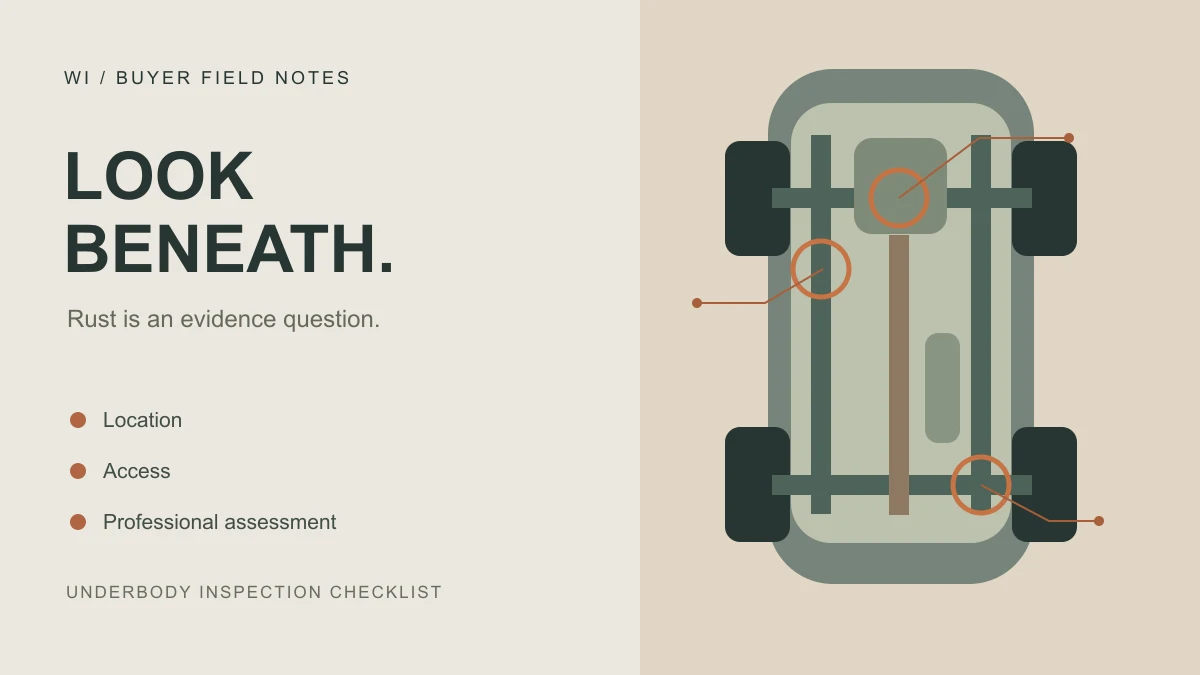
Rust on a used Japanese car cannot be judged safely from colour or a few listing photographs. The important questions are where corrosion is located, what the affected part does, how extensive the damage is and what an independent inspection can establish. Request specific evidence, then let a qualified inspector assess the vehicle against the requirements where it will be used.
This is a document-and-inspection request guide, not a method for certifying structural safety remotely. WI Car Export is a vehicle seller; this article does not represent an inspection of any car in stock.
Why “a little rust” is not a useful verdict
A small affected area can matter if it is in a critical structural location. A larger area on a non-structural panel may have different implications. Great Britain’s DVSA inspection guidance makes the relationship between corrosion, component function and structural significance explicit. Its MOT rules apply in that jurisdiction, not automatically in your destination country. Source: DVSA structural integrity and corrosion guidance.
The practical buying lesson is to replace “looks rusty” with a location-specific question. You are not trying to diagnose the damage yourself. You are trying to make sure the person who can assess it has access to the right areas and provides a usable record.
Low mileage, a clean cabin or a Japanese registration location does not, by itself, document underbody condition. Those details cannot replace an examination of the actual vehicle.
Build an underbody evidence sheet
Use one row per area identified in the inspection. Keep observed facts separate from an assessor’s interpretation and from anything that remains hidden.
| Field | What a useful entry contains | What to avoid |
|---|---|---|
| Location | A named part and its position on the vehicle, linked to an overview image | An unexplained close-up with no orientation |
| Visible observation | What the photograph or inspector actually shows | Calling colour alone “safe” or “structural” |
| Access and coverage | Areas examined, obstructions and areas not assessed | Assuming everything beneath a cover was inspected |
| Professional assessment | The inspector’s findings, method and stated limitations | An unqualified seller reassurance used as a safety verdict |
| Next action | Additional inspection, documented repair assessment or a purchase decision | Treating an unanswered question as a pass |
Ask for wide views that locate each close-up, clear lighting and coverage of the areas the professional considers relevant. Our remote photo and video evidence guide explains how to connect images to one identifiable vehicle.
An inspection needs suitable access and equipment. Do not crawl beneath a car supported only by a jack or try to test corrosion by scraping or striking components yourself. Ask a qualified professional to determine the appropriate examination.
What if the underside has fresh coating?
Fresh underbody coating is a reason to ask about the work, not proof that the car is sound and not proof of dishonesty. Request the date, purpose, invoice and any available photographs taken before application. Ask the inspector whether the coating limits what can be established.
A useful reply might identify a documented treatment and disclose areas that cannot be assessed without further work. “Recently protected” on its own does not answer what was underneath. Equally, the absence of older photographs does not establish concealed damage; it leaves an evidence gap to weigh.
If repairs are recorded, connect them to the car and the affected areas. Use the service-history checklist to organize dated paperwork rather than relying on a general “well maintained” claim.
Proceed, hold or decline: a purchasing framework
Proceed to the next buying step only when a qualified assessment addresses the relevant areas, its limitations are understood and any proposed work has been evaluated for your destination. That is a decision to continue due diligence, not this article declaring the car roadworthy.
Hold when important areas remain unseen, images cannot be linked to the vehicle, repairs are unexplained or your inspector needs further access. Name the evidence needed to resolve the hold; repeating the same overview photograph is not progress.
Decline if required evidence cannot be obtained or if professional advice identifies condition or repair uncertainty outside your budget and tolerance. A buyer does not need to prove misconduct to walk away from an unsuitable risk.
For example, a hypothetical listing might show a clean underbody overview but no detail of an area flagged by the inspector. The next step is targeted inspection, not guessing from the rest of the car. If access remains unavailable before the purchase deadline, the unresolved condition stays in the decision.
Put condition ahead of the headline price
Keep estimated repairs, inspection work and contingency distinct from the vehicle price. A low asking price cannot tell you whether the final cost is manageable; our car import cost guide covers the wider budget.
Your next step: contact WI Car Export with the stock reference and the specific underbody evidence you need. Ask what information is available and what remains unverified before committing. Availability of particular images or inspection arrangements must be confirmed for the individual car.
Illustration: original WI Car Export editorial artwork, created with AI assistance. Conceptual, not a vehicle photograph or technical inspection diagram.