Check tyre date markings, specification and condition on a Japanese used car. Use a four-corner evidence sheet and budget for assessed replacements.
Do not decide that a used car’s tyres are satisfactory simply because the tread looks deep in a listing photograph. Identify the fitted tyres, record their manufacturing information where available, and obtain a qualified assessment of condition and suitability for the vehicle and destination. Tyre age, wear and correct fitment are different questions.
This guide helps an overseas buyer request evidence and budget for the result. It does not certify tyres from photographs or set a universal replacement age, tread limit or inflation pressure.
Start with the vehicle’s requirements
Ask for a clear photograph of the vehicle’s tyre information placard and consult the matching owner’s manual. NHTSA directs buyers to the vehicle information for appropriate tyre sizing and recommends consulting a tyre professional when the correct fitment is uncertain. Use that principle with the actual Japan-market specification, rather than borrowing details from a similar locally sold car. Source: NHTSA tyre guidance, Buying and Tire Size.
Record the full sidewall size and service description, including load and speed markings, for each fitted tyre. Have a professional assess their suitability. If aftermarket wheels are present, the original placard alone does not resolve whether the altered combination is appropriate; disclose the changes and request the relevant assessment.
How to read a tyre date without overinterpreting it
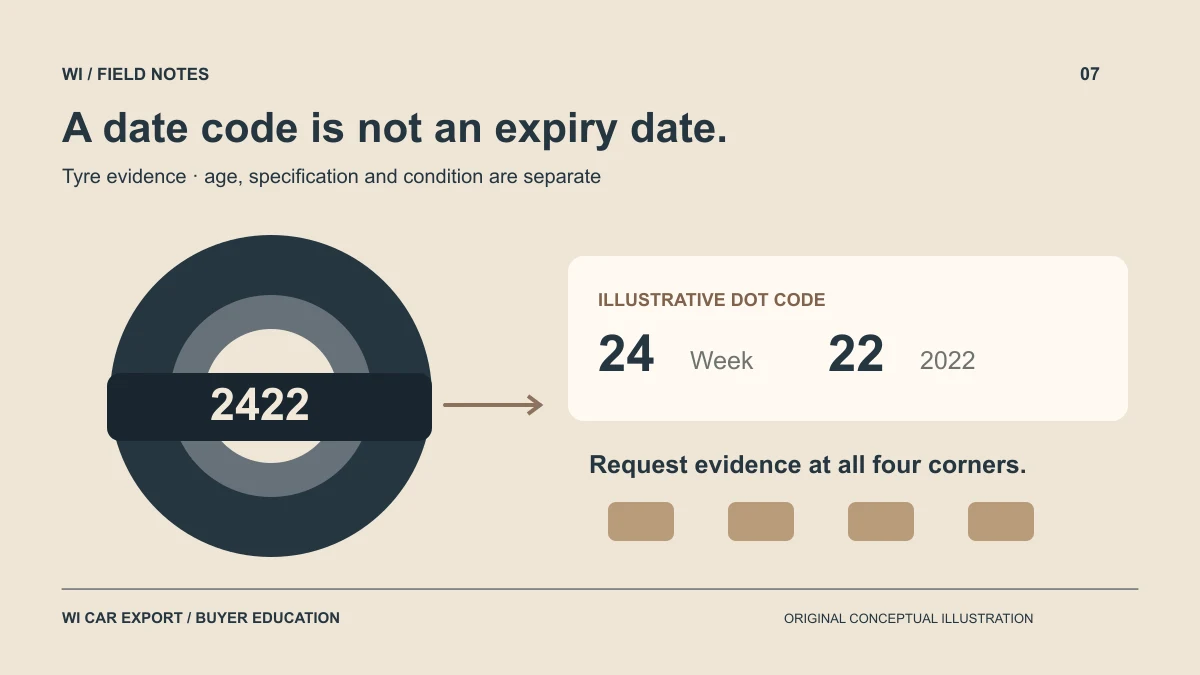
For a tyre with a DOT Tire Identification Number, the final four digits identify the manufacturing week and year. For example, an illustrative code of 2422 means week 24 of 2022, not an expiry date or the date it was fitted to the car. NHTSA also notes that the full marking may not be visible on both sides. Source: NHTSA tyre ageing guidance.
Do not force that interpretation onto an unidentified marking. Where a Japan-market tyre does not present a recognizable DOT code, ask the tyre manufacturer or a qualified tyre professional to interpret its date marking. Do not declare the tyre counterfeit or unusable from an unfamiliar code alone.
A date does not reveal every storage or use condition. Ask the assessor to consider age alongside physical condition and the applicable manufacturer guidance. This is why there is no blanket “safe until year X” statement in this checklist.
Request evidence for all four corners
One attractive wheel photograph does not document a complete set. Label photographs by position, including inner-side information where safely accessible to the inspector. Add the spare if the vehicle has one.
| Position | Identity and markings | Condition evidence | Assessment or action |
|---|---|---|---|
| Front left | Brand/model, size, load/speed description and date marking | Inspector’s observations and measurements | Record findings or unresolved points |
| Front right | Same fields, independently recorded | Do not copy the left-side result | Record findings or unresolved points |
| Rear left | Same fields | Include relevant wear or damage observations | Record findings or unresolved points |
| Rear right | Same fields | Include relevant wear or damage observations | Record findings or unresolved points |
| Spare, if fitted | Identify type and applicable instructions | Record condition and age information | Confirm intended use and limitations |
Ask the professional to assess damage, uneven wear and any repairs within the agreed inspection scope. Keep a photograph’s visible observations separate from a conclusion about roadworthiness. Do not crawl beneath a vehicle or move it into an unsafe position to obtain a missing image.
Match the purchase to the destination
Have the local tyre professional confirm suitability for the climate, intended use and applicable requirements. The fact that tyres were fitted in Japan does not answer every overseas fitment question. Avoid deciding from the word “winter,” “all-season” or a brand name without the full specification and professional advice.
Check whether appropriate replacements are readily obtainable for the actual wheel configuration. Our local parts and workshop guide helps make that enquiry concrete.
If replacement is needed, compare a complete installed quotation, including any associated work the professional recommends. Do not compare a bare tyre price with another supplier’s fitted package.
Put a replacement allowance beside the car price
Consider this fictional comparison in USD, before other import costs. Candidate A costs USD 6,000 and has an assessed USD 500 tyre-related replacement requirement. Candidate B costs USD 6,300 and has no tyre work identified in its current assessment. On those limited inputs, A totals USD 6,500 and B USD 6,300. A’s lower asking price has not survived this adjustment.
Those amounts are invented to show the method, not current tyre prices or a recommendation to buy B. Other condition findings can change the result, and an assessment is not a future guarantee.
WI Car Export’s photo evidence guide can help organize a remote request. Contact the export desk with the stock reference and ask which tyre information is available. Resolve missing evidence or retain a clearly identified budget uncertainty before committing.
Illustration: original WI Car Export editorial artwork, created with AI assistance. Conceptual, not a vehicle photograph or technical inspection diagram.