Assess a used Japanese plug-in hybrid through charging access, compatibility and a transparent weekly energy-cost example—including no charging.
A used plug-in hybrid from Japan deserves a place on your shortlist when you can use compatible charging regularly, its electric capability fits meaningful parts of your routine, and the actual car passes the necessary condition and support checks. Without dependable charging, do not assume its purchase premium will be recovered through low fuel use. Compare a conventional hybrid on the same weekly journeys instead.
A plug-in hybrid electric vehicle, or PHEV, combines a rechargeable traction battery and electric propulsion with an internal-combustion engine. It differs from a non-plug-in hybrid because it can obtain energy from an external supply. Exact operating behaviour remains model-specific; do not assume the engine will always stay off merely because the battery is charged. Source: US Department of Energy’s PHEV explanation.
Start with the parking place, not the advertised electric range
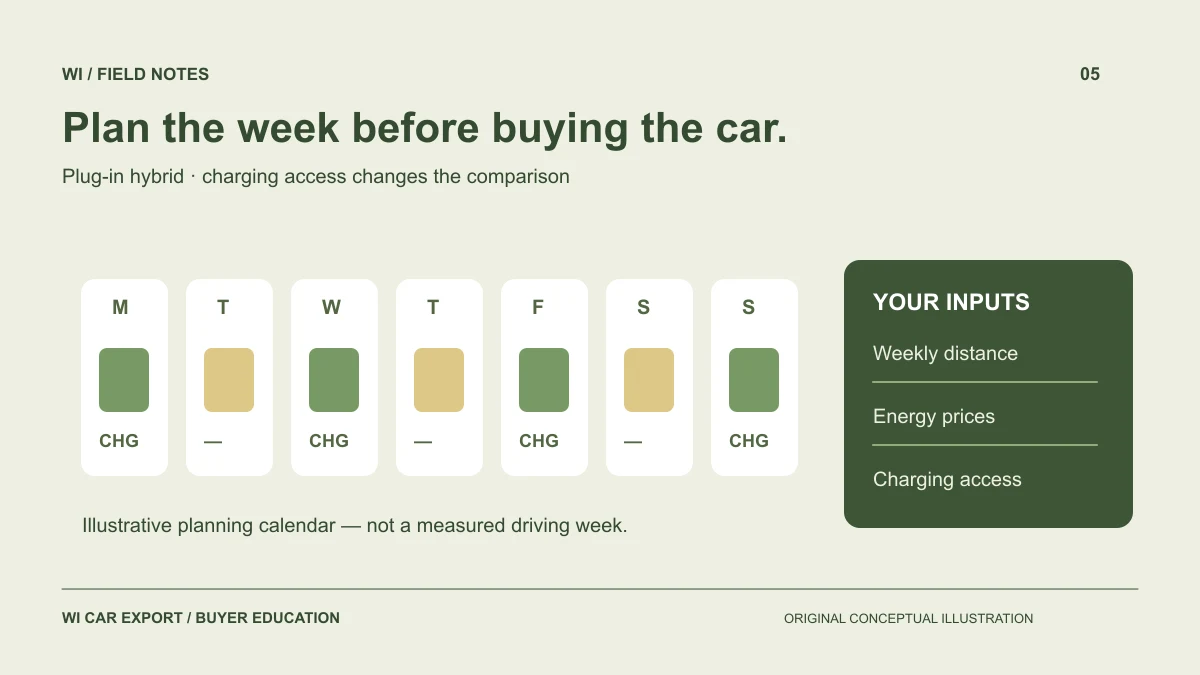
Write down where the car will be parked on ordinary nights and how it could charge there. Include permission to use the space, access to suitable equipment and the likely tariff. A public charger on a map is not the same as a charger you can reliably use within your routine.
Before import, have a qualified installer or technician confirm the compatibility of the vehicle, supply and equipment. The US Department of Energy’s home-charging guidance explains installation planning and local electrical requirements; its US voltage descriptions should not be applied automatically to another country. Source: charging at home.
For a Japan-market car, identify its actual charge inlet, supported charging modes, onboard charging specification and any included cable. Do not assume that a supplied Japanese cable is suitable for your home, or that a physical plug adaptor resolves electrical compatibility. Use the applicable vehicle instructions and qualified local advice.
Calculate a whole week, including petrol travel
Here is an entirely fictional energy-cost comparison in USD. These inputs are not measured results, vehicle specifications or current tariffs:
| Input | Hypothetical PHEV | Hypothetical conventional hybrid |
|---|---|---|
| Total weekly distance | 300 km | 300 km |
| Distance assigned to electric operation | 180 km | Not applicable |
| Electric energy bought at the wall | 18 kWh per 100 electric km | Not applicable |
| Remaining petrol distance and consumption | 120 km at 6 L/100 km | 300 km at 5 L/100 km |
| Energy prices | USD 0.25/kWh and USD 1.50/L | USD 1.50/L |
PHEV electricity: 180 ÷ 100 × 18 × 0.25 = USD 8.10.
PHEV petrol: 120 ÷ 100 × 6 × 1.50 = USD 10.80.
Total PHEV energy cost: USD 18.90 per week. Conventional hybrid petrol cost: 300 ÷ 100 × 5 × 1.50 = USD 22.50. The illustrative difference is USD 3.60 per week.
Now remove the assumed charging access. If the fictional PHEV travels all 300 km at the assumed 6 L/100 km, petrol costs USD 27.00. In that scenario it costs USD 4.50 more than the conventional hybrid, not less.
This simplified model assigns travel to separate electric and petrol portions; real operation can blend energy sources. Use measured wall energy where available so charging losses are not silently excluded. Add charging-session or parking fees separately. Neither calculation includes purchase price, installation, servicing, repairs, tax or resale, so neither is a total-ownership verdict.
Replace the weakest assumptions first
If you do not yet know how often you can charge, test the plan with fewer charging days. If only a battery-capacity figure is available, do not treat it as energy drawn from your meter or proof of current electric range. If a tariff excludes parking charges, add them before comparing.
Request a vehicle-linked battery assessment and evidence that charging has been checked within an agreed inspection scope. Our hybrid battery evidence guide explains why the report’s date, identity and test limitations matter.
The combustion engine also needs relevant records. A PHEV is not an excuse to omit service-history verification or to assume that low displayed mileage establishes the condition of all systems.
When another option makes more sense
Consider a non-plug-in hybrid if charging access is uncertain and the PHEV case depends on frequent charging. Consider a battery-electric vehicle if eliminating petrol use is a requirement and its actual route and charging needs work for you. Retain a petrol option if it better fits the total budget and support available. Compare identifiable candidates rather than technologies in the abstract.
WI Car Export can receive enquiries about specific Japanese stock; this research-based guide does not certify a charging installation or promise a particular inspection service. Contact the export desk with a stock reference, your destination and the charging information you need. Establish what evidence is available before paying for a car whose advantages depend on assumptions you have not tested.
Illustration: original WI Car Export editorial artwork, created with AI assistance. Conceptual, not a vehicle photograph or technical inspection diagram.