Decode Japanese petrol labels, understand RON versus AKI, and check fuel type, octane and ethanol requirements for your exact imported car.
Use the fuel specified in the manufacturer’s documentation for your exact Japanese import, then check how your local pump labels that fuel. A number on a US-style AKI pump is not directly comparable with a RON number. Petrol versus diesel, octane rating and ethanol compatibility are separate checks; a familiar model name cannot answer all three.
This guide helps you collect the right information before purchase or refuelling. It does not replace the matching owner’s manual or qualified advice about an unclear specification.
What do Japanese fuel labels mean?
Three Japanese terms are especially useful when reading vehicle information:
| Japanese label | Meaning | Buying implication |
|---|---|---|
| レギュラー | Regular petrol/gasoline | Match the specified grade and your local rating system |
| ハイオク | Premium, high-octane petrol/gasoline | Do not assume a local “premium” marketing name establishes equivalence |
| 軽油 | Diesel | This is not petrol for a kei car; verify the actual fuel type |
JAF’s guidance distinguishes regular petrol, premium petrol and diesel and emphasizes using the specified fuel. Do not extrapolate Japanese nozzle colours to pumps in another country. Source: JAF’s fuel-type explanation.
Toyota Japan, for example, identifies the GR86’s fuel as unleaded premium petrol. That is a bounded manufacturer example, not a rule for all Toyota vehicles or a substitute for checking the year and specification of your candidate. Source: Toyota Japan GR86 fuel FAQ.
Why 95 RON and 95 AKI are not the same label
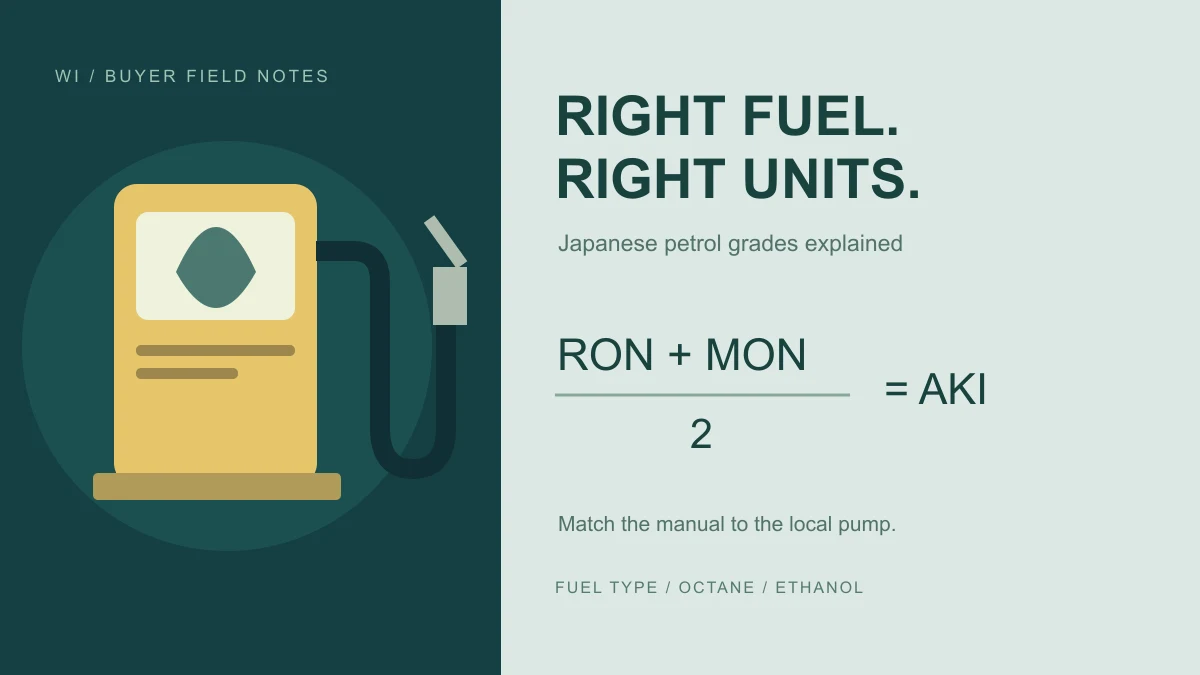
RON means Research Octane Number; MON means Motor Octane Number. They come from different test conditions. US pump octane is commonly displayed as the average of the two, called AKI, or Anti-Knock Index:
AKI = (RON + MON) ÷ 2
Octane rating concerns resistance to engine knock. It does not, by itself, specify every characteristic of a fuel. Source: US Energy Information Administration, octane in depth.
Here are two purely illustrative calculations—not specifications for fuels you can buy:
- Fuel A: RON 95 and MON 87 → AKI = (95 + 87) ÷ 2 = 91.
- Fuel B: RON 95 and MON 85 → AKI = (95 + 85) ÷ 2 = 90.
Both examples have the same RON but different AKI. Without the other information, subtracting a fixed number from RON is not a precise conversion. Ask the fuel supplier for the relevant specifications if the label and the manual use different systems; ask a qualified workshop or manufacturer representative to resolve suitability for the car.
Make a four-part fuel verification card
Keep this with the vehicle documents. It is more useful than a note saying “takes premium.”
- Car identity: chassis/model code, engine information and production details. Establish that the manual belongs to this specification, not a similarly named overseas model.
- Manufacturer requirement: record the fuel type, stated octane requirement and the rating system. Preserve qualifications such as “required” versus “recommended” exactly as the matching documentation presents them.
- Local supply: record the supplier, product and documented rating system. Confirm what the pump number actually means rather than relying on its marketing name.
- Ethanol compatibility: check the applicable manufacturer limit and the supplier’s stated blend separately. An octane number alone does not resolve this question.
If the information is incomplete, leave the relevant field marked “unconfirmed.” Do not turn an unknown into a fuel recommendation. The trim and options verification guide helps with the identity step.
What if the engine has been modified?
A standard owner’s manual may not describe the requirements of an altered engine or tune. Request the modification records and have a competent specialist establish the applicable requirements. A seller saying “runs fine on regular” is not equivalent to technical documentation.
Before choosing a modified import, work through the modification documentation checklist. Do not experiment with alternative fuels, additives or mixtures to resolve uncertainty.
Put the correct fuel into your ownership budget
Price the fuel the specific car requires and that you can actually obtain locally. Comparing one candidate using regular-petrol prices with another that needs a different grade can distort the budget. Fuel availability also matters: a theoretical saving is not useful if it relies on a product outside your normal supply network.
For a transparent cost comparison, use the inputs and method in our petrol versus hybrid fuel break-even guide, replacing assumptions with appropriate local prices and consumption evidence.
Your next step: browse Japanese cars in stock, record a candidate’s exact identity and complete the fuel verification card before committing. If you cannot confidently match the requirement to local fuel, resolve that gap first rather than guessing after the car arrives.
Illustration: original WI Car Export editorial artwork, created with AI assistance. Conceptual, not a vehicle photograph or technical inspection diagram.