Understand CVT, automatic and e-CVT labels, then use a practical records and workshop checklist to assess the exact Japanese used car.
CVT and e-CVT cars are automatic from the driver’s perspective, but those labels do not describe the same mechanical design. When buying a Japanese used car, identify the exact transmission first, then assess its records, condition and local service support. An “AT” listing label or a brand reputation is not enough to establish what you are buying.
This research-based guide explains the questions to ask. It does not rank transmission reliability or diagnose a vehicle remotely.
What do the transmission labels actually tell you?
Separate three things: whether the driver changes gears manually, how the transmission works, and the particular unit fitted to the car. Marketplace descriptions may answer only the first.
| Label or description | Useful meaning | What still needs checking |
|---|---|---|
| Automatic or AT | The listing describes automatic operation | Exact design and transmission code; the label alone is not a mechanical specification |
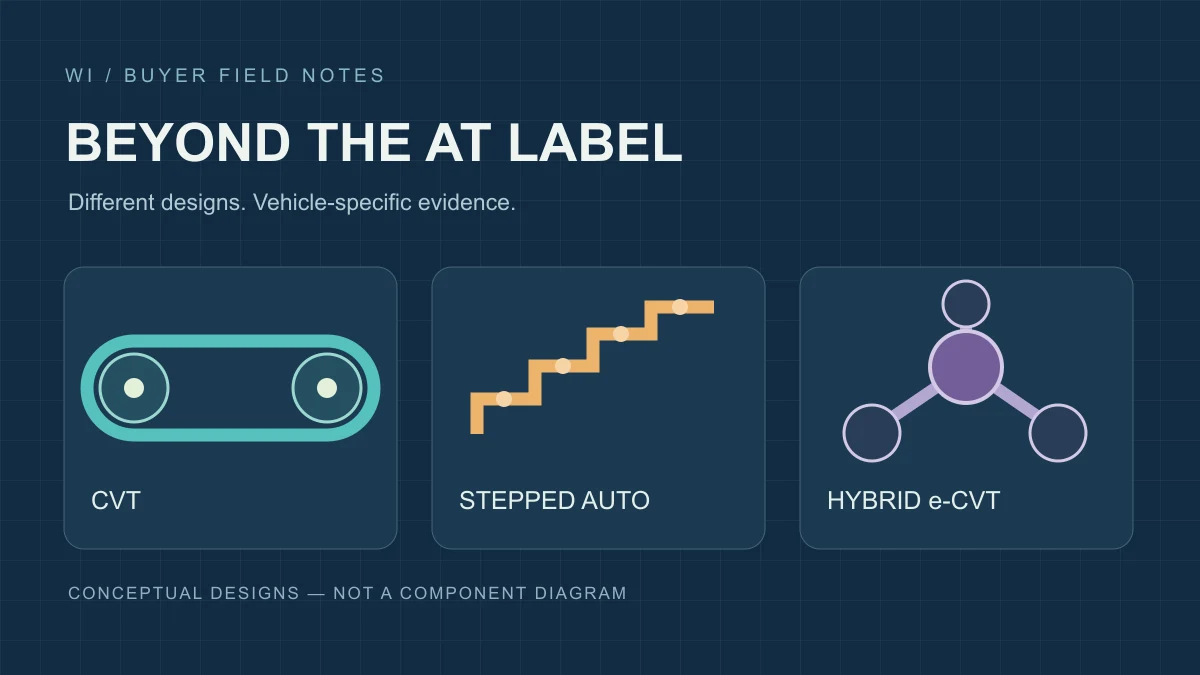
| Conventional stepped automatic | A design using a set of discrete gear ratios | The particular unit, manufacturer requirements and vehicle-specific evidence |
| CVT | A continuously variable transmission; belt-and-pulley designs are one form | The actual design, any additional gearing, and the correct service requirements |
| e-CVT | A manufacturer’s description of electronically controlled variable transmission operation | The hybrid architecture; do not assume a belt CVT or one universal design |
Toyota’s 2018 Direct Shift-CVT is a useful example of why broad labels can mislead: its design combines a launch gear with a belt-and-pulley mechanism. “CVT” does not mean the same arrangement in every vehicle. Source: Toyota’s Direct Shift-CVT explanation.
Is a Toyota hybrid e-CVT a belt CVT?
Do not infer a belt from “e-CVT.” Toyota’s original Prius hybrid-system explanation describes a planetary-gear power-split device working with an engine, motor and generator. This provides an example of electronically controlled variable operation without describing an ordinary belt-and-pulley CVT. It is a historical system explanation, not a specification for every hybrid or every vehicle labelled e-CVT. Source: Toyota’s hybrid-system introduction.
For a car you might buy, match the manufacturer’s documentation to its production details. Our guide to chassis numbers versus model codes explains why a familiar model name is not sufficient identification.
Which transmission is best for a used Japanese import?
There is no defensible winner based on these labels alone. A sensible selection depends on the exact unit, evidence of suitable maintenance, the vehicle’s assessed condition and access to competent support at your destination. Purchase price matters only after those questions have useful answers.
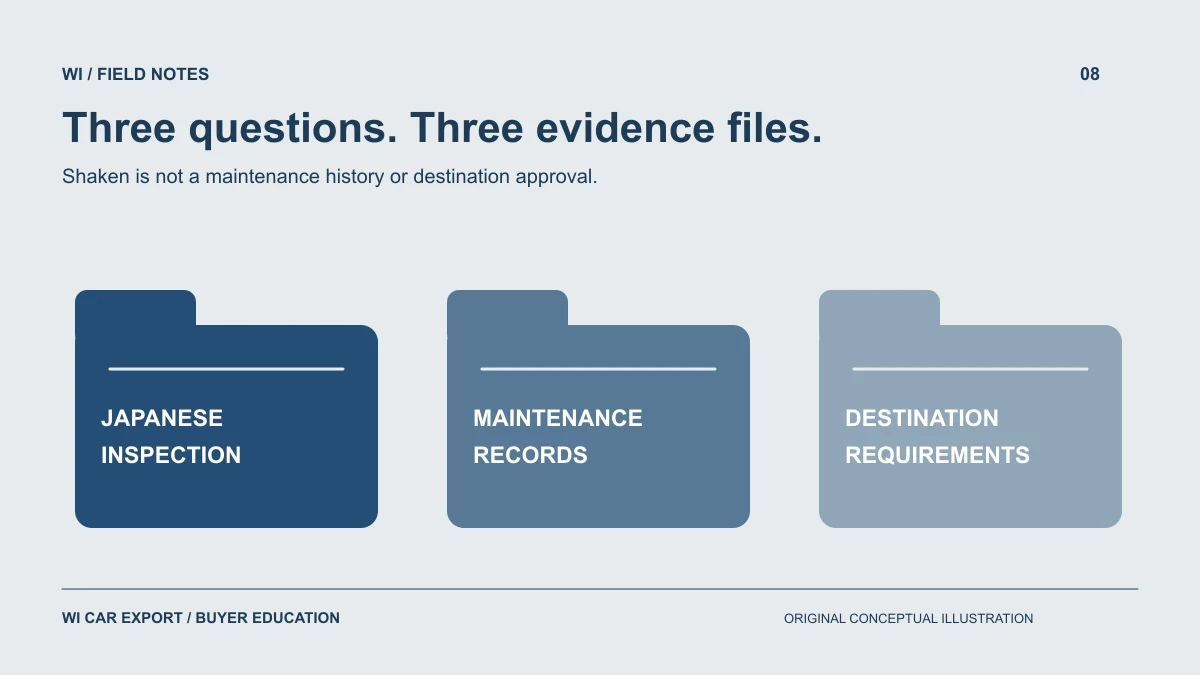
Avoid treating a claimed fluid change as conclusive evidence. The important follow-up questions are what work was done, on which transmission, when, at what mileage and using which specified materials. A generic receipt may establish that a service was purchased without establishing that the correct procedure was followed.
The service-history verification guide helps distinguish documents, seller statements and gaps. Missing paperwork is uncertainty to investigate, not automatic proof of neglect.
Send this request before committing to a car
| Ask for | Why it matters | Who can resolve a gap? |
|---|---|---|
| Chassis/model details and transmission identification | Connects the listing to the correct technical information | Seller and a workshop familiar with the variant |
| Dated service records with mileage and work descriptions | Shows the evidence actually available | Record holder; a technician interprets relevance |
| Applicable manufacturer maintenance information | Prevents borrowing another model’s fluid or schedule | Qualified workshop using the matching documentation |
| Independent condition assessment, with scope and limitations | Separates observed condition from assumptions | Qualified inspector or technician |
| Local service and parts confirmation | Establishes support after arrival | Your destination workshop |
Ask the assessing technician whether appropriate diagnostic checks and a safe road assessment were included, and what they could not assess. Do not attempt improvised transmission stress tests or follow generic internet fluid-change instructions. There is no single fluid, replacement interval or repair procedure appropriate to all the designs in this article.
A worked shortlist example
Imagine two hypothetical listings. Car A says “AT” and includes a service stamp. Car B says “CVT” and includes dated invoices with a clear transmission identifier. Neither description proves good condition, and Car A’s short label does not establish that it has a conventional stepped automatic.
The useful next move is to obtain Car A’s exact specification and have both evidence sets assessed consistently. Rejecting Car B solely because of three letters, or choosing it solely because it has more paperwork, would skip the condition question.
For a hybrid candidate, transmission identification is only part of the enquiry. Check the separate hybrid battery evidence checklist rather than treating the whole hybrid system as one component.
Your next step: browse the Japanese stock listings, save the stock reference and vehicle identifiers, and compare evidence for the exact cars. Use transmission labels to start a question—not to end the buying decision.
Illustration: original WI Car Export editorial artwork, created with AI assistance. Conceptual, not a vehicle photograph or technical inspection diagram.