Compare Japan-market Honda Fit i-DCD and e:HEV generations, identify the actual system, and check records and workshop support before importing.
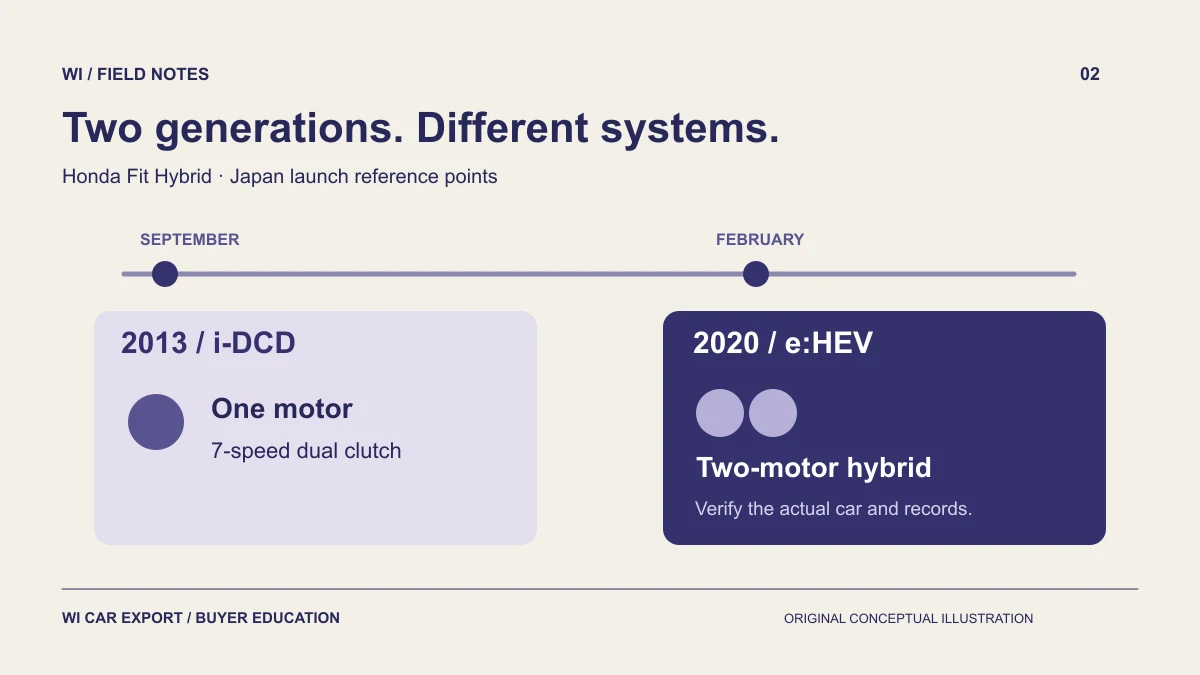
A used Honda Fit Hybrid should not be selected by the word “hybrid” alone. The third-generation Japan-market Fit Hybrid introduced in 2013 used Honda’s one-motor i-DCD system with a seven-speed dual-clutch transmission. The new Japanese Fit launched in February 2020 introduced the two-motor e:HEV version. These are different systems, with different documentation and support questions—not merely different trim badges.
Honda’s dated launch specifications establish those distinctions. They do not establish which used example is in better condition or which will cost less to own. Sources: Honda’s 2013 Fit launch and 2020 Fit launch.
A useful generation comparison starts with scope
The table below describes two Japanese launch families, not every car advertised as a Fit or Jazz worldwide. A registration year near a model change is not enough to identify the system. Match the chassis/model information and build details.
| Candidate | What the cited Japanese launch information establishes | What the label cannot establish |
|---|---|---|
| 2013 launch-family Fit Hybrid | One-motor i-DCD; seven-speed DCT with an integrated motor | Maintenance quality, completed campaigns or present transmission condition |
| 2020 launch-family Fit e:HEV | Two-motor hybrid; manufacturer table lists Electric CVT | Compatibility with every overseas Fit service procedure or equipment list |
| Petrol Fit from either launch family | Separate petrol variants existed alongside the hybrids | That it shares the hybrid’s transmission or running costs |
| Older or unidentified Fit Hybrid | More identification is needed before using this comparison | That it belongs to either of the two systems above |
The source tables contain several variants. Use them to identify a candidate, not to import an old Japanese retail price into today’s export budget.
What changes in your buying enquiry?
For an i-DCD candidate, ask the destination workshop whether it supports that hybrid and dual-clutch system specifically. “We work on Hondas” is a starting point, not confirmation. For an e:HEV candidate, ask the same question using its exact model details and matching service information.
Do not interpret “Electric CVT” as proof that a car has an ordinary belt-and-pulley CVT. Our CVT, automatic and e-CVT explainer separates driver-operation labels from mechanical design.
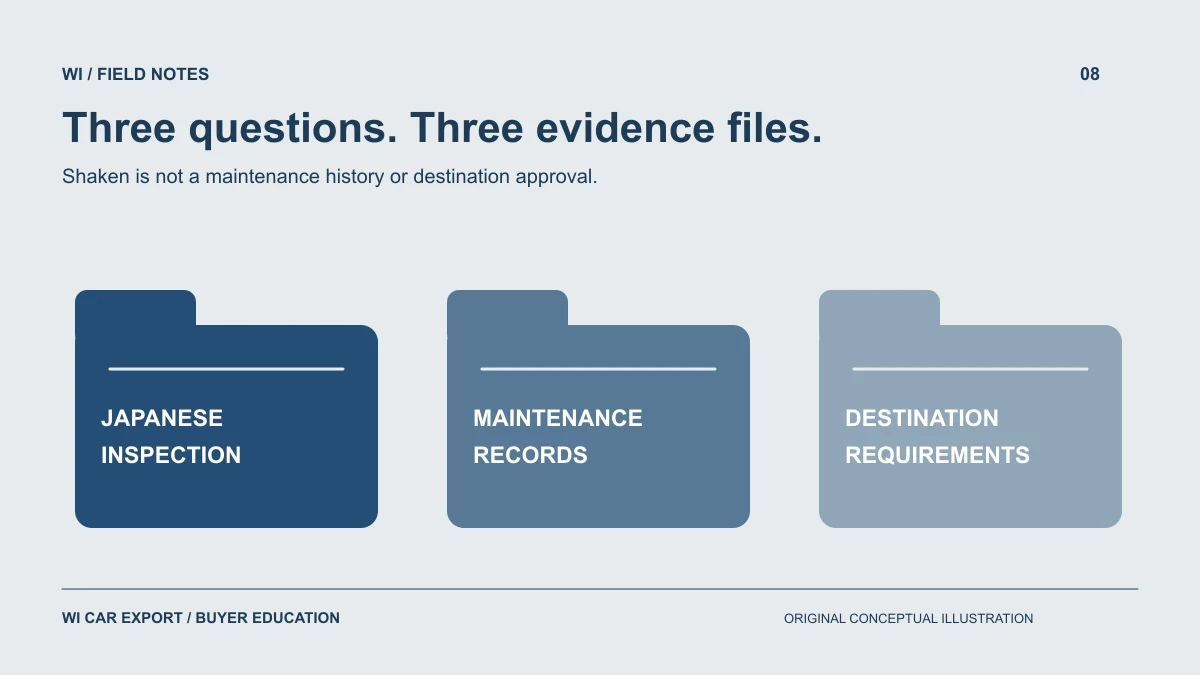
For either hybrid, request dated service records and a qualified condition assessment that states what was checked. If you receive a battery report, establish what it measures and whether it is linked to the vehicle. More paperwork is helpful only when it answers the relevant questions.
Check campaigns by vehicle, not by internet reputation
A discussion about a model’s problems cannot tell you whether a particular car is affected by a manufacturer campaign or whether required work was completed. Search the manufacturer’s system using the appropriate vehicle identifier and obtain completion evidence when applicable.
Our Japanese recall status guide explains the distinction between eligibility and a documented remedy. Do not treat either “this generation had recalls” or “the dashboard is clear” as the final answer.
If a seller says software was updated, ask for a dated record identifying the car and the work. Avoid inventing an update number or borrowing one from a different variant.
Compare the car around the powertrain
Two correctly identified hybrids can still serve different needs. Compare the actual seating arrangement, entry and exit, luggage space with the seats you need occupied, fitted driver-assistance equipment and any modifications. Use an assessment of the particular car rather than a universal statement about how a generation drives.
A newer model may be attractive without being the right allocation of your budget. Conversely, a cheaper older car may leave more cash available but require work or support you have not yet priced. List confirmed costs, quoted work and unresolved items separately; do not assign zero to an unknown.
The parts and workshop support guide can help you test serviceability before a car leaves Japan.
Which should you shortlist?
Shortlist an i-DCD example when it meets your needs and its condition, history and local support are sufficiently established. Shortlist e:HEV when you want that later system and the particular vehicle justifies the total cost. Keep petrol versions in consideration if they better match your budget and available support. None wins simply by having the newest badge or the lowest odometer reading.
Here is a useful hypothetical decision: one candidate has a lower asking price but no clear transmission identification; another is correctly identified with relevant records. Resolve the first car’s identity before comparing costs. Do not let the uncertainty disappear inside a spreadsheet’s “hybrid” row.
WI Car Export’s role is to connect buyers with Japanese fixed-price stock; this guide is desk research, not a Fit reliability test. Browse the stock catalogue, save the references of your Fit candidates and request the exact identifiers. Compare i-DCD with i-DCD, or make a deliberate system-to-system comparison with the differences visible.
Illustration: original WI Car Export editorial artwork, created with AI assistance. Conceptual, not a vehicle photograph or technical inspection diagram.