Mostly short trips? Check a Japanese diesel's DPF requirements, real journey pattern and service evidence before choosing it for fuel savings.
If most of your driving consists of brief trips with little sustained running, investigate a diesel’s operating requirements before choosing it for fuel savings. A diesel particulate filter, or DPF, needs appropriate conditions to manage the particulate matter it collects. The exact requirements depend on the vehicle. A low-mileage listing and an occasional planned long drive are not enough to establish a suitable match.
The useful buying question is not “Are Japanese diesels good?” It is whether this particular diesel, in its assessed condition, suits your actual routine and can be supported locally.
What does a DPF do?
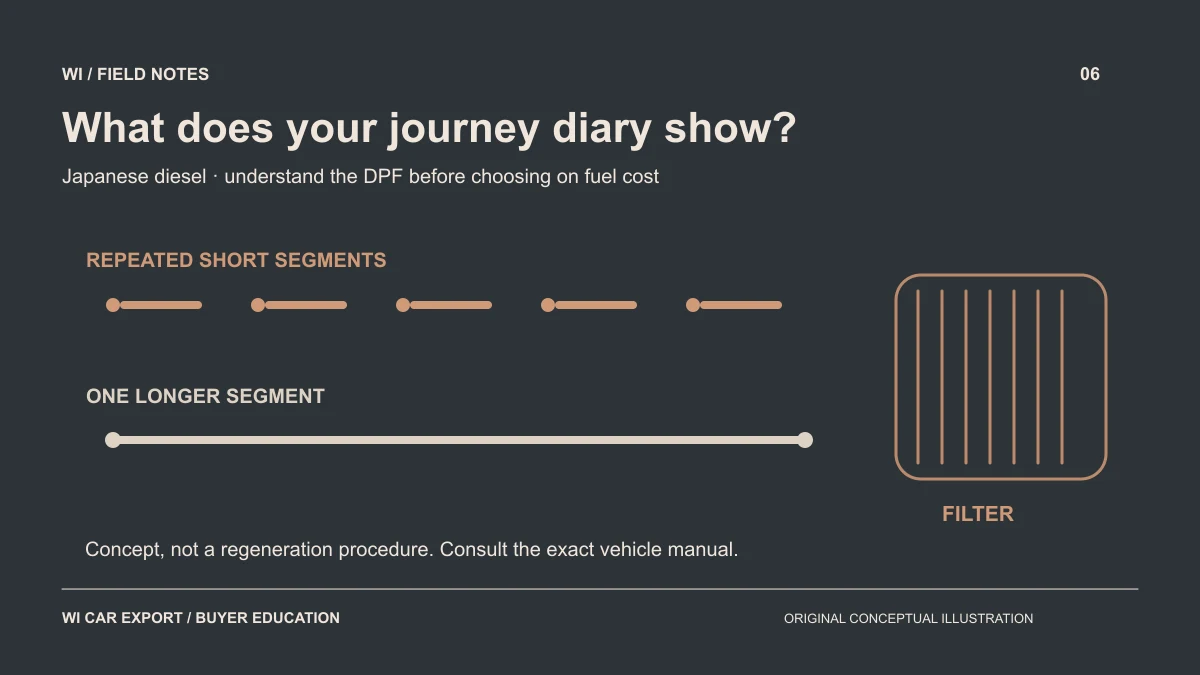
A DPF collects particulate matter from diesel exhaust. Mazda’s CX-5 SKYACTIV-D 2.2 manual explains that collected material is normally cleared during driving, but identifies repeated short trips, cold-engine use, prolonged idling and sustained very low-speed driving as conditions under which normal removal may not occur.
That is a manufacturer example for the specific manual, not a universal time or speed rule for every diesel. It supports examining your journey pattern; it does not diagnose a candidate car. Source: Mazda CX-5 DPF guidance.
Annual mileage hides the pattern that matters
Two drivers can cover similar annual distances through very different journeys. One may make numerous short errands from a cold start; another may cover fewer, longer journeys. A yearly total does not describe that difference.
Build a representative seven-day diary before requesting a diesel quote:
| Record | Example of useful information | Why you are collecting it |
|---|---|---|
| Individual trip duration | Each journey, not only the daily total | Shows whether use is mostly short segments |
| Stops and restarts | How the day is broken up | Helps a technician understand the operating pattern |
| Traffic conditions | Queuing, prolonged stationary periods and open-road sections | Prevents distance from standing in for the whole route |
| Regular longer journeys | Trips that genuinely happen | Separates routine use from a promise to change your habits |
| Local service access | A workshop that supports the exact engine/emissions system | Tests whether practical support exists |
You do not need to infer exhaust temperatures or perform a diagnostic experiment. Give the routine to a qualified workshop and ask how it compares with the applicable manufacturer guidance.
Do not buy on the promise of a “quick clean-out drive”
A seller may suggest that a warning will disappear after a drive. Before purchase, ask for a qualified diagnosis, the relevant fault information and a record of any repair or service performed. Distinguish a symptom that has stopped appearing from an underlying issue that has been assessed.
This article does not provide a regeneration-driving recipe. Appropriate action depends on the exact warning, vehicle and condition; copying speeds or durations from another manual can be unsafe or inappropriate. Do not attempt improvised forced regeneration or continue using a car contrary to its warnings and manufacturer instructions.
If inspection reveals altered or missing emissions equipment, pause the purchase and obtain competent technical and destination-compliance advice. Do not treat a proposed deletion or software workaround as an ordinary solution to an unsuitable use pattern.
What records should a buyer request?
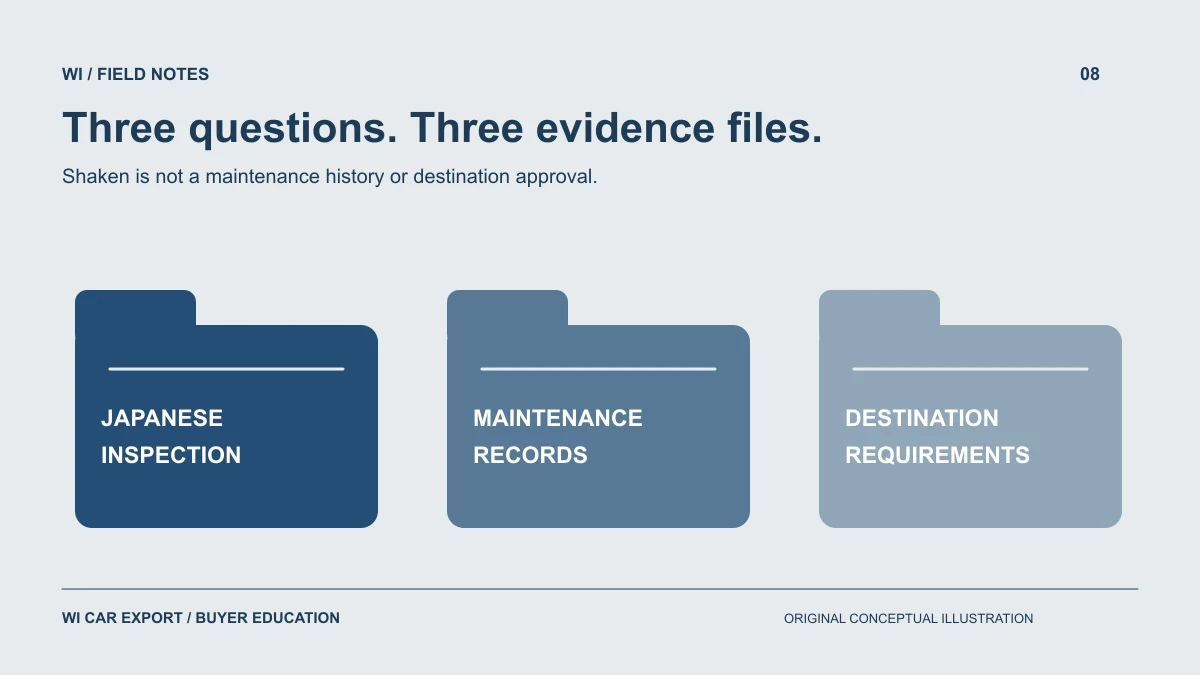
Ask for dated servicing, any recorded DPF or emissions-related work, and the scope of the current inspection. If an invoice says “DPF cleaned,” ask what was done, why, and whether the underlying cause was investigated. A cleaning invoice is not a forecast of future reliability.
Use the Japanese service-history guide to build a chronology. Keep gaps visible. Missing records do not prove a defect, but they may justify further inspection or choosing another candidate.
Also confirm the exact fuel requirement and local supply. The Japanese fuel-grade guide explains the distinction between Japanese petrol labels and diesel; a familiar badge is not a fuel specification.
Compare the alternative before accepting extra uncertainty
Imagine a hypothetical buyer whose regular trips are school drop-offs and nearby errands, with an occasional long journey that is often cancelled. If a diesel’s suitability depends on that optional journey, the ownership plan is fragile. A petrol or hybrid candidate deserves comparison against the routine that actually occurs.
That is not a claim that petrol or hybrid cars have no maintenance needs. It is a recommendation to avoid purchasing a system on the condition that you will repeatedly reorganize your life to suit an unverified assumption.
Check local workshop and parts support before relying on a low asking price. WI Car Export sells Japanese stock, but this desk-researched article is not a mechanical assessment. Browse the stock catalogue with your route diary in mind and compare an appropriate alternative before committing to a diesel.
Illustration: original WI Car Export editorial artwork, created with AI assistance. Conceptual, not a vehicle photograph or technical inspection diagram.