Windscreen replaced on a Japanese import? Check the fitted ADAS equipment, manufacturer requirements and calibration records before you commit.
If a Japanese import has had its windscreen replaced, ask whether its fitted driver-assistance system required camera adjustment or calibration and request the applicable completion record. The answer is vehicle-specific. A clear dashboard and a claim that “all sensors work” do not document which procedure was required or whether it was completed.
This guide is a paperwork and workshop-enquiry checklist. It is not a calibration procedure, a safety certification or a recommendation to test automatic braking yourself.
What is ADAS, and what should buyers verify?
ADAS means advanced driver-assistance systems. Depending on the equipment fitted, a vehicle may offer warnings, assistance with steering or speed, or interventions intended for particular conditions. Those are not interchangeable capabilities. NHTSA distinguishes assistance technologies by what they do and emphasizes the driver’s continuing responsibility. Source: NHTSA driver-assistance technology guidance.
Begin with the exact features installed on the car, not a badge or the equipment list for a different market. Our Japanese trim and options guide explains how to connect equipment claims to an individual vehicle.
For an export purchase, also ask a destination workshop whether it can support that Japan-market system. Do not assume the locally sold model uses identical sensors, software or service information.
Does a replaced windscreen always require calibration?
The requirement must come from the matching manufacturer procedure. As a concrete example, Toyota’s Japanese Crown hybrid manual dated December 2022 states that the front camera needs readjustment after front windscreen replacement and directs the owner to a Toyota dealer. That supports asking for the record on that specification; it is not a universal procedure for every Crown year or every Japanese car. Source: Toyota Crown HEV manual, Toyota Safety Sense.
For your candidate, establish whether a camera or other relevant equipment is fitted and what the manufacturer requires after the work described. A replaced pane of glass and a documented camera adjustment are related records, but one is not a substitute for the other.
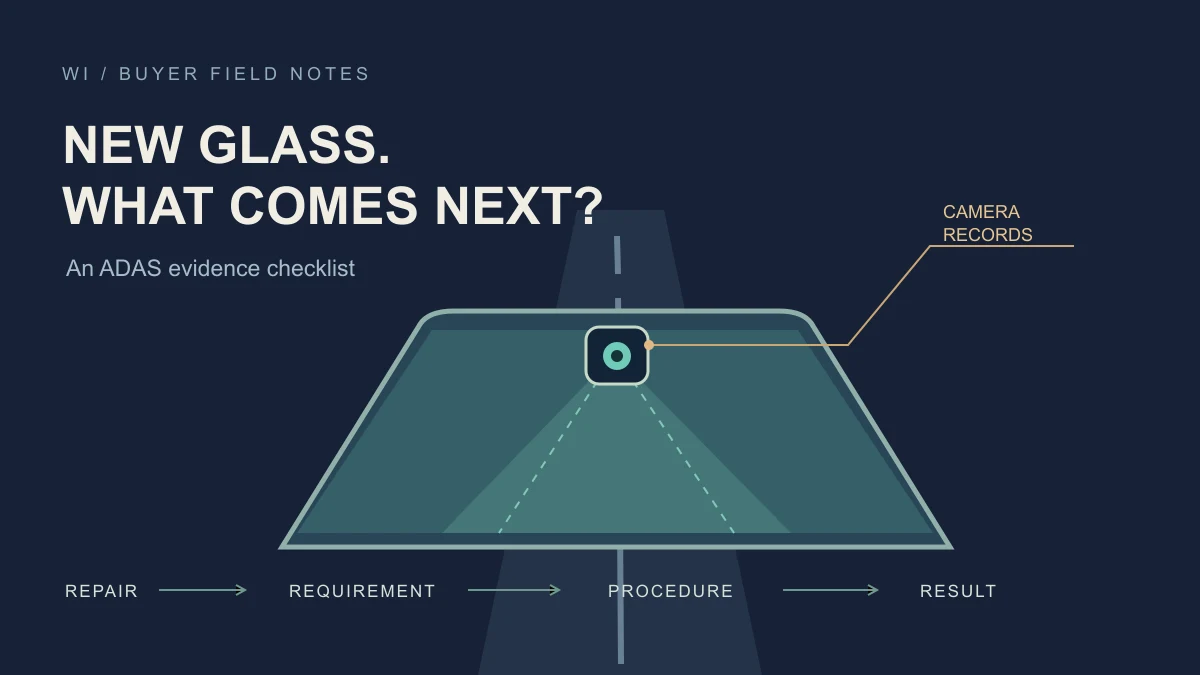
Follow the repair-to-verification document chain
| Evidence link | What to request | What it establishes—and what it does not |
|---|---|---|
| Vehicle identity | Chassis/model details and production information | Which specification the records should match, not the condition of the system |
| Repair event | Dated invoice describing glass replacement or other relevant work | What work is recorded; a brief invoice may omit important detail |
| Applicable procedure | Workshop confirmation of the matching manufacturer requirements | Why adjustment or calibration was required, or the basis for saying it was not |
| Completion evidence | Workshop report tied to the vehicle, with date, procedure and result | What was performed and recorded; unresolved limitations still matter |
| Follow-up | Technician’s explanation of any faults, incomplete steps or further checks | Whether there are open issues to resolve before purchase or use |
Ask the workshop to distinguish diagnostic scanning from adjustment or calibration. A statement that a scan found no stored faults does not itself describe a completed alignment procedure. Equally, the absence of a document in the seller’s folder does not prove no work occurred—it means the evidence still needs to be found or the situation assessed.
Keep the method vehicle-specific. There is no universal rule in this article about static targets, road-based calibration, equipment or distances. Those decisions belong to the applicable procedure and a qualified technician.
A practical example: “new windscreen” on an invoice
Imagine a hypothetical candidate whose invoice says “windscreen replaced.” The listing shows no dashboard warning in one photograph. Neither item answers whether the fitted camera needed readjustment.
The next step is to obtain the relevant requirements and ask the repairing workshop for any completion report. If that cannot be obtained, ask a qualified destination or inspecting technician what assessment and work would be needed, whether they support this specification and what remains uncertain.
Place the purchase on hold if an important question remains unanswered. Do not interpret the repair itself as proof of a bad car, or the clean dashboard as proof of a fully verified system.
What about other repairs or modifications?
Send the technician the full relevant repair history, not only the glass invoice, and ask which events trigger checks under the manufacturer’s instructions. If equipment, bodywork or suspension has been altered, disclose that rather than guessing that an unrelated-looking change cannot matter. Our modified-car documentation guide helps organize those records.
Never deliberately approach a person, vehicle or obstacle to see whether automatic braking activates. Read the matching owner’s manual, understand system limitations and leave diagnostic or calibration work to competent professionals with appropriate facilities.
Before import, use the local workshop support checklist to confirm access to suitable information and equipment for this vehicle—not simply that a garage services the brand.
Your next step: contact WI Car Export with the stock reference and request available repair and driver-assistance documentation. Identify the missing evidence before committing; the availability of records or further assessment must be confirmed for the individual car.
Illustration: original WI Car Export editorial artwork, created with AI assistance. Conceptual, not a vehicle photograph or technical inspection diagram.