Understand Nissan Note e-POWER before importing: petrol-generated electricity, no routine plug-in charging, and the evidence to request for a used car.
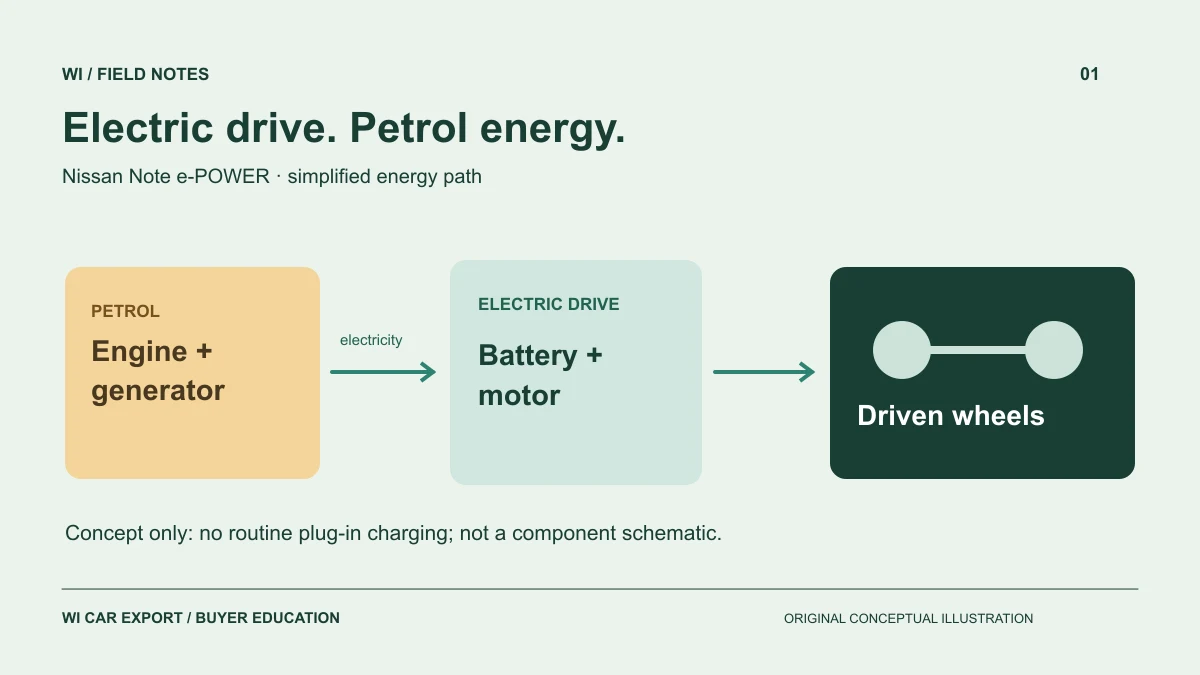
The Nissan Note e-POWER is a petrol-electric hybrid, not a battery-only electric car. Its wheels are driven by an electric motor, while a petrol engine generates electricity. You refuel it rather than plan routine plug-in charging. That can suit someone interested in electric-motor propulsion without a dependable charging place—but it does not remove engine maintenance or the need to assess the hybrid system.
Nissan describes e-POWER as a series hybrid and explains that the engine is not directly connected to the wheels. Its account of the Note’s Japanese introduction in 2016 also explains that the system does not require a charging station. Those are design facts, not a promise about the condition or economy of a particular used car. Sources: Nissan’s e-POWER architecture and Note e-POWER introduction.
Ask two different questions: what drives it, and what fuels it?
“Electric drive” describes propulsion. It does not necessarily mean the car gets its energy from an external electricity supply. Keeping those questions separate avoids comparing a Note e-POWER with a battery-only car on the wrong basis.
For a used Note e-POWER, your ownership enquiry should therefore include both petrol-engine service evidence and hybrid-system assessment. A battery report cannot establish the condition of everything under the bonnet. Equally, a recent engine service is not a report on the traction battery or power electronics.
If your objective is a vehicle that runs without petrol, start with a battery-electric shortlist instead. Our used Nissan LEAF import guide addresses that different charging-and-range decision.
Identify the actual Note before comparing advertisements
A model name, year field and “automatic” label are not a complete specification. Ask for the chassis/model identifiers and production details, then match them to manufacturer information. Do not apply the current Note brochure to an older car or interpret every Note listing as e-POWER.
Your comparison sheet should identify the powertrain, drive configuration, seating, actual fitted equipment and the documents supporting those entries. If two listings use different naming conventions, leave the disputed field unconfirmed until resolved. Our chassis number and model code guide explains which identifiers to request.
This matters most when a low asking price looks unusually attractive. Before treating it as a saving, establish whether you are comparing equivalent vehicles. A different specification is not necessarily a bad purchase; it is simply a different proposition.
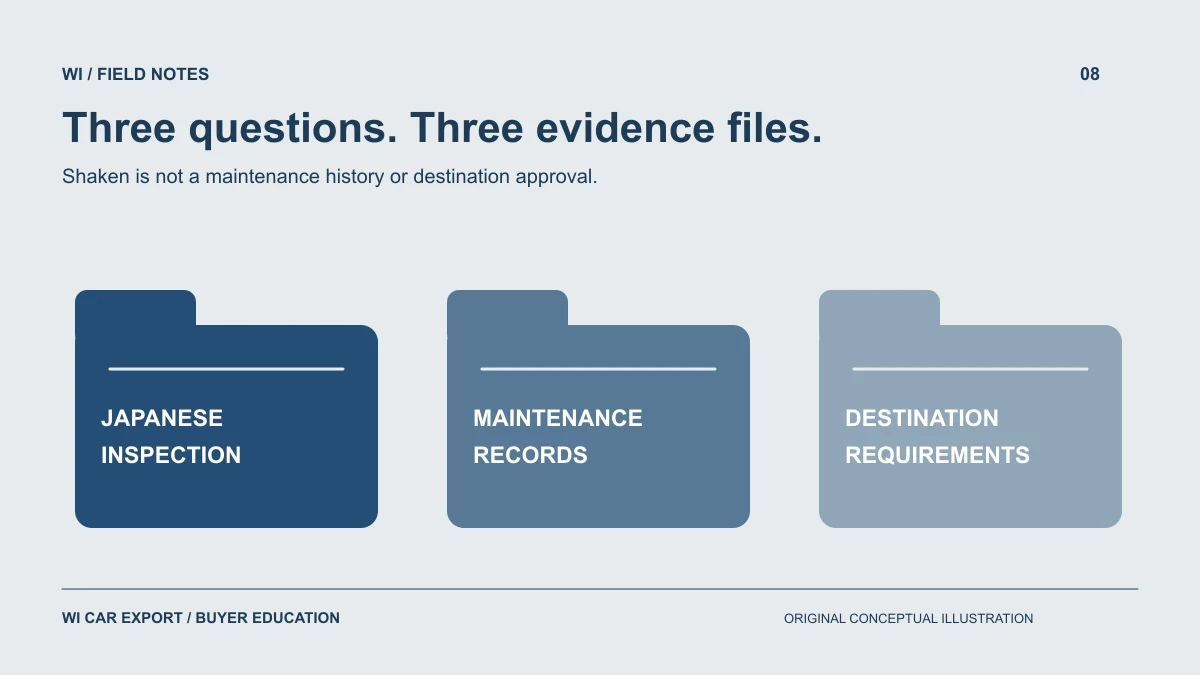
Build a three-part evidence file
| Part | What you need to know | Useful evidence |
|---|---|---|
| Engine and conventional servicing | What work is documented for this car, and what remains due? | Dated invoices with identity, mileage and descriptions of the work |
| Hybrid system | What has actually been assessed, by whom and with what limitations? | A vehicle-linked technician’s report; distinguish observations from predictions |
| Whole-car condition | Does the rest of the car justify the purchase? | Independent inspection covering the agreed scope, repair history and unanswered questions |
Do not accept a dashboard energy graphic as a battery-health certificate. Ask what any test measures, when it was conducted and whether the report identifies the car. The hybrid battery evidence checklist provides a more detailed request.
Avoid diagnosing a warning light through a seller’s video. A statement that a fault is “probably only a small battery” needs a qualified assessment, not a buyer’s hopeful interpretation. Ask for the actual diagnosis and any completed repair record.
When is it worth shortlisting?
An e-POWER Note is worth investigating when you want this type of motor-driven hybrid, the actual cabin and route fit your needs, and a local workshop can support the exact version. It is less suitable as a shortlist choice if your non-negotiable requirement is avoiding petrol, or if technical support for the specification cannot be established.
For example, imagine a buyer without home charging who makes mixed urban and intercity trips. Removing the need to find a charging place answers one problem. It does not answer whether the particular car is comfortable for the trip, in sound condition or economical at local fuel prices. Those remain separate purchase questions.
Use comparable consumption evidence for the cars you are evaluating; do not turn a launch-era laboratory number into a forecast for your commute. Include acquisition costs and foreseeable work alongside fuel spending.
Turn the explanation into a shortlist
WI Car Export offers fixed-price Japanese stock, with vehicles sourced and exported by Washin Auto. This article is a research-based buying guide, not a road test or a claim that every vehicle comes with a particular diagnostic report.
Browse the Japan stock catalogue, search for Nissan Note and save the references of suitable candidates. Confirm e-POWER specification first, then compare the evidence for the engine, hybrid system and whole car. A well-defined enquiry is more useful than asking whether “the Note” is reliable in general.
Illustration: original WI Car Export editorial artwork, created with AI assistance. Conceptual, not a vehicle photograph or technical inspection diagram.